

Mitsui O.S.K. Lines (MOL) and IBM Japan have launched a co-developed generative AI platform within MOL’s Safety Operation Supporting Center (SOSC) to integrate previously fragmented weather, telemetry, and geopolitical risk data into a unified real-time stream. Aligned with the shipping company’s “BLUE ACTION 2035 Phase 2” management strategy, the system combines automated predictive risk modeling with human seafaring expertise to shift fleet operations toward proactive, preventive safety management.
Tokyo | July 1, 2026 – In an era defined by intensifying climate volatility and escalating maritime security threats, Mitsui O.S.K. Lines, Ltd. (MOL) and IBM Japan, Ltd. have officially launched a co-developed, generative AI-powered operational platform. The digital command framework is designed to centralize and synthesize previously siloed global vessel data into an actionable, real-time risk intelligence stream.
Officially going live on July 1, 2026, the new platform serves as the central technological backbone for MOL’s specialized Safety Operation Supporting Center (SOSC) in Tokyo. The center is charged with monitoring the movements and environmental exposures of hundreds of MOL-affiliated vessels traversing international shipping lanes 24 hours a day, 365 days a year.
The Operational Challenge: Fragmented Data in High-Risk Seas
In modern merchant shipping, shore-based oversight teams are frequently overwhelmed by data fragmentation. When a geopolitical crisis erupts or an unpredicted localized storm develops, operations managers traditionally have had to toggle between separate proprietary systems to cross-reference:
- Live hydrographic and meteorological conditions
- AIS telemetry and vessel speed parameters
- Fragmented geopolitical threat intelligence briefings
Under the weight of these multi-layered variables, balancing rapid response times with analytical accuracy has become the industry’s greatest bottleneck. The joint MOL-IBM initiative aims to eliminate this operational blind spot by converting a vast, dispersed stream of information into a single, cohesive interface.
Data Fragmentation vs. AI Consolidation
The shift from legacy fleet monitoring to MOL’s new AI-driven architecture represents a fundamental evolution in maritime command and control. The table below illustrates how the platform transforms scattered data points into structured operational intelligence:
| Operational Variable | The Legacy Dispersed Data Problem | The AI Consolidation Solution |
| Environmental Monitoring | Weather & Sea States: Tracked via siloed meteorological feeds, requiring manual cross-referencing with voyage routes. | Real-Time Synthesis: Ingested continuously into a single dashboard, mapping storm fronts directly over live vessel coordinates. |
| Vessel Tracking | Telemetry & AIS: High-frequency data streams isolated from broader contextual risk factors. | Contextual Analytics: Telemetry is actively paired with environmental and security risks to predict hull stress or delays. |
| Security & Compliance | Geopolitical Intelligence: Monitored through separate security bulletins, slowing down rerouting decisions during crises. | Automated Threat Mapping: Conflict zones and risk areas are dynamically overlaid onto active shipping lanes with instant alerts. |
| Institutional Knowledge | Accident Logs & Case Studies: Historical response data locked in static databases, relies heavily on individual memory. | Generative AI Knowledge Engine: Actively queries decades of historical records to provide operators with prioritized, text-based recommendations. |
Inside the Technology Architecture
The development represents a cross-border technical collaboration, utilizing the operational expertise of the SOSC, software architecture from MOL Information Technology India Pvt. Ltd. (MOLIT), and advanced enterprise AI data models from IBM Japan. The engineering cycle was executed via the IBM Garage methodology, an agile framework built to prototype, test, and implement scaled enterprise systems rapidly.
The resulting platform relies on three core operational pillars:
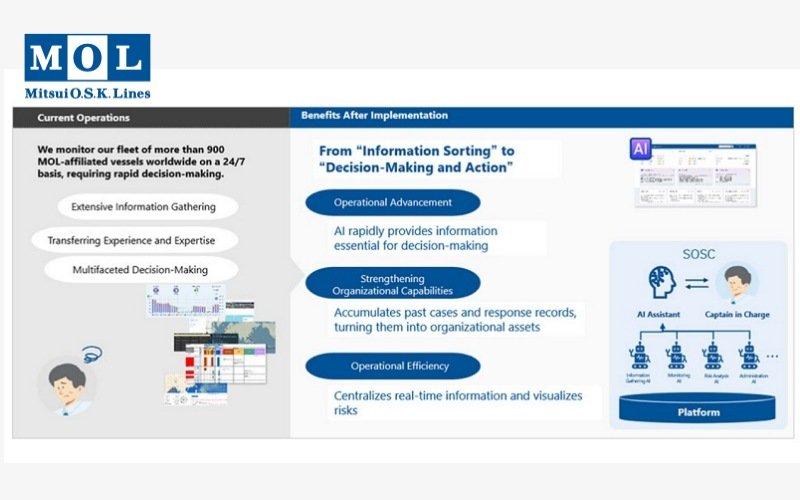
- Unified Situational Awareness: The system aggregates live global ocean weather tracking, dynamic vessel telemetry, and real-time geopolitical threat alerts. Rather than forcing personnel to hunt down anomalies, the data platform automatically registers changing variables and flags vessels moving into higher risk tiers.
- Risk Detection via Generative AI Assistant: At the core of the platform is an active generative AI assistant. By continuously running historical operational records, post-accident post-mortems, and decades of navigation logs against current voyage routes, the AI extracts and highlights looming risks. This allows shored-based captains to prioritize critical incidents before they manifest as accidents.
- Institutional Knowledge Democratization: The platform acts as a digital institutional memory bank. Field insights, historical emergency response case studies, and near-miss logs are structured and indexed organization-wide. This ensures that the collective experience of seasoned captains is instantly accessible to junior operations managers facing an active incident.
Digital Transformation Under “BLUE ACTION 2035”
For MOL, the system’s launch represents a concrete milestone in its “BLUE ACTION 2035 Phase 2” corporate management plan. Officially commenced at the start of the 2026 fiscal year, Phase 2 shifts the shipping giant’s strategic focus from initial expansion to “Value Realization.”
Under this roadmap, Digital Transformation (DX) and Safety are positioned as core pillars required to build resilience against global supply chain shocks. Crucially, MOL emphasizes that the platform is not an automated replacement for human crew management. Instead, it serves as a decision-amplifier, combining rapid, AI-driven data synthesis with the seasoned intuition of veteran mariners to achieve “preventive safety management.”
By establishing this centralized oversight capability, MOL aims to drive down its operational insurance profiles, guarantee higher reliability to blue-chip energy and cargo charterers, and establish a new benchmark for predictive safety across the global maritime industry.
About Mitsui O.S.K. Lines, Ltd. (MOL)
Mitsui O.S.K. Lines – MOL is a global leader in shipping, operating over 800 ships worldwide. Its diverse fleet includes bulk carriers, liquefied natural gas carriers, Ro-Ro car carrier ships, and oil tankers, among others. Beyond traditional shipping, MOL also engages in social infrastructure businesses, including real estate, terminal and logistics, and offshore wind power. With one of the largest merchant fleets and 140 years of history, MOL aims to be a resilient corporate group that provides new value to all stakeholders.
Source: Mitsui O.S.K. Lines