
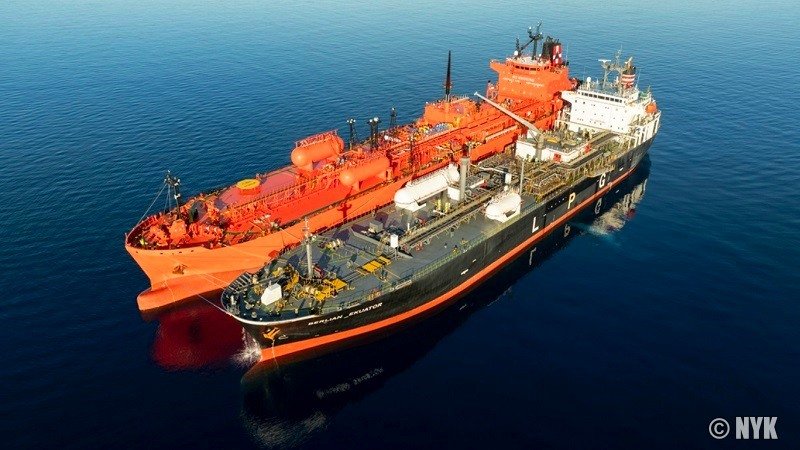
Japan | September 2, 2025 – In a major step forward for the development of a flexible and scalable ammonia supply network, a successful ship-to-ship (STS) transfer of approximately 23,000 metric tons of liquefied ammonia has been completed offshore near Ceuta, Spain.
The transfer was executed from the ammonia carrier Berlian Ekuator, owned by NYK Line and time-chartered by Mitsui & Co., Ltd., to the ammonia carrier Eco Enchanted, operated by global ammonia trader Trammo, Inc.. The operation adhered to strict international safety protocols and was supported by International Fender Providers Ltd., a specialist in STS safety management.
This marks NYK’s first ship-to-ship operation involving liquefied ammonia, building upon its existing experience in STS transfers of crude oil, LNG, and LPG.
Table of Contents
Expanding the Role of STS in Ammonia Logistics
The successful transfer showcases the growing importance of STS operations in the evolving ammonia logistics chain, particularly as ammonia emerges as a next-generation marine fuel. With carbon-free combustion and increasing demand from both the chemical and energy sectors, ammonia is gaining traction as a key player in maritime decarbonization strategies.
Unlike conventional land-based transfers that rely heavily on port infrastructure and terminal capacity, STS methods offer greater flexibility, especially in areas lacking specialized ammonia terminals. This makes it a valuable logistics tool for developing an agile, global ammonia fuel supply network.
Operational Excellence Underpinned by Collaboration
The STS operation was the result of close collaboration between industry leaders:
- NYK Line provided the Berlian Ekuator, bringing decades of maritime operational expertise and a refined safety management system.
- Mitsui & Co., Ltd., as time-charterer, played a key role in commercial coordination.
- Trammo, Inc., a major player in global ammonia trading, supplied the receiving vessel Eco Enchanted and provided operational oversight.
- International Fender Providers Ltd. supported the operation with specialized STS safety systems, fendering equipment, and procedural management.
The full cargo of 23,000 metric tons of liquefied ammonia was successfully transferred, with no safety incidents reported.

Strategic Importance for the Maritime Fuel Transition
As the shipping industry intensifies its transition toward low- and zero-carbon fuels, this operation is a clear signal that STS could become a core component of ammonia bunkering strategies. The ability to conduct large-scale transfers offshore removes constraints typically posed by onshore facilities and allows for greater geographical reach.
The success of this operation not only validates the technical feasibility of STS ammonia transfers but also sets a precedent for safe, scalable, and cost-effective ammonia logistics in support of global decarbonization goals.
Toward a Scalable Ammonia Bunkering Future
NYK has stated that it will leverage the insights gained from this operation to further develop its capabilities in handling next-generation fuels. Combined with Japan’s growing focus on ammonia as a marine energy solution, this milestone is expected to catalyze future innovations in both ammonia bunkering operations and supply chain infrastructure.
For stakeholders across the shipping, energy, and fuel logistics sectors, this development underscores the strategic role of STS transfers in enabling the future of clean marine fuels.
About NYK Line
Established in 1885 in Japan, NYK Line, formally known as Nippon Yusen Kabushiki Kaisha, has emerged as a global leader in the maritime industry over its 135-year history. Operating a diverse fleet, including container ships, bulk carriers, and tankers, NYK serves over 800 locations worldwide, offering a comprehensive suite of shipping services.
NYK Line has earned recognition for its commitment to innovation, sustainability, and safety, navigating the complexities of global logistics with diligence and foresight. This ongoing dedication underscores NYK’s pivotal role in shaping the future of ocean transport and reaffirms its status as a cornerstone of the maritime landscape.
Source NYK Line