
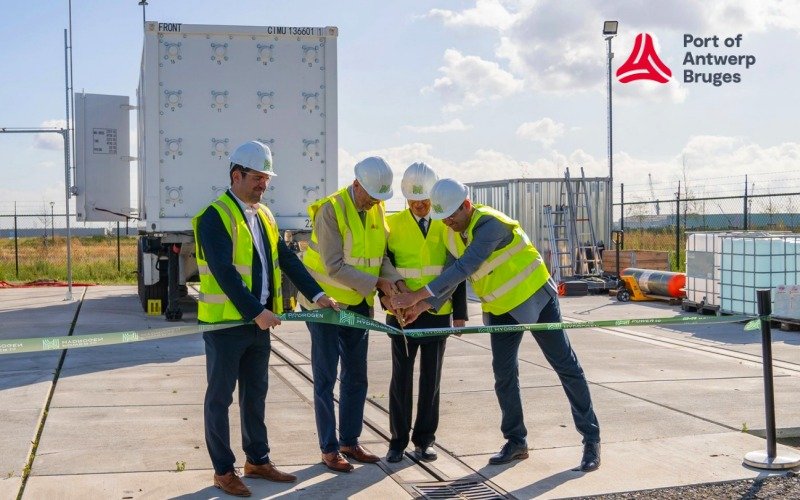
Power to Hydrogen (P2H2) has officially launched commercial green hydrogen production at the Port of Antwerp-Bruges using its pioneering 500 kW AEM system. Producing up to 70 tonnes annually, the setup uses smart grid-following capabilities and a durable hybrid membrane design to deliver lower-carbon, cost-competitive fuel for regional mobility and industrial applications. Backed by successful pilot metrics showing extended stack lifespans, P2H2 is now scaling toward multi-megawatt deployments across Europe.
Antwerp, Belgium | September 24, 2026 – Power to Hydrogen (P2H2), an advanced developer of anion exchange membrane (AEM) electrolyzer systems, has officially commenced commercial green hydrogen production at the NextGen District of the Port of Antwerp-Bruges.
The landmark installation marks a critical milestone for European energy resilience, providing a cost-effective, lower-carbon hydrogen supply directly into one of Europe’s premier industrial, chemical, and maritime logistics hubs.
Project Overview & Regional Impact
The newly operational setup features a 500 kW system constructed from two 250 kW stacks. This represents a major scaling achievement, marking the world’s first commercial deployment of 250 kW AEM stack modules, scaling up individual stack sizes by more than tenfold compared to legacy AEM solutions on the market.
- Annual Output: Designed to generate up to 70 tonnes of green hydrogen annually.
- Primary Offtakers: Regional gas supplier Holthausen and local mobility and industrial customers.
- Strategic Value: Supplies zero-emission fuel directly to heavy transport and regional chemical sectors, significantly reducing long-distance transport overhead and strengthening localized energy security.
Dynamic Load-Following & Economics
Because electricity represents the single largest expenditure in hydrogen production, P2H2 engineered its platform for high-frequency dynamic operations.
- Smart Grid Integration: Featuring a wide 10% to 100% operating range and a rapid sub-50-millisecond load response, the system seamlessly mirrors Belgium’s day-ahead power pricing. It ramps up production during periods of cheap renewable abundance and dials down when electricity prices spike.
- Competitive Pricing: This load-following agility allows P2H2 to deliver locally sourced hydrogen at a levelized cost of approximately €3.86 per kilogram, achieving roughly a 16% cost reduction over incumbent electrolyzer setups. Calculations are anchored in the U.S. Department of Energy’s H2A-Lite framework using specific operational inputs.
Breakthrough Hybrid AEM Technology
For years, Anion Exchange Membrane (AEM) electrolysis has promised the high-performance attributes of Proton Exchange Membrane (PEM) systems alongside the lower capital costs of traditional alkaline systems. However, membrane durability remained a stubborn barrier to widespread industrial adoption. P2H2’s proprietary architecture successfully overcomes this hurdle:
- Hybrid Design: A specialized alkaline separator is placed between the membrane and the oxygen-producing electrode, shielding the membrane to radically extend operating lifespans.
- Iridium-Free Catalysts: The system completely avoids scarce, expensive precious metals like iridium, instead utilizing earth-abundant materials.
- High-Pressure Output: Robust mechanical membrane support enables direct 30 bar output pressure with minimal gas crossover, drastically minimizing downstream compression requirements.
Recent validation underscores these metrics. Following a rigorous 1,250-hour pilot with European energy major Repsol, P2H2 recorded an irreversible degradation rate of just 2 mV/kHr, outperforming US Department of Energy and EU Clean Hydrogen Partnership AEM benchmarks by a factor of 5 to 10, with a projected stack lifespan eclipsing 50,000 hours.
Scaling Roadmap and Next Steps
Building on the Antwerp deployment, P2H2 is actively preparing data pipelines to support wider multi-megawatt platform rollouts.
A second commercial order for an identical 500 kW dual-stack system is slated for delivery later this year to the Norwegian research institute SINTEF, destined to back the EU-funded PYROCO2 green-chemicals initiative.
- Funding Acknowledgement: The Port of Antwerp-Bruges deployment is supported in part by the European Regional Development Fund (ERDF/EFRO) and the Flemish VLAIO innovation and entrepreneurship fund.
Power to Hydrogen
Power to Hydrogen (P2H2) develops industrial-scale electrolyzer systems that produce green hydrogen from renewable electricity. Its anion exchange membrane (AEM) platform is engineered to deliver dynamic performance, including a sub-50-millisecond load response and a 30 bar hydrogen output, using a cost-effective, iridium-free materials pathway that avoids the scarce inputs historically constraining large-scale electrolyzers. P2H2’s systems are designed for direct integration with variable renewable power and scale seamlessly into repeatable multi-megawatt deployments, with multiple commercial projects currently underway worldwide. P2H2 is backed by industry leaders AEP, EDP, E.ON, ESB, Air Liquide, JERA, and Asahi Kasei, and was named a 2026 World Economic Forum Technology Pioneer.
About Port of Antwerp-Bruges
Port of Antwerp-Bruges is one of Europe’s largest and most important maritime hubs, connecting global markets with industries and consumers across the continent. Formed through the merger of the ports of Antwerp and Zeebrugge, it handles a wide range of cargo, including containers, vehicles, chemicals and energy products. Beyond its role in international trade, the port manages vital infrastructure and maritime operations while investing in innovation, sustainability and resilience to meet the changing demands of global shipping.
Source: Port of Antwerp-Bruges