

July 2025 — In a groundbreaking collaboration aimed at advancing maritime decarbonization, climate technology startup Seabound has teamed up with the Hartmann Group, InterMaritime Shipmanagement Ltd., and Heidelberg Materials to deploy its full-scale carbon capture system aboard an active cement carrier. This project represents the world’s first-ever commercial installation of Seabound’s technology at sea and creates a unique circular value chain by turning captured CO₂ emissions into a valuable input for cement manufacturing.
Table of Contents
Capturing Carbon at Sea on the UBC Cork
The project is set to take place on the UBC Cork, a cement carrier owned by the Hartmann Group, managed by InterMaritime Shipmanagement, and chartered by Heidelberg Materials. The vessel will be equipped with Seabound’s modular, containerized carbon capture units designed specifically for marine use. Unlike traditional carbon capture systems that compress CO₂ into liquids, Seabound’s innovative technology chemically reacts CO₂ with calcium oxide, converting the emissions into stable, solid limestone.
This approach eliminates the need for energy-intensive CO₂ liquefaction and storage, making the system simpler to install and operate onboard. The technology also captures up to 95% of CO₂ and 98% of sulfur emissions from the vessel’s exhaust, significantly reducing the ship’s environmental footprint. The resulting limestone is safely stored onboard until it can be offloaded at port.
Circular Economy Link to Cement Production
The captured limestone will be offloaded at the Port of Brevik, Norway, and transported directly to Heidelberg Materials’ Brevik cement plant — the world’s first cement kiln with an integrated carbon capture facility. This facility is connected to the Northern Lights Joint Venture, the pioneering cross-border CO₂ storage hub beneath the North Sea, enabling permanent carbon sequestration.
By using the limestone as an input for cement production, the project creates a closed-loop system where marine CO₂ emissions are recycled into the industrial supply chain, demonstrating a compelling circular economy model.
Strategic Industry Collaboration
Seabound’s Co-Founder and CEO, Alisha Fredriksson, emphasized the significance of the project:
“While our containerized technology is naturally suited to container ships, the unique synergy between our limestone end-product and cement’s raw material makes bulk cement transport a fantastic starting point. This world-first project enables us to prove a market-ready value chain for marine carbon capture, gather essential operational data, and prepare for wider deployment to support the industry’s regulatory compliance.”
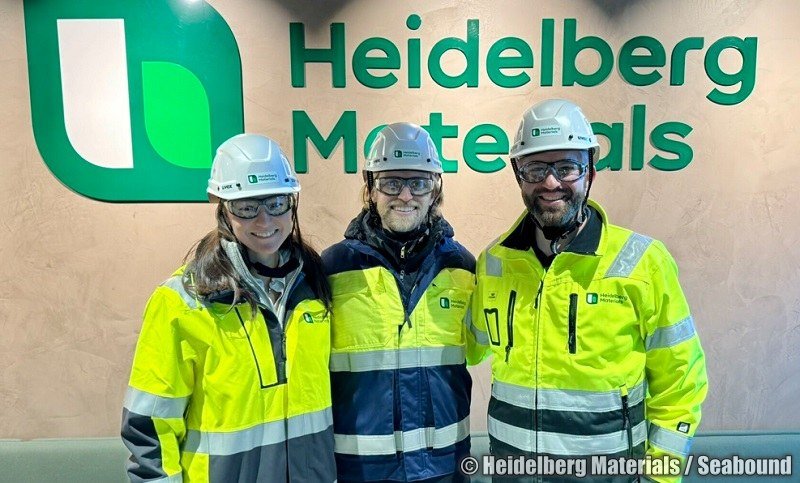
The initiative brings together leading players from maritime and heavy industry sectors. The Hartmann Group operates a global fleet of roughly 150 vessels, including bulk carriers and cement carriers, with a strong commitment to sustainability. Heidelberg Materials, a global leader in building materials, is actively advancing its net-zero goals through supply chain decarbonization and pioneering carbon capture and storage technologies.
Meeting Industry Regulations and Decarbonization Goals
This pioneering project is a vital step towards scaling onboard carbon capture solutions and offers a viable pathway for shipowners seeking to reduce emissions and comply with evolving regulations from the International Maritime Organization (IMO) and regional bodies.
With shipping responsible for approximately 90% of global trade, innovations like Seabound’s system are poised to become key components in the sector’s decarbonization toolkit — alongside cleaner fuels and energy efficiency measures.
Why It Matters for the Bunkering Sector
For bunker fuel suppliers, the rise of onboard carbon capture technologies introduces new dimensions in fuel strategy and emissions management. As shipowners adopt systems like Seabound’s, demand for compatible fuels, carbon credits, and innovative compliance solutions will grow, reshaping the bunkering landscape.
Seabound’s project showcases the tangible integration of maritime emissions reduction with industrial carbon reuse, setting the stage for further innovations that can help the bunkering and shipping sectors meet their environmental commitments.
About the Hartmann Group
The Hartmann Group is an independent, family-owned shipping company with a global presence, specializing in ship owning, technical and commercial ship management, and crewing. Operating a diverse fleet of about 150 vessels, including gas carriers, tankers, and bulk carriers, the group is committed to leveraging strong maritime traditions and technical expertise to deliver efficient and environmentally responsible shipping solutions.
About Heidelberg Materials
Heidelberg Materials is one of the world’s largest integrated producers of building materials and a leader in aggregates, cement, and concrete. The company is at the forefront of the industry’s green transition, with a strong focus on circular economy and carbon capture, utilization, and storage (CCUS) technologies to achieve its ambitious climate goals. The Brevik plant in Norway is a testament to its commitment to pioneering sustainable solutions for the future of construction.
About Seabound
Seabound is an award-winning climate tech startup developing modular carbon capture systems for ships. Founded in late 2021, the company has completed a successful pilot with Lomar Shipping and Hapag-Lloyd, capturing CO2 at approximately 80% efficiency. Seabound has raised significant funding from world-class investors and has received grants from the UK Government. The company is currently building its first full-scale commercial systems with the goal of helping the shipping sector decarbonize today.
Source Seabound