
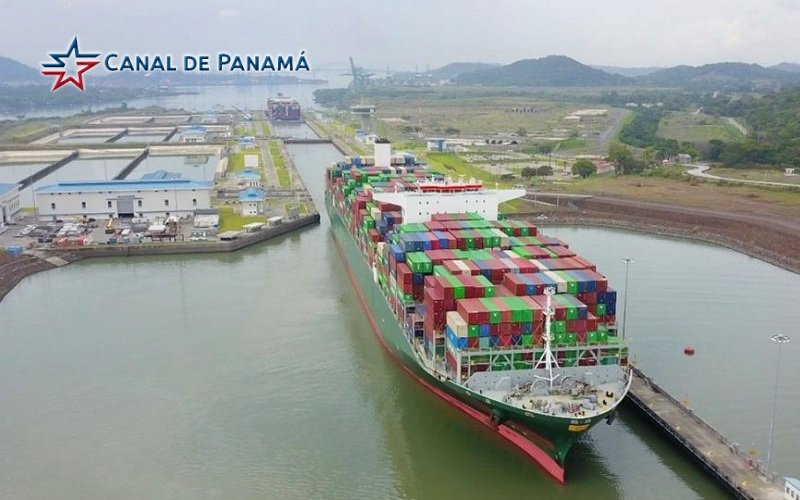
The Panama Canal Authority has announced consecutive maximum draft reductions for Neopanamax locks, lowering the limit to 48 feet on August 26 and 47.5 feet on September 3, 2026. Driven by proactive water management of Gatun Lake and El Niño forecasts, these adjustments aim to ensure long-term operational sustainability without impacting daily vessel transit numbers. Maritime operators and bunker planners must now factor these payload constraints into upcoming voyage optimizations.
Panama City, Panama | August 5, 2026 – In a fresh move to safeguard the long-term sustainability of the interoceanic waterway, the Panama Canal Authority (ACP) has issued a formal advisory to shipping lines detailing consecutive maximum authorized draft reductions for the waterway’s larger Neopanamax locks.
Effective August 26, 2026, the cap will drop to 48 feet (14.63 meters), followed closely by a second tightening on September 3, 2026, which will further lower the limit to 47.5 feet (14.48 meters) Tropical Fresh Water (TFW).
Key Operational Details at a Glance
- First Adjustment: 48.0 feet (14.63 m) TFW, effective August 26, 2026.
- Second Adjustment: 47.5 feet (14.48 m) TFW, effective September 3, 2026.
- Daily Transits: Unaffected; normal daily transit slot counts remain stable.
- Driver: Proactive water resource management responding to Gatun Lake levels and El Niño forecasts.
Engineering Water Sustainability
The upcoming adjustments, marking the fourth and fifth official draft revisions under the current administrative cycle, are directly tied to real-time hydrological evaluations of Gatun Lake. Water preservation measures have remained continuously active since December 2025 as part of the ACP’s extended blueprint to manage the regional dry season and buffer against the looming threat of the El Niño weather phenomenon.
Unlike the severe capacity crises witnessed during the 2023–2024 drought cycle, when daily transits plummeted drastically, the current strategy aims to decouple draft limits from slot availability. The ACP has confirmed that daily vessel transits will not be reduced under these specific measures.
Neopanamax Draft Reduction Timeline
| Effective Date | Maximum Authorized Draft (ft) | Maximum Authorized Draft (m) | Status |
| July 24, 2026 | 49.0 ft | 14.94 m | Active |
| August 15, 2026 | 48.5 ft | 14.78 m | Active |
| August 26, 2026 | 48.0 ft | 14.63 m | Upcoming |
| September 3, 2026 | 47.5 ft | 14.48 m | Upcoming |
Implications for Bunker and Shipping Markets
For maritime operators, vessel planners, and charterers, the stepped rollout offers a brief window to optimize cargo loads. Vessels scheduled to call at the canal in late August and early September will need to carefully recalculate cargo intake to comply with the 14.48-meter threshold, preventing costly last-minute light-loading or shifting of containers.
Bunker buyers operating larger container ships, dry bulkers, and tankers through the region should factor potential payload adjustments into voyage optimization calculations. Lighter cargo loads can marginally alter fuel consumption profiles over long-haul routes connecting the U.S. Gulf Coast to Asia.
Specialized canal hydrologists continue to track precipitation patterns and climate indices around the clock. The ACP has reiterated that additional adjustments will be communicated promptly should regional weather developments dictate a change in course.
About the Panama Canal
The Panama Canal, an engineering marvel spanning approximately 80 kilometers between the Atlantic and Pacific Oceans, is a vital link between North and South America. Built in one of the continent’s narrowest stretches, the Canal plays a key role in facilitating global maritime trade through its sophisticated system of locks.
The Canal’s locks, Gatun, Pedro Miguel, and Miraflores, function as water lifts, raising ships from sea level to the level of Gatun Lake, which sits 26 meters above sea level. The lock chambers measure 33.53 meters wide by 304.8 meters long, accommodating vessels up to 32.3 meters in width, with a draft of up to 12 meters in tropical fresh water, and a length of up to 294.1 meters.
Water for the locks is drawn from Gatun Lake, using gravity to move ships between different elevations. The Canal’s narrowest section, the Culebra Cut, stretches 13.7 kilometers from the Pedro Miguel Locks to Gatun Lake, carved through rock and limestone.
Annually, the Panama Canal facilitates the passage of between 13,000 and 14,000 ships, connecting over 180 maritime routes and serving more than 1,920 ports in 170 countries. The Canal operates 24/7 year-round, supported by a dedicated workforce of approximately 9,000 employees, ensuring seamless transit services for global maritime traffic.
Source: Autoridad Marítima de Panamá