
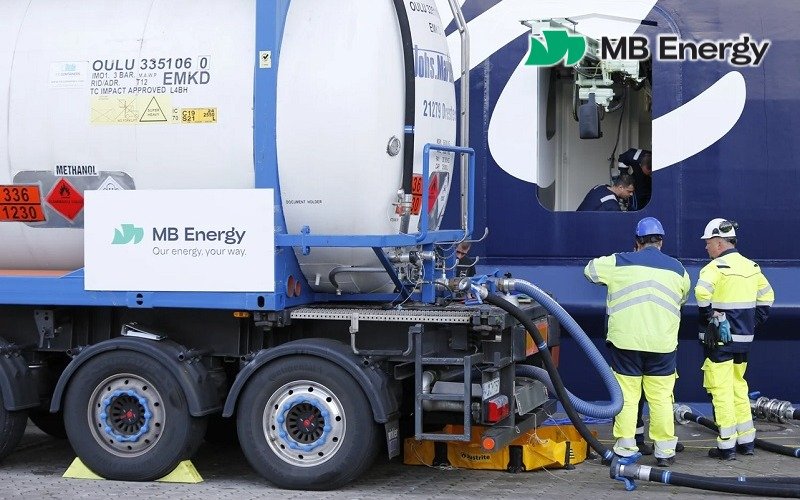
MB Energy and TUI Cruises successfully completed a pioneering methanol bunkering test for the Mein Schiff 7 at the Port of Kiel, delivering 25 cubic meters of renewable-sourced methanol during simultaneous passenger operations. Transported via an HVO 100-fueled truck by Johs. Martens, the milestone demonstrates the safe handling of alternative marine fuels under real-world conditions. This collaborative project provides valuable operational experience as MB Energy expands its Northern European storage infrastructure in Hamburg and Kiel to support the maritime industry’s broader decarbonization goals.
Kiel, Germany | September 1, 2026 – MB Energy has successfully completed a pioneering test run of a methanol bunkering system for TUI Cruises’ contemporary cruise vessel, the Mein Schiff 7, at the Ostseekai cruise terminal in the Port of Kiel. This milestone marks a critical operational leap forward in both companies’ collaborative efforts to scale up lower-carbon marine fuels, highlighting MB Energy’s broader commitment to steering the maritime sector toward sustainable operations.
Operational Breakdown and Logistics
During the milestone operation, the passenger vessel received approximately 25 cubic meters of certified methanol sourced entirely from renewable feedstocks. While the alternative fuel is primarily utilized to power the ship’s boiler operations rather than main propulsion, the delivery framework was engineered to test end-to-end sustainability.
The physical transport and terminal delivery were managed by logistics specialist Johs. Martens. Emphasizing the project’s dedication to lowering emissions across the entire supply chain, the transport truck itself was fueled using HVO 100 (Hydrotreated Vegetable Oil), serving as a future-oriented, low-emission alternative to conventional diesel.
The bunkering process successfully demonstrated robust system readiness under complex, real-world terminal conditions. MB Energy and TUI Cruises safely supplied the large passenger vessel, housing approximately 2,900 guests on board, while multiple simultaneous pier operations were underway. This complex operational environment provided critical performance metrics and hands-on experience for future alternative fuel scaling.
Industry Leadership Perspectives
Jonathan Perkins, CEO of MB Energy, emphasized the strategic weight of the trial “This deployment demonstrates that lower-carbon fuels like methanol from renewable resources can already be safely and reliably integrated into cruise operations. Together with TUI Cruises and our logistics partner Johs. Martens, we are showing that the infrastructure and expertise are in place to support reduced-carbon forms of shipping.”
Perkins noted that the Kiel operation underscores MB Energy’s capability to deliver custom, end-to-end fuel solutions, encompassing everything from global procurement and strategic storage to synchronized transport and final quayside delivery.
Echoing this sentiment, Jörg Umann, Director of Strategic Planning, Treasury, IR and Fuel at TUI Cruises, highlighted the value of gathering empirical operational data “For TUI Cruises, this project has provided valuable operational experience with the supply and handling of certified renewable methanol under real operating conditions. While the methanol supplied from renewable raw materials in this operation is used for boiler operation and not for propulsion, projects like this help us to better understand how alternative fuels can contribute to emission reduction as part of a broader carbon reduction strategy.”
Infrastructure Scaling and Northern European Hubs
To meet anticipated demand from major maritime clients across Northern Europe, MB Energy is actively scaling up its storage capabilities. The energy company is currently expanding its storage terminal infrastructure in Hamburg-Blumensand to ensure readiness for supplying commercial maritime customers with larger quantities of low-carbon methanol and ammonia down the line.
Moving forward, Hamburg and Kiel will function as MB Energy’s primary operational anchors in Northern Germany, backed by the operational flexibility to service additional key European ports.
Concluding on the necessity of cross-sector collaboration, Jonathan Perkins added “By combining our own storage infrastructure with integrated logistics, we can offer customers a reliable and uninterrupted methanol supply. Our first bunkering with the ‘Mein Schiff 7’ is a strong signal of what is possible when shipping companies, ports and energy suppliers work together.”
About TUI Cruises
TUI Cruises stands as a premier cruise provider in the German-speaking market. Established as a joint venture between TUI AG and the U.S.-based cruise line Royal Caribbean Cruises Ltd., the company employs approximately 750 people across its offices in Hamburg and Berlin. Under the Mein Schiff brand, the enterprise operates a contemporary, premium fleet comprising nine numbered vessels (Mein Schiff 1 through Mein Schiff 7) alongside the newer InTUItion-class ships, Mein Schiff Relax and Mein Schiff Flow, offering a cumulative berth capacity of roughly 26,800. Additionally, Hapag-Lloyd Cruises joined the TUI Cruises GmbH portfolio at the end of 2020 and currently operates a five-ship fleet. This includes the luxury liners EUROPA and EUROPA 2, as well as the specialized expedition vessels of the HANSEATIC class, cementing Hapag-Lloyd Cruises’ legacy of 130 years as the leading luxury and expedition cruise brand in the German-speaking world.
About MB Energy
The MB Energy Group, founded in 1947 and headquartered in Hamburg, is an independent, integrated energy company with operations spanning Europe, the United States, and Singapore. The company specializes in the import, storage, distribution, and marketing of petroleum products, liquefied petroleum gas (LPG), chemicals, and biofuels. Backed by decades of industry experience and a progressive outlook, MB Energy actively shapes the global energy landscape by developing and delivering future-oriented alternatives that assist customers in transitioning toward lower-emission energy sources. Since 1972, enport by MB Energy has served as a major force in tank storage logistics, establishing itself as one of Germany’s largest independent providers of tank storage and infrastructure solutions. Operating 13 tank farms across Germany, Denmark, and Hungary with a combined capacity of 2.6 million cubic meters (m3), enport leverages its strong regional footprint to ensure the safe and efficient distribution of energy products and chemicals throughout Europe.
Source: MB Energy