
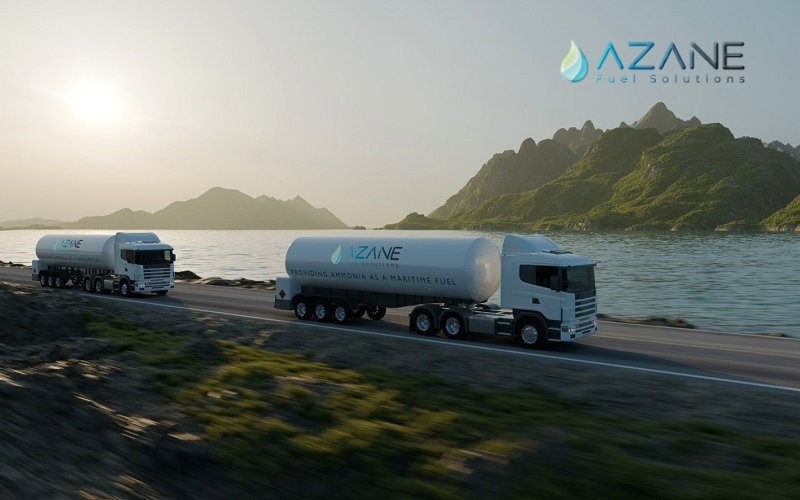
AZANE Fuel Solutions and Equinor have signed a pioneering framework agreement covering ammonia fuel supply and truck-to-ship bunkering operations, with initial deliveries scheduled for the second half of 2026. The partnership marks a critical transition from conceptual infrastructure planning to repeatable commercial fuel delivery for zero-emission shipping. By bridging the gap between fuel producers and maritime operators, the agreement provides a vital real-world test for safe, scalable ammonia bunkering in Norwegian coastal and offshore waters.
Oslo, Norway | August 20, 2026 – In a landmark milestone for maritime decarbonization, AZANE Fuel Solutions and Equinor have signed a pioneering framework agreement covering ammonia fuel supply and truck-to-ship bunkering operations. Marking a significant step in the development of a commercial supply chain for ammonia-fuelled shipping, the companies report that first deliveries under the agreement are scheduled for the second half of 2026.
The agreement brings together two entities that have collaborated for years on the practical requirements for introducing ammonia into Norway’s maritime fuel system. For AZANE, the deal represents a definitive transition from technology development and infrastructure planning toward commercial fuel delivery. For Equinor, it integrates a concrete supply and bunkering arrangement into its broader corporate strategy for lower-emission maritime operations.
AZANE describes the arrangement as the world’s first framework agreement for ammonia fuel supply and truck-to-ship bunkering operations, reflecting growing industry confidence in ammonia as a viable marine fuel. The announcement arrives as the maritime sector shifts from demonstration projects toward the more complex phase of building dependable fuel supply chains, bunkering infrastructure, and operational safety procedures for alternative fuels.
From Ammonia Technology to Commercial Fuel Delivery
Ammonia has attracted considerable attention in shipping because its molecular structure contains no carbon, meaning its combustion generates no direct carbon dioxide (CO2). However, achieving true zero emissions depends entirely on upstream production processes.
- The Lifecycle Emissions Challenge: Renewable or “green” ammonia offers near-zero lifecycle greenhouse-gas emissions, whereas conventional ammonia production remains carbon-intensive. Furthermore, ammonia combustion creates nitrous oxide and nitrogen oxides, demanding advanced engine technology and strict emissions controls.
- The Infrastructure Gap: Beyond engine design, shipping companies require reliable access to the fuel, secure storage infrastructure, cryogenic transfer systems, trained personnel, and robust safety protocols.
This infrastructure gap defines AZANE’s business model. Designed to resolve the classic “chicken-and-egg” dilemma, where shipowners hesitate to order alternative-fuel vessels without assured availability, and fuel suppliers withhold infrastructure investment without guaranteed demand, AZANE develops specialized terminals and transfer systems. The Equinor agreement succeeds precisely because it links fuel supply directly with an identified industrial customer and a defined operational footprint.
Truck-to-Ship Bunkering Bridges the Early Market
Under the framework, ammonia will be supplied via truck-to-ship bunkering, a delivery model where road tankers transport the fuel directly to the quayside for transfer to receiving vessels.
While truck-based operations demand far less permanent capital expenditure than large fixed terminals during early market development, handling ammonia is exceptionally demanding compared to conventional marine gas oil:
- Strict Safety Parameters: Ammonia’s toxicity requires rigorous multi-layered controls against accidental release, including advanced transfer connections, continuous pressure and temperature monitoring, automated emergency shutdown systems, and sophisticated leak detection.
- Regulatory Milestones: AZANE’s operational readiness builds on years of safety classification, including securing what the company reported as the world’s first safety permit for an ammonia bunkering facility in 2024.
Norway as an Early Testbed for Clean Marine Fuels
Norway continues to serve as an international sandbox for alternative marine fuels, bolstered by proactive government decarbonization mandates and a dense offshore maritime ecosystem. AZANE’s broader infrastructure push has received substantial public backing, notably a NOK 442 million funding award from Enova in late 2025 to build three ammonia bunkering terminals targeted at coastal and offshore trades.
The Equinor agreement reinforces how successful alternative fuel adoption relies on synchronized collaboration across the entire value chain, involving energy majors, shipowners, technology providers, ports, classification societies, and national regulators.
As other major global hubs, such as recent initiatives by NYK, Golden Island, and Yara Clean Ammonia in Singapore, or CF Industries and TFG Marine, accelerate their own clean ammonia footprints, the competitive landscape is shifting. The central question for modern maritime logistics is no longer whether an engine can burn ammonia, but where the fuel will be produced, how its emissions are certified, and how safely it can be bunkered at scale.
With initial deliveries slated for late 2026, the AZANE-Equinor partnership moves ammonia out of the theoretical realm and into the crucible of daily commercial operations. For a shipping industry under mounting pressure to meet global greenhouse gas reduction targets, this transition from conceptual framework to repeatable bunker execution represents a critical stride forward.
About the Partners
Azane Fuel Solutions: Pioneering Zero-Emission Infrastructure
Headquartered in Oslo and Sandefjord, Norway, Azane Fuel Solutions is at the forefront of developing the world’s first ammonia bunkering terminals. The company specializes in groundbreaking technology designed to deliver fast, safe, and reliable bunkering of ammonia to ships. Beyond core bunkering terminals, Azane actively drives the decarbonization of the global shipping industry by innovating dedicated ammonia cargo-handling systems and fuel-handling infrastructure.
Azane is backed by prominent, solid investors with leading global positions across the maritime sector and the ammonia industry, including:
- Amon Maritime
- ECOnnect Energy
- Fjord Base
- Navigator Gas
- Yara Growth Ventures
Equinor: Securing Energy and Powering the Transition
Headquartered in Norway, Equinor is a premier international energy company with approximately 25,000 employees operating in over 20 countries. Guided by its core purpose, Energy for people. Progress for society. Searching for better. Equinor delivers reliable energy to a growing world while supporting energy security across Europe and international markets.
While building on strong foundations in oil, gas, and power, Equinor’s corporate strategy centers on creating long-term value through competitive, integrated low-carbon solutions. The company combines industrial scale, operational efficiency, and market access to reduce emissions, develop new energy systems, and partner globally to supply the secure, lower-emission energy required for the future of maritime transport.
Source: Azane Fuel Solutions | Equinor