
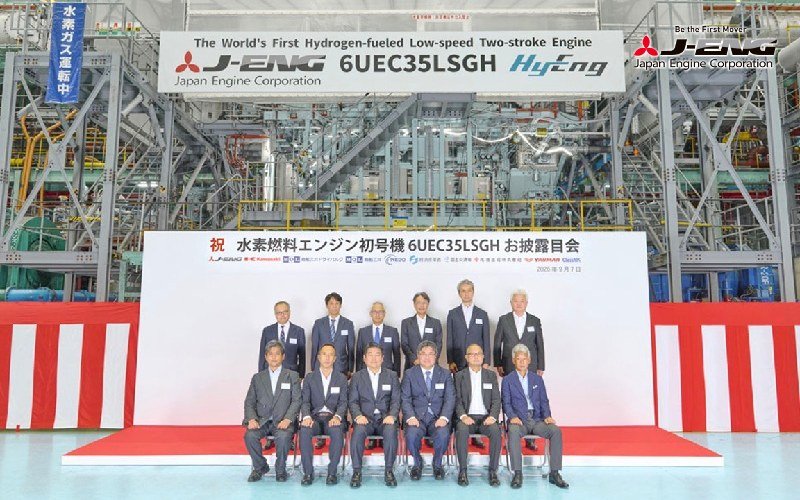
J-ENG and Japanese industrial consortium has successfully completed land-based testing for the world’s first hydrogen-fueled engine for large commercial vessels, achieving a 95% reduction in greenhouse gas emissions. Developed under a NEDO project by Japan Engine, Kawasaki, and Yanmar, the 6UEC35LSGH engine will be installed on an MOL multipurpose vessel for groundbreaking onboard sea trials starting in April 2028. This milestone reinforces global maritime decarbonization efforts by successfully coupling clean hydrogen propulsion with advanced bunkering infrastructure and ClassNK safety frameworks.
Akashi, Japan | September 18, 2026 – A consortium of leading Japanese industrial, maritime, and energy organizations has achieved a major milestone in global decarbonization. Japan Engine Corporation has officially completed land-based testing for the world’s first hydrogen-fueled low-speed two-stroke main engine for large commercial vessels, the 6UEC35LSGH.
Key Highlights
- Dramatic Emissions Reduction: Factory testing proved a hydrogen co-firing rate of at least 95%, cutting greenhouse gas (GHG) emissions by over 95% compared to conventional heavy-fuel-oil (HFO) engines.
- The “Blue Harmony” Project: The engine is scheduled for installation in January 2027 aboard a 17,500 DWT multipurpose vessel, with full-scale sea trials and onboard demonstration slated for April 2028.
- Collaborative Industry Muscle: Backed by NEDO’s Green Innovation Fund, the initiative unites key players including Japan Engine, Kawasaki Heavy Industries, Yanmar Power Solutions, Mitsui O.S.K. Lines (MOL), MOL Drybulk, Onomichi Dockyard, and ClassNK.
Technical Breakdown: The 6UEC35LSGH Engine
Unveiled to project stakeholders at Japan Engine’s headquarters factory, the 6UEC35LSGH represents a colossal leap forward for maritime propulsion.
To achieve stable combustion using hydrogen. a fuel notorious for its wide flammability range and high flame velocity, the engine adopts a high-pressure direct injection system. This mechanism injects hydrogen directly into the cylinder at precise pressures right before combustion, supplemented by a small amount of pilot fuel (such as marine gas oil).
Because hydrogen handling demands rigorous safety protocols, the design integrates heavy-duty preventive engineering:
- Leak Mitigation: A robust structural layout explicitly engineered to prevent hydrogen leakage.
- Double-Walled Piping: Installed across all vital hydrogen supply lines to secure absolute containment.
Approval testing was meticulously conducted under the watchful eye of classification society ClassNK, passing all safety evaluations.
Moving from Testbed to Open Sea: The Timeline
The initiative operates under the umbrella of NEDO’s (New Energy and Industrial Technology Development Organization) Green Innovation Fund Project / Next-Generation Ship Development, specifically targeting the “Development of Marine Hydrogen Engines and MHFS”.
- January 2027: The 6UEC35LSGH engine will be installed on a new 17,500 DWT multipurpose vessel. The ship is currently under construction by Onomichi Dockyard Co., Ltd. for Mitsui O.S.K. Lines, Ltd. (MOL) and MOL Drybulk Ltd.
- Bunkering & Fuel Supply: Kawasaki Heavy Industries, Ltd. is engineering and manufacturing the Marine Hydrogen Fuel System (MHFS), comprising specialized marine hydrogen fuel tanks and supply systems, alongside dedicated liquefied hydrogen bunkering equipment.
- April 2028: Following initial harbor and sea trials, official onboard demonstration testing under the “Blue Harmony” project will commence, evaluating true durability and performance under real-world commercial trading patterns.
Strategic Implications for the Bunkering and Maritime Sectors
As international shipping faces mounting pressure to reach net-zero carbon emissions by 2050, the commercial readiness of alternative fuels is transitioning from theory to reality.
This milestone follows closely on the heels of Japan Engine’s completion of the world’s first commercial-model ammonia-fueled low-speed two-stroke engine in August 2025. By advancing both ammonia and hydrogen propulsion avenues, Japanese maritime stakeholders are actively solving the chicken-and-egg dilemma of zero-emission shipping: pairing primary engine architecture with synchronized port bunkering solutions and safety frameworks overseen by ClassNK.
“The Blue Harmony project symbolizes not only the clean blue aura of hydrogen energy but the ultimate integration of cutting-edge Japanese marine technologies working in tandem to secure a sustainable future for global trade.”
Participating Stakeholders at a Glance
- NEDO: Commissioning and funding body via the Green Innovation Fund.
- Japan Engine Corporation: Main engine developer.
- Kawasaki Heavy Industries, Ltd.: MHFS and bunkering equipment developer.
- Yanmar Power Solutions Co., Ltd.: Partner in marine hydrogen engine development.
- Mitsui O.S.K. Lines, Ltd. & MOL Drybulk Ltd.: Vessel operators/owners.
- Onomichi Dockyard Co., Ltd.: Shipbuilder.
- Nippon Kaiji Kyokai (ClassNK): Safety and classification assessor.
About Japan Engine Corporation (J-ENG)
Headquartered in Akashi, Japan, Japan Engine Corporation (J-ENG) has emerged as a cornerstone of the global marine propulsion industry. Formed in 2017 through the consolidation of Kobe Diesel and Mitsubishi Heavy Industries’ marine engine division, J-ENG is the only manufacturer with an integrated system for the UE low-speed engine, one of the three dominant platforms worldwide. J-ENG has evolved beyond traditional engine manufacturing to become a central architect of shipping’s transition to carbon-neutral fuels.
The UE Engine Legacy
Japan’s domestically developed UE engine series has long rivaled global leaders such as Everllence and WinGD. Known for high thermal efficiency and compact design, the platform has progressed through several defining generations:
- LSH Series: Optimized for maximum fuel economy using conventional fuels
- LSJ Series: Incorporating proprietary stratified water injection for enhanced efficiency on MGO
- LSJA Series: The world’s first commercial-grade ammonia-fueled low-speed engines
Recent milestones have redefined J-ENG’s market position:
- Ammonia Propulsion: Completion of the 7UEC50LSJA-HPSCR, setting a new global benchmark for low-carbon gas carriers
- Hydrogen Advancement: World-first land-based operation of a marine hydrogen engine at the Akashi factory, in partnership with Kawasaki Heavy Industries and Yanmar
- Methanol Expansion: Launch of the UEC50LSJM methanol engine program, targeting completion in 2027
J-ENG operates with a highly specialized workforce of approximately 400 professionals, supported by a blue-chip shareholder base including:
- Mitsubishi Heavy Industries, Ltd.
- Namura Shipbuilding Co., Ltd.
- Shin Kurushima Dockyard Co., Ltd.
This tightly integrated ecosystem enables rapid iteration, testing, and deployment, an advantage few global competitors can match.
Source: Japan Engine Corporation