
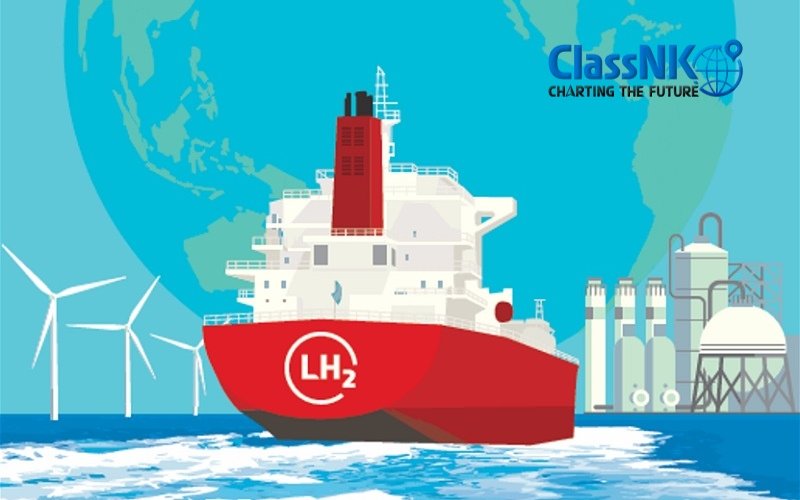
ClassNK has released Edition 3.1 of its Guidelines for Liquefied Hydrogen Carriers, integrating the IMO’s newly adopted Revised Interim Recommendations for Carriage of Liquefied Hydrogen in Bulk (MSC.597(111)). The update establishes comprehensive safety requirements for membrane-type cargo containment systems utilizing vacuum insulation. Additionally, it refines material and welding standards to effectively mitigate risks such as low-temperature embrittlement and hydrogen attack for shipboard equipment.
Tokyo, Japan | September 10, 2026 – Major classification society ClassNK has officially released the ‘Guidelines for Liquefied Hydrogen Carriers – Edition 3.1’. This revision incorporates the ‘Revised Interim Recommendations for Carriage of Liquefied Hydrogen in Bulk’ IMO Resolution MSC.597 -111, adopted by the IMO in 2026, and updates existing safety requirements, including guidance on the selection of materials and welding practices for hydrogen equipment.
Through this revision, shipyards, designers, shipowners, and other maritime stakeholders can gain a clear understanding of the safety requirements for liquefied hydrogen carriers and proceed with their design studies and safety assessments more smoothly.
Background
Hydrogen is expected to play a key role as an energy carrier in realizing a decarbonized society, and the development of liquefied hydrogen carriers as a means of large-scale transportation is advancing worldwide. In recent years, the design of such vessels has become increasingly diverse, including the development of liquefied hydrogen carriers fitted with membrane-type cargo containment systems.
In response to recent developments in liquefied hydrogen carrier design, the Revised Interim Recommendations for Carriage of Liquefied Hydrogen in Bulk were adopted at the 111th session of the IMO Maritime Safety Committee (MSC 111), introducing additional safety requirements for cargo containment systems based on new design concepts.
The revised ClassNK Guidelines incorporate the provisions of these IMO Interim Recommendations while also reflecting the latest knowledge and experience gained through the construction and operation of demonstration vessels, as well as various research and development projects.
Main Revisions
- Requirements for Membrane-Type Cargo Containment Systems: Following the adoption of the IMO Interim Recommendations at MSC 111, requirements have been developed for liquefied hydrogen carriers fitted with membrane tanks using vacuum insulation. In addition to incorporating the content of the IMO Interim Recommendations, design requirements relating to vacuum insulation systems, monitoring devices, pressure control equipment, and emergency response have been clarified. This enables developers of newly designed liquefied hydrogen carriers fitted with membrane-type cargo containment systems to refer to internationally recognized safety requirements and proceed smoothly with studies toward Flag Administration approval and safety demonstration.
- Improved Guidance on Materials and Welding for Hydrogen Equipment: Based on ClassNK’s experience in design reviews and technical assessments in actual projects, the verification procedures for the selection of metallic materials, testing, and quality control have been updated. The revised guidance clarifies how to address material degradation that requires particular attention in the design of liquefied hydrogen carriers, such as low-temperature embrittlement, hydrogen embrittlement, and hydrogen attack, and is expected to reduce the risk of design changes and additional verification.
As a third-party certification body, ClassNK will continue to support the efforts of stakeholders to address environmental challenges through the development of standards, certification, and the provision of technical information.
The guidelines are available to download via ‘Guidelines’ of My Page on ClassNK’s website
About ClassNK
Established in 1899, ClassNK is a classification society dedicated to safety and environmental protection through third-party certification. ClassNK conducts diverse technical services, including surveys and classifications of ships and marine structures based on its own rules and international conventions on behalf of more than 100 flag states, as well as management system certifications in line with ISO and other industry standards. ClassNK is committed to providing the industry with full support to tackle digitalization and decarbonization challenges through expanding certification services and R&D with industry partners.
Source: ClassNK