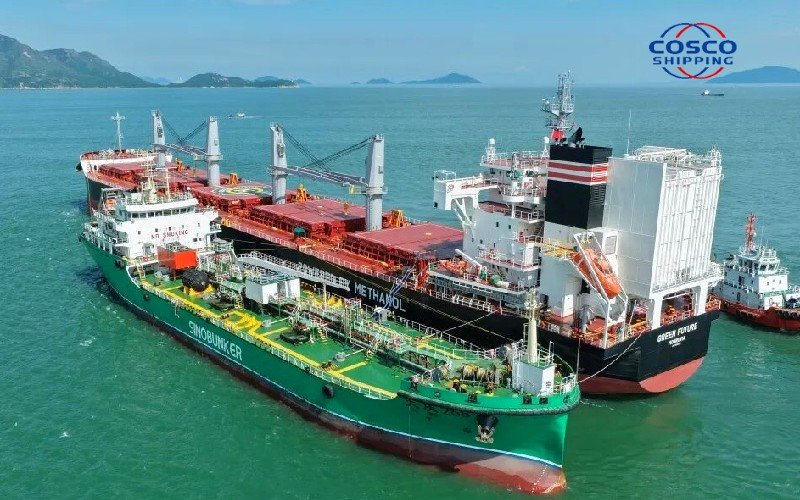
COSCO Shipping and Sinopec successfully completed Guangzhou’s first green methanol bunkering for an international dry bulk carrier, transferring 1,021 tons of ISCC-EU certified fuel to the Green Future at Guangzhou Port’s Lantau Island anchorage. Utilizing the domestically built bunker vessel Daqing 268 during a challenging 10-hour ship-to-ship operation, the milestone expands green marine fuel services from container ships to the more logistically complex bulk carrier sector. This achievement solidifies the Guangdong-Hong Kong-Macao Greater Bay Area’s collaborative regional refueling network, marking a major leap from isolated pilot projects to normalized commercial green bunkering.
Guangzhou, China | September 8, 2026 – In a landmark development for maritime decarbonization, Guangzhou has successfully executed its first-ever green methanol bunkering operation for an international-voyage bulk carrier. On September 6, China Shipping & Sinopec Suppliers Co., Ltd. completed a complex ship-to-ship (STS) green methanol bunkering at the Dayushan anchorage near Lantau Island in Guangzhou Port. The company’s specialized bunker vessel, Daqing 268, transferred 1,021 tons of ISCC-EU certified green methanol into the world’s first methanol dual-fuel bulk carrier, the Green Future.
This operation marks a critical paradigm shift: extending green marine fuel infrastructure beyond container ships and roll-on/roll-off (Ro-Ro) vessels into the broader, more logistically complex dry bulk shipping sector.
Overcoming Dry Bulk Logistics Challenges
While container and liner shipping operate on predictable schedules and fixed port rotations, dry bulk carriers feature scattered routes and random port calls. Furthermore, single bunkering stems for bulkers frequently exceed 1,000 tons, demanding high coverage density, massive storage capacity, and exceptional supply chain stability.
- Scaling Up Volume: Successfully delivering a thousand-ton stem proves that COSCO SHIPPING and Sinopec’s integrated methanol fuel supply chain can robustly support mainstream dry bulk vessel classes.
- Lifecycle Reductions: The fuel supplied was pure biomass-based green methanol produced at CIMC Enric’s facility in Zhanjiang, Guangdong. Over its entire lifecycle, this fuel cuts greenhouse gas emissions by over 65% (with specific certifications exceeding 85%) compared to traditional heavy fuel oils, fulfilling strict International Maritime Organization (IMO) trajectory standards.
The Workhorse: Daqing 268 Proves Its Capability
The core asset driving this milestone is the Daqing 268, commissioned in January 2026. Key specifications of the vessel include:
- Dimensions & Capacity: 109.9 meters in length with a 7,500-deadweight ton (dwt) payload capacity.
- Propulsion: Features a 100% domestically produced core propulsion and dual-fuel system.
- Regulatory Milestone: It is currently the only designated methanol bunker vessel holding official operating qualifications for Hong Kong-Macau cross-jurisdictional routes.
Operating during an open anchorage transfer at Lantau Island, the Daqing 268 crew successfully managed choppy wind and wave conditions. The rigorous 10-hour STS transfer highlighted the precision, safety, and stability of homegrown Chinese bunkering equipment during high-volume operations.
Regional Collaboration Across the Greater Bay Area
The milestone operation was heavily supported by coordinated efforts from the Guangzhou Municipal Bureau of Commerce, Guangzhou Customs, maritime safety administrations, border inspection agencies, and Guangzhou Port Group.
With Guangzhou joining Shenzhen and Hong Kong, the Guangdong-Hong Kong-Macao Greater Bay Area (GBA) has established a fully functional, multi-port regional bunkering network. The regional “production-storage-transportation-fueling” chain has officially graduated from isolated pilot schemes to synchronized cross-jurisdictional collaboration, completing a vital puzzle piece in China’s green maritime network.
Looking Ahead
As the IMO accelerates toward its net-zero 2050 targets, shipowners globally are turning to dual-fuel architectures. The Green Future, a 65,700-dwt Ultramax bulk carrier owned by Japan’s Kambara Kisen and chartered by NYK Bulk & Projects Carriers, represents the vanguard of this transition.
Buoyed by this breakthrough at Guangzhou Port, Sinopec and COSCO SHIPPING plan to transition green methanol bunkering from initial pioneering runs into normalized, routine commercial services, offering shipowners an unyielding guarantee for global fleet decarbonization.
About COSCO SHIPPING
COSCO SHIPPING Lines is a key business unit of COSCO SHIPPING Group, established through the merger of COSCO Container Lines Co., Ltd. and China Shipping Container Lines CO., Ltd. in 2016. Headquartered in Shanghai, the company operates a vast global shipping network, with domestic branches in nine major Chinese ports and international offices across Europe, North America, Southeast Asia, West Asia, South America, Australia, Japan, Korea, and Africa.
As of July 2024, COSCO SHIPPING Lines owns and operates 403+ container vessels with a total capacity of 2.3 million+ TEUs. Including its subsidiary Orient Overseas International, the fleet expands to 529+ vessels with a total capacity of 3.2 million+ TEUs.
With 413 shipping routes, including 275 international routes, the company services 617 ports in 145 countries and regions. Employing 16,700 professionals worldwide, COSCO SHIPPING Lines remains a leader in innovation, efficiency, and sustainability within the global shipping industry.
Source: COSCO SHIPPING Lines | Sinopec