A Japanese consortium led by NYK Line has completed the world’s first ship-to-ship ammonia bunkering operation, transferring fuel directly from the carrier Shoei Maru to a new ammonia-fueled medium gas carrier. Supported by NEDO’s Green Innovation Fund, the milestone addresses critical toxicity and safety challenges while establishing vital operational frameworks for the commercial deployment of zero-emission vessels. As the receiving vessel prepares for sea trials ahead of its November 2026 delivery, this achievement marks a foundational step toward building a global maritime supply chain for alternative fuels.
Tokyo, Japan | September 18, 2026 – A collaborative heavyweight consortium led by NYK Line, alongside Japan Marine United Corporation, Nihon Shipyard Co., Ltd., Mitsubishi Gas Chemical Company, Inc., and Kokuka Sangyo Co., Ltd., has cemented Japan’s leadership in maritime decarbonization by completing the world’s first ship-to-ship (STS) ammonia bunkering operation involving an ammonia-fueled vessel.
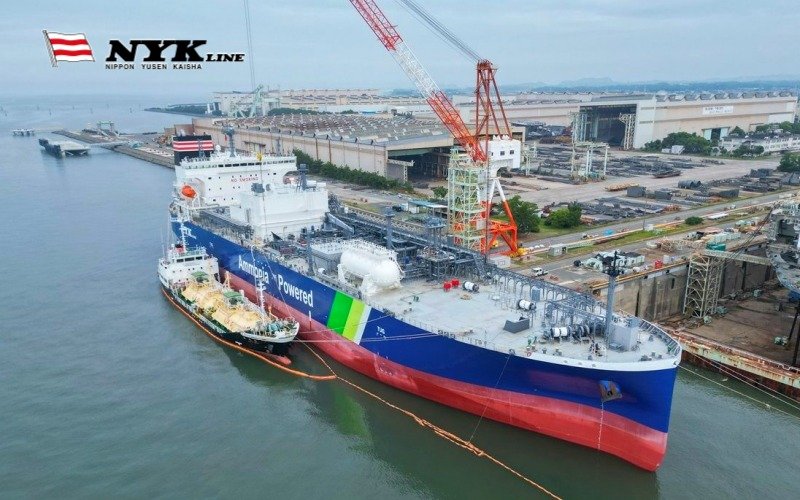
Completed on September 17, 2026, at a quay within Japan Marine United Corporation’s Ariake Shipyard, the landmark milestone involved transferring fuel-grade ammonia directly from the ammonia carrier Shoei Maru to an ammonia-fueled medium gas carrier (AFMGC). With the receiving AFMGC slated for delivery in November 2026, the successful transfer serves as a crucial dry run for the vessel’s upcoming sea trials using fuel ammonia.
Bridging the Gap: From Concept to Commercial Reality
While maritime decarbonization has seen significant headway in engine development, building a dependable fuel-supply chain remains one of the industry’s steepest hurdles. A vessel cannot operate commercially on alternative fuels without a resilient infrastructure to supply them.
Ship-to-ship bunkering addresses this by allowing fuel to be transferred directly between vessels via specialized hoses and transfer equipment. Unlike fixed shore-side terminals, STS operations offer vital flexibility for servicing ships in ports and emerging shipping hubs.
The September 17 operation successfully bridged the gap between paper engineering and real-world execution, providing invaluable operational insight into:
- Multi-party coordination across shipowners, shipyards, fuel suppliers, and operators.
- Complex logistics for handling toxic marine fuels.
- Standardized safety protocols for emergency response, leak mitigation, and transfer management.
Navigating Ammonia’s Promise and Toxicity Challenge
Ammonia (NH3) has emerged as a frontrunner in the maritime industry’s search for carbon-neutral fuels. Because it contains no carbon atoms, its combustion produces zero carbon dioxide (CO2) emissions from the fuel itself. However, ammonia’s primary drawback is its high toxicity, which demands exceptionally rigorous controls during storage, transport, and transfer.
To mitigate these risks, the consortium undertook extensive advance planning, establishing comprehensive safety routines and work processes. According to NYK Line, these meticulous preparations ensured the transfer was executed flawlessly, generating critical safety benchmarks that will inform global ammonia bunkering standards moving forward.
Anatomy of the Milestone: The Vessels and State Backing
The success of the operation relied on specialized assets and targeted government support:
- Shoei Maru (Supplying Vessel): Owned by Kokuka Sangyo Co., Ltd. (gross tonnage: 998 tons; LOA: 71.5 meters), this vessel is typically deployed to transport ammonia for Mitsubishi Gas Chemical Company’s Niigata Plant. Its existing operational profile made it an ideal candidate for the demonstration.
- Ammonia-Fueled Medium Gas Carrier (Receiving Vessel): Currently in the final stages of construction at Japan Marine United Corporation, this vessel is the centerpiece of Japan’s ambitions to operationalize next-generation ship technology ahead of its November 2026 delivery.
- The Green Innovation Fund: The AFMGC project is backed by Japan’s multi-trillion-yen Green Innovation Fund, administered by the New Energy and Industrial Technology Development Organization (NEDO). Part of Japan’s roadmap to achieve carbon neutrality by 2050, the fund provides critical long-and short-term capital for zero-emission ship technology, including fuel supply systems, engines, and cryogenic tanks.
The Road Ahead for Ammonia Bunkering
The September 17 transfer does not instantly create a global bunkering network, nor does it solve every regulatory or economic roadblock facing alternative marine fuels. However, it represents a definitive shift away from laboratory theory and toward maritime reality.
As the AFMGC moves toward its maiden sea trials ahead of its November delivery, the maritime world is watching closely. The successful execution of the world’s first STS ammonia bunkering operation proves that the future of zero-emission shipping relies as much on the supporting supply chain as it does on the vessels themselves.
About NYK Line
Established in 1885 in Japan, NYK Line, formally known as Nippon Yusen Kabushiki Kaisha, has emerged as a global leader in the maritime industry over its 135-year history. Operating a diverse fleet, including container ships, bulk carriers, and tankers, NYK serves over 800 locations worldwide, offering a comprehensive suite of shipping services.
NYK Line has earned recognition for its commitment to innovation, sustainability, and safety, navigating the complexities of global logistics with diligence and foresight. This ongoing dedication underscores NYK’s pivotal role in shaping the future of ocean transport and reaffirms its status as a cornerstone of the maritime landscape.
Source: NYK Line