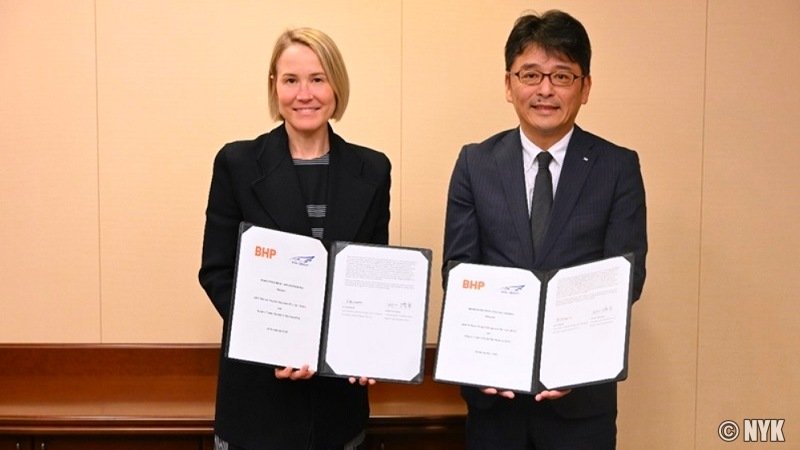
Japan | November 26, 2025 – Nippon Yusen Kabushiki Kaisha (NYK Line), a global shipping leader, and BHP Group Ltd (BHP), one of the world’s largest dry bulk charterers and a key global resources company, have renewed their strategic Memorandum of Understanding (MOU), initially signed in June 2022. The renewed pact, signed on November 25, reinforces a joint commitment to accelerate the decarbonization and enhance the operational safety of the dry bulk sector.
Strategic Renewal: Deepening a High-Stakes Partnership
This collaboration is critical as it pairs a major vessel owner (NYK) with a major cargo owner (BHP), creating a powerful bilateral model to drive technological and operational change across the supply chain, particularly for hard-to-abate commodity transport like iron ore, coal, and copper.
Emma Roberts, Vice President Maritime & Supply Chain Excellence, BHP, commented on the renewed commitment: “We have a shared commitment to be innovative and to accelerate industry safety, technology, and sustainability performance across the maritime sector. As one of the world’s largest dry bulk charterers, BHP has a deep interest in working alongside our partners to advance a safer, technology-driven, and efficient shipping industry.”
Next-Generation Fuels: The Ammonia and Biofuel Focus
The updated MOU lays out clear, future-facing initiatives that focus directly on the marine fuel industry and advanced vessel technology:
- Continued Joint Research on Ammonia Dual-Fuel Vessels: Ammonia NH3 is a zero-carbon fuel candidate that produces no CO2 when burned. This joint research is aimed at rapidly advancing the technical and safety readiness of ammonia-capable vessels for the dry bulk trade, with BHP previously outlining an intent to deploy ammonia dual-fuel vessels on its Australia-China iron ore trade routes before 2030.
- Bunkering Implication: Focusing on ammonia signals a long-term view towards a net-zero solution, acknowledging that significant safety protocols and new bunkering infrastructure will be required for this toxic fuel, especially at key commodity ports.
- Propulsion of Biofuel Trials and Low-Carbon Shipping: While ammonia is the future focus, the renewal prioritizes the immediate use of biofuels as a transition measure to reduce current greenhouse gas GHG emissions. Biofuel bunkering, often done as a drop-in replacement or blend with conventional fuels, offers immediate compliance and GHG reduction benefits.
The partnership underscores a dual-path strategy: immediate GHG reduction through market-ready biofuels (e.g., used cooking oil methyl ester – UCOME) and long-term, structural decarbonization via ammonia technology development.
Prioritizing Safety in Dry Bulk Operations
Beyond fuels, a core component of the renewed agreement is the focus on enhanced safety operation. The MOU leverages NYK Line’s expertise in high-quality vessel tonnage and technical management for the maritime transport of dry bulk cargoes.
The move acknowledges that as the dry bulk sector introduces complex, high-pressure equipment for new fuels like ammonia, and navigates increasingly stringent environmental and operational regulations, a robust safety framework is paramount. NYK will supply high-quality vessel tonnage, ensuring that new technologies are deployed on ships that adhere to the highest standards of structural and operational integrity.
Hiroaki Nishiyama, Managing Executive Officer, Chief Executive of Dry Bulk Division, NYK Line, stated: “Amid an uncertain outlook for environmental regulations, we will combine the strengths of both companies to accelerate the development of next-generation environmental technologies and steadily advance toward achieving our net-zero target by 2050.”
About BHP
BHP is a global leader in resources, headquartered in Melbourne, Australia, with a vast portfolio spanning iron ore, copper, coal, oil, and gas. As one of the world’s largest dry bulk charterers, BHP’s commitment to maritime decarbonization is a powerful market signal. Its Scope 3 emissions (which include emissions from chartered shipping) are substantial, making partnerships like this critical to achieving its aspirational goal of net zero Scope 3 emissions by 2050.
BHP is actively involved in green shipping initiatives, including being a founding member of the Maritime Decarbonisation Centre in Singapore, emphasizing its role in supporting the uptake of low-to-zero GHG emission fuels.
About NYK Line
Established in 1885 in Japan, NYK Line, formally known as Nippon Yusen Kabushiki Kaisha, has emerged as a global leader in the maritime industry over its 135-year history. Operating a diverse fleet, including container ships, bulk carriers, and tankers, NYK serves over 800 locations worldwide, offering a comprehensive suite of shipping services.
NYK Line has earned recognition for its commitment to innovation, sustainability, and safety, navigating the complexities of global logistics with diligence and foresight. This ongoing dedication underscores NYK’s pivotal role in shaping the future of ocean transport and reaffirms its status as a cornerstone of the maritime landscape.
Source NYK Line