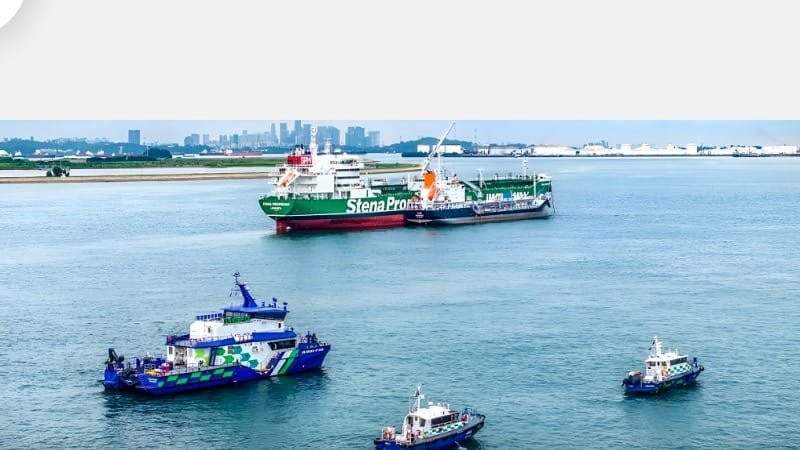
The Maritime and Port Authority of Singapore (MPA) has officially opened applications for licences to supply methanol as a marine fuel in Singapore. This marks a significant step forward in the country’s ongoing efforts to support decarbonisation in the shipping industry.
The move follows the finalisation of Singapore’s methanol bunkering licensing framework and standards, which have been developed through extensive consultation, incorporating over 50 proposals submitted under MPA’s Expression of Interest (EOI) launched in December 2023. This is in addition to methanol bunkering trials and operations that have been conducted in Singapore since 2023.
With the increased focus on sustainable maritime fuels, the introduction of a methanol bunkering licence is expected to play a pivotal role in decarbonising shipping operations in the region. The MPA’s new framework is designed to ensure the safe, reliable, and sustainable supply of methanol as a marine fuel, setting the stage for a new era in maritime fuel operations in Singapore.
Key Licensing Requirements:
- End-to-End Supply Solution:
- Licensees must implement a comprehensive methanol bunkering supply solution, acting as both bunker suppliers and bunker craft operators. This includes securing a steady supply of methanol to Singapore, managing quality assurance protocols, ensuring proper storage and handling, and establishing emergency response measures.
- Additionally, licensees are required to own and operate at least one IMO Type 2 chemical tanker. (These tankers are essential for safe transport and delivery of methanol, with specifications including a deadweight of 20,000 tonnes or above for crude oils and other fuels, or 30,000 tonnes or above for other oils, with segregated ballast tank requirements.)
- Methanol Supply Compliance:
- Licensees must supply methanol as a marine bunker fuel to vessels operating in Singapore for the licensing period from 1 January 2026 to 31 December 2030.
- The supplied methanol must meet stringent carbon intensity standards on a well-to-wake basis. To further support international shipping’s decarbonisation goals, licensees must demonstrate a transparent chain of custody methodology to track emissions from source to delivery. Additionally, they must possess operational readiness and emergency response preparedness.
- Adoption of New Technologies:
- Licensees will be expected to implement mass flow meters, digital bunkering systems, and meet the new standards for methanol bunkering in Singapore. This is part of the ongoing efforts to modernise and enhance the accuracy and efficiency of bunkering operations.
- Potential Pilots and Exercises:
- MPA may invite selected licensees to participate in methanol bunkering pilots and exercises in 2025 to further test and refine operational standards before the full-scale launch.
Companies interested in supplying methanol as a marine fuel in Singapore can refer to MPA’s official website for more details. Applications must be submitted to MPA’s email at bsd(at)mpa.gov.sg by 28 May 2025.
Technical Reference and Standards for Methanol Bunkering:
- TR129 – Technical Reference for Methanol Bunkering:
- Launched in early 2025, TR129 provides detailed guidelines on the custody transfer requirements, operational protocols, safety standards, and crew training competencies needed for methanol bunkering. This reference document serves as a crucial tool for potential licence applicants to ensure they meet Singapore’s regulatory standards.
- Standards for Port Limit Methanol Bunker Tankers:
- To ensure safe and efficient operations, the Standards for Port Limit Methanol Bunker Tankers have been developed by MPA in consultation with industry stakeholders. These standards focus on the safety, redundancy of propulsion, manoeuvrability, and vapour management systems for bunker tankers operating within Singapore’s port limits.
About Singapore Maritime Week 2025
Singapore Maritime Week (SMW) is an annual gathering that brings together key players from the global maritime community to tackle industry challenges and explore new opportunities for growth and sustainability. Driven by MPA in collaboration with industry stakeholders, research bodies, and educational institutions, SMW features conferences, dialogues, and forums to foster the exchange of ideas and promote Singapore’s position as a leading global maritime hub.
About the Maritime and Port Authority of Singapore (MPA)
The MPA was established in 1996 with the mission to position Singapore as a premier global hub port and international maritime centre. It plays a critical role as a regulator, planner, and champion of maritime safety, security, and environmental sustainability. MPA has also been a driving force behind Singapore’s efforts in digitalisation and decarbonisation within the maritime sector, representing Singapore in international forums like the International Maritime Organization (IMO).
Through close partnerships with the maritime industry, research communities, and various agencies, MPA continues to ensure Singapore remains at the forefront of maritime innovation and sustainable growth.