

Maritime history was made at the Fincantieri shipyard in Ancona with the launch of the “Viking Libra,” the world’s first cruise vessel engineered to run on liquefied hydrogen and fuel cells. This 54,300 GT pioneer, developed through the long-standing partnership between Fincantieri and Viking, represents a paradigm shift in bunkering requirements for the luxury cruise sector. Designed for zero-emission operations in the world’s most sensitive marine environments, the Viking Libra is scheduled for delivery in late 2026, marking the dawn of the hydrogen propulsion era.
Ancona, Italy | March 19, 2026 – Fincantieri has reached a historic milestone in the maritime energy transition with the launch of the Viking Libra at its Ancona shipyard. This vessel represents a definitive shift in the global orderbook as the world’s first cruise ship powered by a hydrogen-based propulsion system.
Scheduled for delivery in late 2026, the Viking Libra is not merely another addition to the luxury cruise market; it is a proof-of-concept for the future of zero-emission bunkering and cryogenics in large-scale passenger shipping.
The Hydrogen Revolution: Fincantieri and Viking Redefine Propulsion Limits
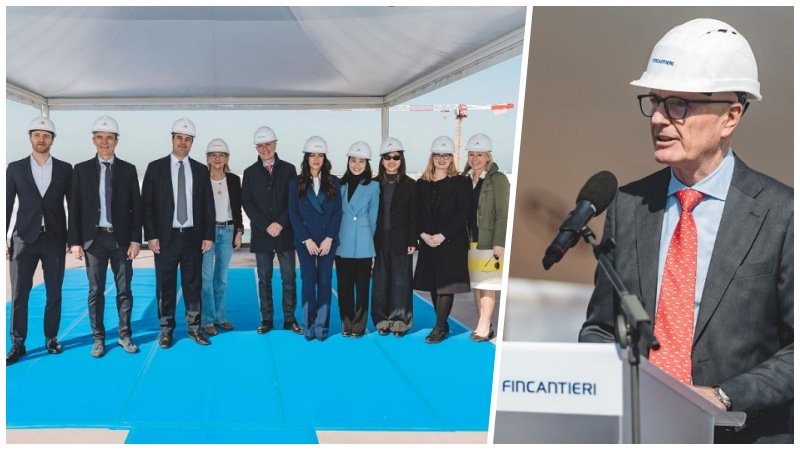
The launch of the Viking Libra is not just a milestone for the Ancona shipyard; it is a signal to the global bunkering industry that the transition to liquefied hydrogen (LH2) is no longer theoretical. Attended by Gilberto Tobaldi, Director of the Ancona Shipyard, and the Viking project team, the ceremony celebrated the culmination of a decade of R&D into zero-emission navigation.
Technical Profile: The LH2 Advantage
The Viking Libra stands as a technical marvel in the “Operations Excellence” program, blending luxury with cutting-edge physics:
- Propulsion System: A world-first hybrid setup based partially on liquefied hydrogen and fuel cells.
- Environmental Capability: The ship is engineered for full zero-emission navigation, allowing it to enter restricted ecological zones (ECAs) and sensitive fjords where traditional combustion is increasingly prohibited.
- Dimensions: 239 meters in length, with a gross tonnage of approximately 54,300 tons.
- Capacity: 499 staterooms accommodating up to 998 passengers, maintaining Viking’s signature small-ship luxury experience while removing the carbon footprint.
Strategic Partnership: A 26-Ship Legacy
The collaboration between Fincantieri and Viking, which began in 2012, has evolved into the most robust partnership in the cruise sector. With the Viking Libra launch, the overall portfolio between the two groups, including orders, signed contracts, and options, now reaches a staggering 26 units. This long-term commitment provides the market stability needed for bunker suppliers to begin investing in hydrogen refueling infrastructure at major cruise hubs.
Ancona: The Engine of Innovation
The Ancona shipyard, spanning 360,000 m2, has become the Group’s laboratory for high-tech construction. The site’s strategic role is underlined by:
- Production Might: A capacity of 60,000 GT and lifting systems capable of moving 500-ton sections.
- Operations Excellence: The yard is integrating Robotics and AI to enhance precision in hull construction (currently 1,200 tons capability).
- Workforce: A daily commitment from 3,700 workers who have delivered over 20 ships since 2009.
Bunker Industry Perspective: The Hydrogen Pivot
For the bunkering world, the Viking Libra is a “proof of concept” for high-density passenger vessels. Hydrogen fuel cells offer a silent, vibration-free, and water-vapor-only exhaust solution. As the ship enters the final outfitting phase for its late 2026 delivery, the focus now shifts to the supply chain: where and how will these vessels “bunker” liquefied hydrogen at scale?
This launch proves that the technology is ready; the next “giant leap” belongs to the infrastructure providers.
Vessel Specifications at a Glance
| Feature | Detail |
| Vessel Name | Viking Libra |
| Primary Fuel | Liquefied Hydrogen (LH2) / Fuel Cells |
| Gross Tonnage | 54,300 GT |
| Length | 239 Meters |
| Passenger Capacity | 998 |
| Shipyard | Fincantieri (Ancona) |
| Delivery Date | Late 2026 |
Fincantieri: Shaping the Future of the Global Bunkering Landscape
As the maritime industry navigates the most significant energy transition in its history, Fincantieri has emerged as a primary architect of future fuel demand. With a production network of 18 shipyards and a backlog extending into the next decade, the Italian shipbuilding giant is no longer just building vessels; it is defining the infrastructure requirements for the next generation of bunkering.
The Multi-Fuel Orderbook: What to Watch
Fincantieri’s current strategy provides a clear roadmap for bunker suppliers. The Group is moving beyond traditional HFO and MGO, focusing on three key pillars:
- Hydrogen Leadership: In March 2026, Fincantieri reached a historic milestone with the “float out” of the Viking Libra at its Ancona yard. Scheduled for delivery in late 2026, it is the world’s first cruise ship powered by liquid hydrogen (LH2) and fuel cells. This project signals the start of a new bunkering segment requiring specialized cryogenic handling and modular storage solutions.
- The Methanol Pivot: Fincantieri is currently delivering a series of “methanol-ready” vessels, including hybrid Commissioning Service Operation Vessels (CSOVs). These ships are designed to bridge the gap until green methanol supply reaches global scale.
- LNG and Beyond: The Group continues to dominate the LNG-powered cruise sector, recently securing a multi-billion euro contract with Carnival Corporation for a new class of 230,000 GT LNG-powered “mega-ships” due for delivery between 2029 and 2033.
Source: Fincantieri