
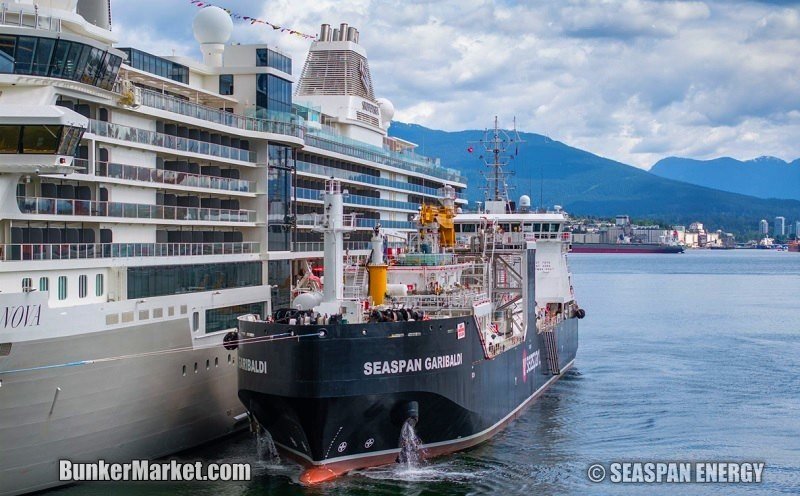
In a groundbreaking development for the maritime fuel sector, Seaspan Energy has successfully completed the first-ever LNG (liquefied natural gas) bunkering of a cruise ship at the Port of Vancouver. The luxury vessel Silver Nova, operated by Silversea Cruises, was bunkered by Seaspan Garibaldi, Seaspan Energy’s state-of-the-art LNG bunkering vessel, as it prepared to depart for Alaska.
This pivotal event represents a major advancement in the shift away from traditional marine fuels such as heavy fuel oil and marine diesel, supporting global and local efforts to reduce greenhouse gas emissions and adopt cleaner energy alternatives across the maritime industry.
Table of Contents
LNG Bunkering: A First for Cruise at Port of Vancouver
This marks the first time a cruise ship has bunkered with LNG at the Port of Vancouver, a development made possible through the collaborative efforts of Seaspan Energy, the Vancouver Fraser Port Authority, and fuel supplier FortisBC. LNG is the first alternative marine fuel to be available in significant quantities for international shipping and is now approved for local bunkering at Canada’s largest and most diverse port.
The successful bunkering of Silver Nova signals the beginning of a new era in cruise shipping from Vancouver. The vessel, designed with sustainability at its core, will now benefit from LNG’s substantially lower emissions profile compared to conventional marine fuels, including a significant reduction in nitrogen oxides (NOₓ), sulfur oxides (SOₓ), particulate matter, and carbon dioxide.
Port of Vancouver Steps into Clean Fuel Future
Captain Shri Madiwal, Vice President of Operations and Supply Chain at the Vancouver Fraser Port Authority, emphasized the port’s strategic commitment to supporting alternative fuels:
“We all have a crucial role to play enabling the energy transition and as a port authority our focus is on putting the infrastructure and processes in place to ensure visiting ships can move beyond traditional marine fuels and embrace alternative fuels like LNG,” said Madiwal.
He noted that LNG’s introduction sets the stage for future adoption of even more advanced fuels such as ammonia and methanol, aligning with the International Maritime Organization’s goal of net-zero emissions by 2050.
The port has already been offering biofuels in limited quantities for several years, but LNG is the first widely available diesel alternative for deep-sea vessels at Vancouver. This first cruise LNG bunkering reflects the port’s larger strategy to be a leader in decarbonizing maritime transport.
Seaspan Energy Leading the Charge
As the first accredited supplier of LNG marine fuel at the Port of Vancouver, Seaspan Energy is rapidly establishing itself as a central player in West Coast alternative fuel services. The company now operates three LNG bunkering vessels and has already conducted several successful operations this year for various vessel types, including container ships, car carriers, and bulk cargo vessels.
Harly Penner, President of Seaspan Energy, highlighted the significance of this milestone:
“We are proud to play a key role in advancing the shift to alternative marine fuels in North America’s fourth largest port and look to become a major centre for LNG bunkering,” said Penner. “This first LNG bunkering of a cruise ship at the port is a milestone we are excited to share with the Port of Vancouver, as it signals meaningful progress in the industry’s decarbonization efforts.”
Seaspan’s LNG operations follow a stringent port authority accreditation process involving international best practices and comprehensive safety assessments, ensuring the safe integration of LNG fueling at port terminals.
Fuel Supplied by FortisBC
The LNG used in this historic bunkering operation was supplied by FortisBC, which has been instrumental in supporting the development of LNG infrastructure in British Columbia.
Mike Leclair, Vice President of Major Projects and LNG at FortisBC, said:
“FortisBC is proud to be a part of the growth of LNG marine fuelling at the Port of Vancouver by providing fuel for Seaspan Energy’s first cruise ship bunkering event. We look forward to working with Seaspan Energy and Port of Vancouver operators to support the success of this initiative, driving innovation in the maritime industry.”
Cruise Industry’s Broader Environmental Commitment
Vancouver’s cruise sector is recognized as one of the most environmentally proactive in the world. More than 80% of cruise calls in 2024 were shore power enabled, allowing ships to plug into B.C.’s clean hydroelectric grid rather than run diesel generators while docked. Since 2009, shore power usage has cut port-related cruise emissions by over 45,000 tonnes of GHGs.
Cruise lines have also actively participated in the ECHO Program, a port authority-led initiative that reduces underwater noise to protect endangered whales. In 2024, over 90% of cruise ships engaged in voluntary slowdowns in critical habitats like the Salish Sea.
Five cruise lines received Blue Circle Awards from the port authority in 2024 for their leadership in environmental protection.
Port of Vancouver: Economic and Environmental Engine
With 301 cruise calls scheduled in 2025, each injecting approximately $3 million into the local economy, Vancouver continues to serve as a major hub for Alaska-bound cruises. As a homeport, Vancouver is where ships are provisioned, maintained, and now—bunkered with alternative fuels like LNG.
The Port of Vancouver, administered by the Vancouver Fraser Port Authority, is Canada’s largest and most diversified port, handling nearly $300 billion in trade with up to 170 countries annually. It supports over 132,000 supply chain jobs across the country.
About the Vancouver Fraser Port Authority
The Vancouver Fraser Port Authority is a non-share federal agency responsible for stewarding the lands and waters that make up the Port of Vancouver. Operating under the Canada Marine Act, it reinvests all profits into infrastructure and environmental initiatives and works closely with over 35 Coast Salish First Nations to ensure sustainable port development.
About Seaspan Energy
Seaspan Energy is a division of Seaspan Marine Transportation, a leading marine services provider on the West Coast of North America. Seaspan’s operations span ship assist, coastal and deep-sea transportation, ferry services, and marine fuel bunkering, with a legacy of over 100 years supporting Pacific Northwest commerce.
Source Seaspan Energy