

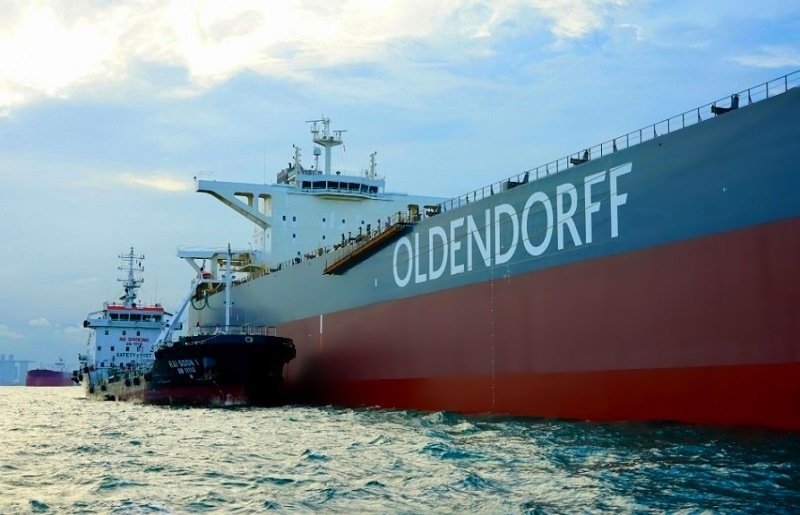
Petrobras, through its Singapore-based subsidiary, Petrobras Singapore, has partnered with Vale, a global mining leader, to test a new marine biofuel blend containing renewable content. This collaboration focuses on the supply of Very Low Sulfur (VLS) B24 fuel, which incorporates 24% second-generation biodiesel, for a chartered vessel operated by Vale. The test took place on April 22, 2025, with the bulk carrier Luise Oldendorff being refueled in Singapore. This marks a significant milestone in the joint efforts of the two companies to reduce the environmental impact of maritime shipping.
Table of Contents
Collaboration Details: Testing of VLS B24 with 24% Biodiesel
The VLS B24 fuel was formulated by Petrobras Singapore using a mix of 76% fossil fuel oil sourced from Petrobras’ refineries and 24% UCOME (Used Cooking Oil Methyl Ester), a biofuel made from used cooking oil collected locally. This blend represents a significant step towards more sustainable marine fuel options. The test was conducted with the support of Oldendorff Carriers, demonstrating the practical application of renewable fuels in the shipping industry. The fueling process took place in Singapore, marking the completion of the test on April 22, 2025.
Sustainability Certification: Petrobras Singapore’s ISCC EU Certification
Petrobras Singapore holds the prestigious ISCC EU certification, which ensures that the fuel meets rigorous sustainability standards. This certification guarantees that the entire supply chain for the biofuel, from production to delivery, follows strict environmental and sustainability criteria. The use of recycled cooking oil in the biofuel further highlights the company’s commitment to reducing waste and supporting a circular economy. The certification reinforces the credibility of the renewable fuel, making it a reliable and sustainable choice for maritime shipping.
Strategic Partnership: Advancing Decarbonization Efforts
This renewable content bunker fuel trail is part of a broader strategic partnership between Petrobras and Vale, both of which are committed to advancing decarbonization in their respective industries. The collaboration aims to deliver competitive products while contributing to global sustainability goals.
Petrobras President, Magda Chambriard, expressed the company’s dedication to developing more sustainable fuels, stating, “We are constantly developing more sustainable fuels and fulfilling our commitment to decarbonizing our operations. This partnership with Vale is a key step in our goal to improve our production and logistics capacity, delivering greener products and reinforcing our decarbonization strategy.”
Commitment to Decarbonization: Petrobras and Vale’s Shared Goals
Vale’s CEO, Gustavo Pimenta, emphasized the importance of reducing greenhouse gas emissions in maritime transport, stating, “Vale is fully committed to decarbonizing its operations. Our shipping division has been exploring various options to cut greenhouse gas emissions from maritime transport. This includes developing multi-fuel solutions for both new and existing ships that transport our products worldwide. Petrobras plays a crucial role in this process.” Both Petrobras and Vale have long-term commitments to decarbonizing their operations.
This partnership exemplifies how the two companies are aligning their sustainability efforts to tackle climate change and transition to a low-carbon economy.
Vale’s Maritime Emissions Reduction Initiatives
The fuel test is part of Vale’s broader efforts to reduce its emissions from maritime transport, an area that represents a significant portion of its carbon footprint. As part of its sustainability strategy, Vale aims to reduce its Scope 1 and 2 emissions by 33% by 2030. Furthermore, the company has committed to a 15% reduction in Scope 3 emissions, which are associated with its value chain, by 2035. These initiatives are aligned with the targets set by the International Maritime Organization (IMO) to lower emissions from the global shipping industry.
Petrobras’ Investment in Energy Transition and Decarbonization
For Petrobras, the commercialization of renewable-content bunker fuel supports its strategy to offer new, low-carbon products. As part of its Business Plan for 2025-2029, Petrobras has allocated US$ 16.3 billion for energy transition initiatives. This investment will fund projects in low-carbon energy, decarbonization of operations, and research and development (R&D) across all business sectors. The amount represents 15% of the company’s total capital expenditure for the next five years, marking a 42% increase compared to the previous investment plan. This reflects Petrobras’ strengthened commitment to sustainability and innovation.
Impact on the Global Maritime Industry: A Step Toward Sustainable Shipping
This partnership between Petrobras and Vale represents a significant development in the global shipping industry’s push for sustainability. Through the continued testing and implementation of alternative fuels, the two companies are contributing to the wider goal of reducing carbon emissions in maritime transport. By exploring renewable fuel options, they are helping to drive the transition to more sustainable shipping practices that align with international emissions reduction goals. The ongoing collaboration is a critical step in both Petrobras and Vale’s efforts to lead the way in environmental responsibility and sustainable energy solutions.
About Petrobras
Petrobras, officially known as Petróleo Brasileiro S.A., stands as Brazil’s largest energy corporation and one of the world’s largest oil and gas companies by market capitalization. With operations spanning across exploration, production, refining, and distribution, Petrobras plays a pivotal role in Brazil’s economy and global energy markets. The company has a proven track record in technological innovation and sustainable practices, exemplified by its pioneering efforts in deep-water oil exploration and commitment to reducing carbon emissions. Petrobras continues to lead the way in advancing Brazil’s energy independence and promoting environmental stewardship in the energy sector.
Source Petrobras