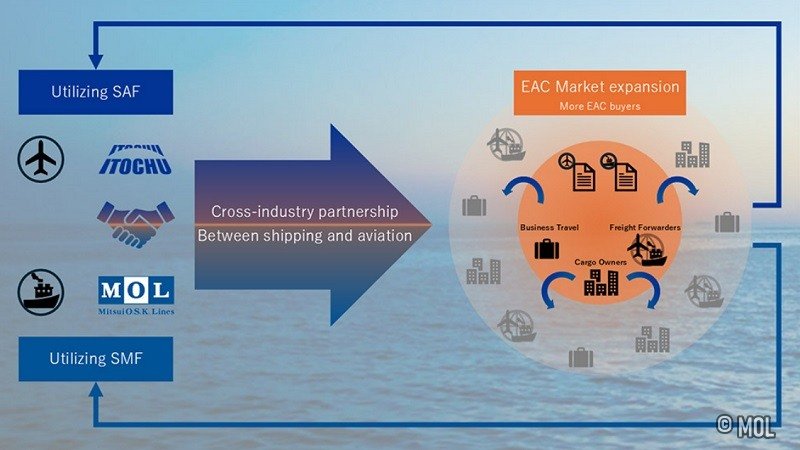
Tokyo, Japan | January 09, 2026 – Japanese shipping giant Mitsui O.S.K. Lines (MOL) and trading house ITOCHU Corporation have signed a Memorandum of Understanding (MOU) to pioneer a strategic partnership focused on Environmental Attribute Certificates (EACs). The move marks Japan’s first collaborative model bridging maritime and aviation sectors to tackle the complex challenge of Scope 3 emissions.
Table of Contents
The Mechanism: Decoupling Carbon from Physical Flow
Unlike traditional bunkering where a specific vessel burns a specific fuel, this partnership utilizes a “Book and Claim” model. This allows the environmental benefits (attributes) of low-carbon fuels, such as Bio-LNG or Ammonia for shipping and Sustainable Aviation Fuel (SAF) for planes, to be digitized into certificates (EACs).
These certificates can then be traded independently of the physical fuel, enabling companies to claim emission reductions even if their cargo wasn’t on the specific “green” voyage.
A Mutual Trade Demonstration
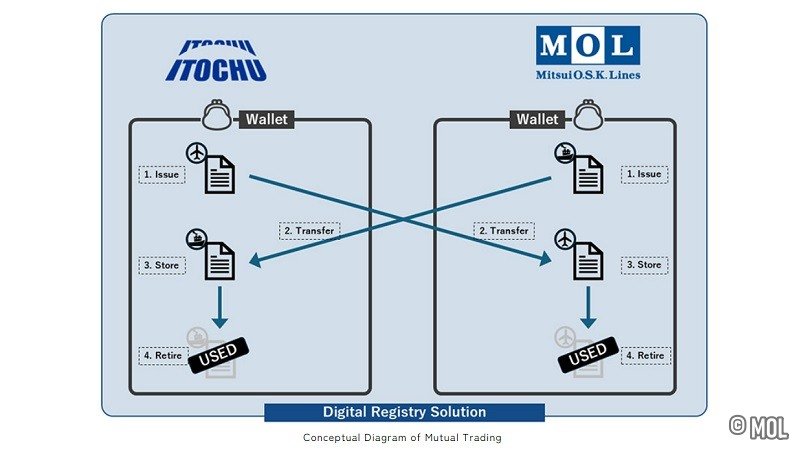
To kickstart the alliance, both companies completed a mutual exchange of certificates:
- MOL purchased air transport EACs from ITOCHU to offset emissions from its employees’ business travel.
- ITOCHU purchased maritime EACs from MOL to reduce the carbon footprint of its sea freight logistics.
The transactions were executed via the 123Carbon digital platform, a Netherlands-based blockchain registry that ensures traceability and prevents “double-counting”, a critical concern for bunkering transparency.
Why This Matters for the Bunker Industry
For the marine fuel sector, this represents a shift in how “green” value is monetized.
- Revenue for High-Cost Fuels: By selling EACs, shipowners can recover the price premium of alternative fuels (like green methanol or biofuels) from cargo owners who are willing to pay for Scope 3 reductions.
- Bridging the Supply Gap: It allows decarbonization to scale even in regions where physical green bunker infrastructure is not yet available.
- Cross-Industry Synergy: By linking with ITOCHU’s SAF expertise, MOL is creating a “total logistics” green solution that goes beyond just the pier.
“Reducing Scope 3 emissions is an unavoidable challenge,” MOL stated. “One of the key barriers is the difficulty of ensuring traceability given the complexity of supply chains.”
Looking Ahead
This partnership is a core component of the “BLUE ACTION NET-ZERO ALLIANCE” launched by MOL in 2025. As shipping moves toward FuelEU Maritime and IMO 2030/2050 targets, the ability to trade verified carbon attributes will likely become as essential as the physical bunkering process itself.
About 123Carbon
123Carbon is a Netherlands-based startup dedicated to decarbonizing the logistics sector through innovative solutions and platforms that enable the tracking, management, and allocation of GHG emission reductions.
About ITOCHU Corporation
The history of ITOCHU Corporation dates to 1858 when the Company’s founder Chubei Itoh commenced linen trading operations. Since then, ITOCHU has evolved and grown over 160 years. With approximately 90 bases in 61 countries, ITOCHU, one of the leading sogo shosha, is engaging in domestic trading, import/export, and overseas trading of various products such as textile, machinery, metals, minerals, energy, chemicals, food, general products, realty, information and communications technology, and finance, as well as business investment in Japan and overseas.
About Mitsui O.S.K. Lines, Ltd. (MOL)
MOL is a global leader in shipping, operating over 800 ships worldwide. Its diverse fleet includes bulk carriers, liquefied natural gas carriers, Ro-Ro car carrier ships, and oil tankers, among others. Beyond traditional shipping, MOL also engages in social infrastructure businesses, including real estate, terminal and logistics, and offshore wind power. With one of the largest merchant fleets and 140 years of history, MOL aims to be a resilient corporate group that provides new value to all stakeholders.
Source Mitsui O.S.K. Lines