MB Energy, Covestro and Fertiglobe have signed an MoU to establish a comprehensive ammonia supply chain connecting global production to Germany through a proposed import terminal in Hamburg. The tripartite collaboration evaluates conventional, lower-carbon, and renewable ammonia opportunities to feed industrial manufacturing, meet hydrogen requirements, and reinforce European supply resilience. By leveraging Fertiglobe’s export scale, MB Energy’s logistical infrastructure, and Covestro’s chemical demand, the initiative aims to advance regional energy transformation and align with strict EU regulatory frameworks.
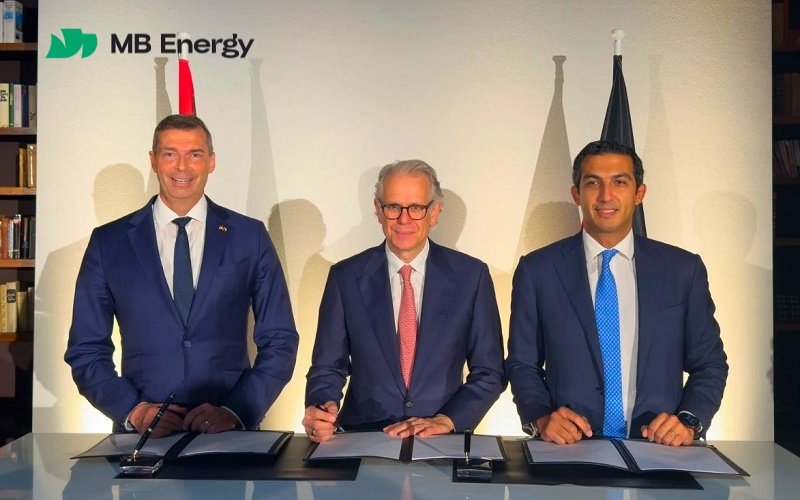
Hamburg | September 11, 2026 – In a major development bolstering European industrial resilience and the clean energy transition, Covestro, Fertiglobe, and MB Energy have signed a landmark Memorandum of Understanding (MoU). Formally inked during the historic state visit to Germany by His Highness Sheikh Mohamed bin Zayed Al Nahyan, President of the United Arab Emirates, the agreement establishes a tripartite framework to explore, develop, and secure a robust ammonia supply chain feeding Germany and the broader European market.
The strategic collaboration unites three complementary powerhouses across the energy and chemical sectors: Fertiglobe, a global pacesetter in ammonia and urea production; MB Energy, an independent integrated energy and infrastructure specialist; and Covestro, a world-leading high-performance polymer manufacturer reliant on steady chemical feedstocks.
Bridging Global Production with European Industry
Under the terms of the MoU, the partners will evaluate the commercial, logistical, and technical viability of importing, storing, distributing, and off-taking ammonia. A focal point of the agreement centers on MB Energy’s proposed import terminal at Blumensand in Hamburg. Fertiglobe, the world’s largest seaborne exporter of urea and ammonia, will investigate supplying volumes through the hub, alongside exploring potential equity investment in the Hamburg terminal infrastructure itself.
For Covestro, a major industrial consumer of ammonia, the partnership represents a critical stride toward securing reliable feedstocks for polymer manufacturing and tapping into viable hydrogen supply pathways.
The alliance is engineered to target multiple tiers of the market:
- Conventional & Low-Carbon Molecules: Assessing conventional supplies alongside lower-carbon and renewable green ammonia.
- Regulatory Alignment: Ensuring strict compliance with evolving European frameworks, including the EU Carbon Border Adjustment Mechanism (CBAM) and regional low-carbon hydrogen mandates.
- Multimodal Logistics: Mapping out onward distribution networks utilizing a flexible combination of pipelines, rail transport, and inland barges to reach industrial clusters across Europe.
Executive Perspectives: Building the Infrastructure of Tomorrow
Industry leaders emphasized that Europe’s energy transformation hinges just as much on physical logistics and supply security as it does on low-carbon molecule production.
“This MoU marks an important step in strengthening Fertiglobe’s connectivity with industrial customers in Europe and expanding routes to market for our global ammonia platform,” said Ahmed El-Hoshy, CEO of Fertiglobe. “Together with Covestro and MB Energy, we see an opportunity to support the development of a reliable and competitive ammonia supply chain through Hamburg, in line with our Grow 2030 focus on customer proximity and disciplined growth in lower-carbon ammonia.”
For Covestro, diversifying import routes is deeply tied to the company’s long-term climate-neutrality roadmap.
“Ammonia is an essential building block for the chemical industry, and its carbon footprint matters for the transformation of our production,” added Dr. Markus Steilemann, CEO of Covestro. “Securing reliable, competitive and increasingly low-carbon ammonia is therefore a strategic priority for Covestro. Together with Fertiglobe and MB Energy, we are exploring an additional supply route that could support our path toward climate neutrality while strengthening supply resilience in Germany and Europe.”
MB Energy underscored the indispensable role of physical import hubs in turning clean-energy ambitions into industrial reality.
“Europe’s energy transition depends not only on low-carbon molecules, but on reliable infrastructure to reach industrial customers at scale,” noted Jonathan Perkins, CEO of MB Energy. “This MoU brings together complementary capabilities across supply, logistics and demand to explore a credible ammonia value chain through Hamburg. With MB Energy’s long-standing infrastructure and logistics capabilities, we aim to strengthen supply security while enabling the progressive introduction of lower-carbon ammonia in Germany and across Europe.”
Strategic Significance for the Bunkering and Maritime Energy Sectors
Beyond its direct application as a chemical feedstock and hydrogen carrier, the development of major import terminals like the proposed Blumensand facility highlights Hamburg’s expanding role as a premier energy gateway for Northern Europe. As maritime shipping and heavy industries increasingly look toward ammonia as a viable zero-emission marine fuel and energy vector, establishing large-scale import, storage, and bunkering-ready infrastructure lays the vital groundwork for Europe’s multi-commodity future.
About the Companies
MB Energy
The MB Energy Group, founded in 1947 and headquartered in Hamburg, is an independent, integrated energy company with operations across Europe, the United States, and Singapore. The company engages in the import, storage, distribution, and marketing of petroleum products, LPG, chemicals, and biofuels. With decades of industry experience and a forward-looking approach, MB Energy plays an active role in the global energy landscape and supports the transition to lower-emission fuels through the development and provision of future-oriented alternatives.
Fertiglobe
Fertiglobe is the world’s largest seaborne exporter of urea and ammonia combined, and an early mover in sustainable ammonia. Fertiglobe’s production capacity comprises 6.6 million tons of urea and merchant ammonia produced at four subsidiaries in the UAE, Egypt, and Algeria, making it the largest producer of nitrogen fertilizers in the Middle East and North Africa (MENA). It benefits from direct access to six key ports and distribution hubs on the Mediterranean Sea, the Red Sea, and the Arab Gulf. Headquartered in Abu Dhabi and incorporated in the Abu Dhabi Global Market (ADGM), Fertiglobe employs more than 2,700 people. Fertiglobe is listed on the Abu Dhabi Securities Exchange (ADX) under the symbol “FERTIGLB” and ISIN “AEF000901015”.
Covestro
Covestro is one of the world’s leading manufacturers of high-quality polymer materials and their components. With its innovative products, processes, and methods, the company helps enhance sustainability and quality of life in many areas. Covestro supplies customers around the world in key industries such as mobility, building and living, and the electrical and electronics sector. In addition, polymers from Covestro are used in sectors such as sports and leisure, telecommunications, healthcare, and the chemical industry itself. The company is geared entirely toward the circular economy. Furthermore, Covestro aims to achieve climate neutrality for its Scope 1 and Scope 2 emissions by 2035, with the Group’s Scope 3 emissions also set to be climate-neutral by 2050. Covestro generated sales of EUR 12.9 billion in fiscal year 2025. At the end of 2025, the company operated 46 production sites worldwide and employed approximately 17,600 people (calculated as full-time equivalents). You can find more information on the Covestro website.
Source: MB Energy