
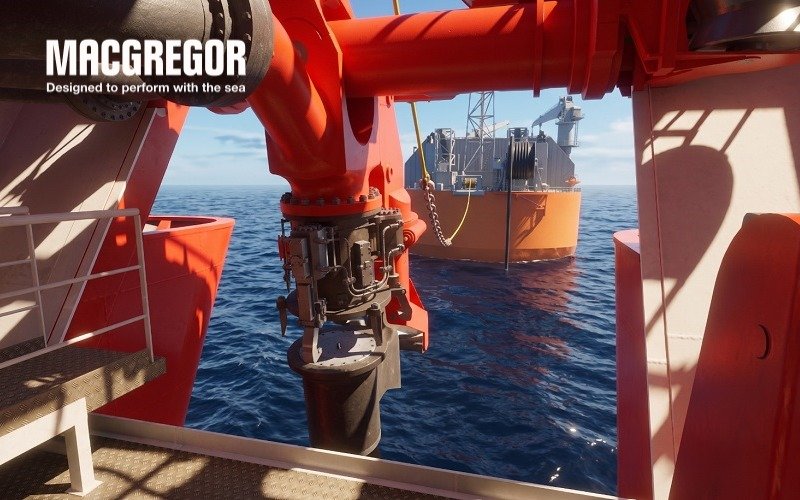
MacGregor has introduced its innovative Liquid Carbon Dioxide Bow Transfer System to enable direct ship-to-well and ship-to-rig transfer, eliminating the need for costly onshore buffer facilities. Building upon five years of proven bow-loading technology, the system utilizes SINTEF-tested seals capable of withstanding extreme temperatures down to -57°C and heavy sea states. Currently undergoing DNV qualification ahead of mid-2027 prototype testing, the hardware supports four distinct system architectures to optimize offshore carbon capture and storage projects.
Finland | August 24, 2026 – MacGregor has officially unveiled its new Liquid Carbon Dioxide (LCO₂) Bow Transfer System (BTS), a breakthrough solution designed to facilitate safe, reliable, and direct ship-to-well and ship-to-rig transfer of LCO₂ across harsh offshore operating conditions.
By creating a direct, flexible connection between LCO₂ carriers and offshore injection sites, the innovative system eliminates the operational necessity for costly intermediate onshore buffer storage and conditioning facilities that current standard CCS value chains frequently require.
Heritage Engineering Meets Low-Temperature Demands
The newly developed BTS is built upon MacGregor’s legendary Bow Loading System (BLS) architecture, which has delivered reliable performance to the global oil and gas sector since the 1970s. Approximately 79% of the new system draws directly from this field-proven offshore technology. The remaining 21% consists of carefully engineered, targeted modifications specifically designed to manage the unique, highly volatile properties of LCO₂.
To ensure extreme material resilience, specialized seal materials for the system were rigorously tested in collaboration with renowned Scandinavian research organization SINTEF. The testing simulated rapid gas decompression and severe LCO₂ conditions, confirming that the seals successfully maintain structural integrity through repeated pressure cycles and plunging temperatures as low as -57°C, the critical threshold below which CO₂ transitions out of its liquid state.
Furthermore, the system is engineered to deliver:
- Uninterrupted, secure handling in heavy sea states featuring significant wave heights of five to six metres.
- Reliable sealing against water ingress at operational depths of up to 150 metres.
“Our robust new design solves the challenges of securing reliable and safe connection, transfer, and disconnection in all seasons, even in severe weather, without delays or interruptions,” said Øyvind Solli, Development Programs Manager at MacGregor. “This ensures zero disruption across the value chain, directly supporting the business case for CCS projects.”
Flexible Architectures and Rigorous Industry Qualification
To accommodate diverse offshore geological formations, MacGregor’s hardware serves as the foundation for four distinct system architectures. These span low- and medium-pressure (30–60 bar) configurations as well as high-pressure (300 bar) direct reservoir injection frameworks via seabed swivels or disconnectable turrets, granting operators ultimate design flexibility to match specific field criteria.
MacGregor is actively advancing the commercial readiness of the BTS. After joining the EU-funded COREu research and innovation consortium in early 2025, the company entered a comprehensive technology qualification process with DNV.
The initial planning phase, encompassing the qualification basis, technology assessment, formal threat assessment, and qualification plan, has been successfully completed. Full prototype testing and physical demonstration milestones are slated for mid-2027.
“At this stage, we have successfully identified all risks associated with our equipment and its application for LCO₂ transfer,” Solli added. “DNV has formally acknowledged these findings, and together, we have established a framework for managing and mitigating the identified risks, including the specific methods required to provide the evidence for final verification.”
Public Debut at ONS 2026
MacGregor is presenting the LCO₂ Bow Transfer System to the global energy and maritime community this week at ONS 2026 in Stavanger, Norway (August 24–27, Hall 5, Stand 5540), where industry stakeholders can inspect the engineering models and discuss deployment strategies for upcoming offshore carbon transport networks.
About MacGregor
MacGregor enables sustainable global maritime and offshore operations by maximizing efficiency in cargo and load handling. With decades of experience, a global presence, and a strong portfolio of innovative technologies and services, MacGregor creates lifetime value for its customers.
MacGregor solutions are designed to perform with the sea, helping customers enhance safety, reduce environmental impact, and optimize operational efficiency from newbuilding to upgrades and modernizations. In 2025, MacGregor’s sales totaled approximately EUR 830 million, and it employs about 2,000 people across 30 countries.
Source: MACGREGOR