
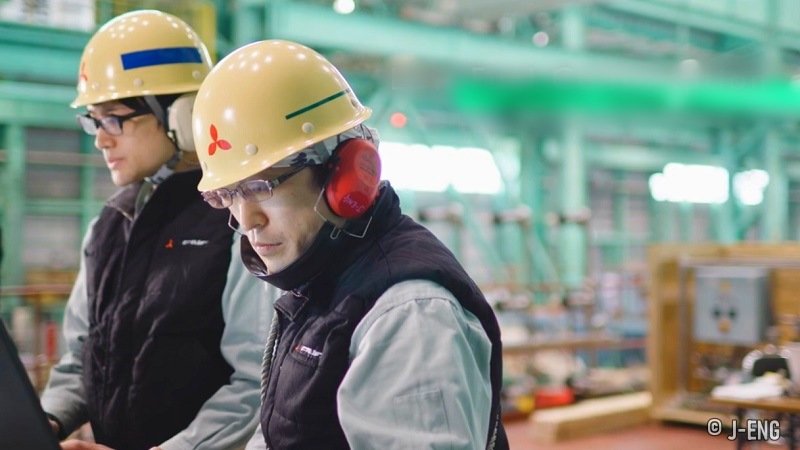
J-ENG has granted Akasaka Diesels a new license to manufacture and sell the world-leading LSJA series ammonia-fueled engines. The renewed agreement strengthens Japan’s UE engine network and accelerates the commercialization of hydrogen (LSGH) and methanol (LSJM) propulsion technologies for the global shipping industry.
Tokyo, Japan | March 9, 2026 – In a move that cements Japan’s leadership in the next-generation maritime engine market, Japan Engine Corporation (J-ENG) has officially renewed its long-standing license agreement with Akasaka Diesels Limited. The high-impact deal expands Akasaka’s manufacturing portfolio to include J-ENG’s world-first ammonia-fueled low-speed two-stroke engines (LSJA series).
This agreement marks a pivotal shift for the “UE family”, the global network of licensees for the only Japanese-designed marine engines, as it moves from traditional heavy fuel oil (HFO) toward a multi-fuel, decarbonized future.
The LSJA Series: A World-First in Ammonia Propulsion
The centerpiece of the renewed contract is the LSJA series, an ammonia-fueled engine technology that J-ENG completed in 2025, ahead of global competitors. The engine, specifically the 7UEC50LSJA model, has already undergone rigorous testing, demonstrating:
- 95% Reduction in GHG: Achieving a 95% co-firing rate of ammonia.
- Near-Zero Ammonia Slip: Utilizing High-Pressure Selective Catalytic Reduction (SCR) to eliminate unburned ammonia emissions.
- Thermal Efficiency: Matching or exceeding the performance of traditional HFO engines.
By granting Akasaka the rights to manufacture and sell this series, J-ENG is effectively scaling the commercial availability of carbon-free propulsion at a time when the IMO’s 2030 and 2040 GHG reduction targets are looming over shipowners.
A Roadmap for Hydrogen and Methanol
The collaboration extends beyond ammonia. J-ENG confirmed it is aggressively diversifying its “Next-Generation Fueled Engine” portfolio to ensure Japanese shipbuilding remains competitive against Chinese and South Korean rivals.
- Hydrogen (LSGH Series): Currently in the development and manufacturing phase.
- Methanol (LSJM Series): Development has officially commenced, with a targeted completion by fiscal year 2027.
“J-ENG will promote the spread of next-generation fueled engines by providing appropriate licenses to licensees in a timely manner, thereby contributing to the sustainable development of the shipping, shipbuilding, and marine industries,” the company stated in its official release.
Strengthening the “UE Family”
The partnership between J-ENG and Akasaka is more than a legal renewal; it is a strategic alliance designed to maintain Japan’s domestic manufacturing base. As the movement toward a “decarbonized society” accelerates, J-ENG intends to deepen cooperation with Akasaka to ensure that “UE” remains a preferred brand for international shipowners looking for reliability in alternative fuels.
About the Partners
Akasaka Diesels Limited
Established in 1910 and listed on the Tokyo Stock Exchange, Akasaka Diesels Limited is a cornerstone of Japanese maritime engineering with over a century of expertise. The company is renowned for its high-quality manufacturing of low-speed engines for various vessel types, ranging from coastal ships to ocean-going carriers. Headquartered in Tokyo and led by President Katsuhiko Sakaguchi, the company operates a robust manufacturing base in Yaizu City, generating annual net sales of approximately 7.85 billion Yen.
As a premier specialist in the design, manufacture, and repair of marine internal combustion engines, Akasaka combines its heritage in heavy fuel oil engines with a modern focus on decarbonization. With a dedicated workforce and a diverse portfolio spanning marine equipment, castings, and fuel sales, the company serves as a vital manufacturing partner in the “UE engine” family, now positioned at the forefront of the global transition to ammonia and alternative fuel propulsion.
Japan Engine Corporation: Architect of Zero-Emission Propulsion
Headquartered in Akashi, Japan, Japan Engine Corporation has emerged as a cornerstone of the global marine propulsion industry. Formed in 2017 through the consolidation of Kobe Diesel and Mitsubishi Heavy Industries’ marine engine division, J-ENG is the only manufacturer with an integrated system for the UE low-speed engine, one of the three dominant platforms worldwide.
By late 2025, J-ENG has evolved beyond traditional engine manufacturing to become a central architect of shipping’s transition to carbon-neutral fuels.
The UE Engine Legacy
Japan’s domestically developed UE engine series has long rivaled global leaders such as MAN and WinGD. Known for high thermal efficiency and compact design, the platform has progressed through several defining generations:
- LSH Series: Optimized for maximum fuel economy using conventional fuels
- LSJ Series: Incorporating proprietary stratified water injection for enhanced efficiency on MGO
- LSJA Series: The world’s first commercial-grade ammonia-fueled low-speed engines
2025: A Year of Breakthroughs
Three milestones in 2025 have redefined J-ENG’s market position:
- Ammonia Propulsion: Completion of the 7UEC50LSJA-HPSCR, setting a new global benchmark for low-carbon gas carriers
- Hydrogen Advancement: World-first land-based operation of a marine hydrogen engine at the Akashi factory, in partnership with Kawasaki Heavy Industries and Yanmar
- Methanol Expansion: Launch of the UEC50LSJM methanol engine program, targeting completion in 2027
Corporate Strength and Future Outlook
J-ENG operates with a highly specialized workforce of approximately 400 professionals, supported by a blue-chip shareholder base including:
- Mitsubishi Heavy Industries, Ltd.
- Namura Shipbuilding Co., Ltd.
- Shin Kurushima Dockyard Co., Ltd.
This tightly integrated ecosystem enables rapid iteration, testing, and deployment, an advantage few global competitors can match.
Source: Japan Engine Corporation