
IBIA and GCMD have renewed their strategic partnership in Singapore to accelerate maritime decarbonisation through deep-tier research and the development of scalable fuel standards. By bridging the gap between global bunkering expertise and technical innovation, the collaboration aims to de-risk the transition to alternative fuels like ammonia and methanol. Under a unified leadership front, the alliance focuses on ensuring that emerging green solutions are both operationally viable and commercially sustainable for the global shipping industry.
Singapore | April 20, 2026 – Against the high-stakes backdrop of Singapore Maritime Week 2026, the International Bunker Industry Association (IBIA) and the Global Centre for Maritime Decarbonisation (GCMD) have formally reaffirmed their strategic partnership, signaling a deepening of ties between the global bunkering community and the vanguard of maritime research.
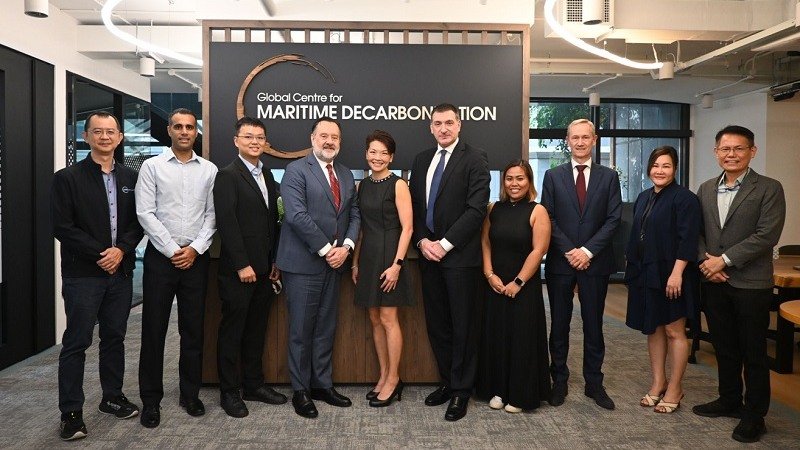
The renewal was solidified during a high-level summit in the Lion City, where IBIA’s newly appointed leadership, Chair Adrian Tolson, Vice Chair Jeroen de Vos, and Executive Director Alexander Prokopakis, met with Professor Lynn Loo, CEO of GCMD. The meeting, which also included IBIA’s Regional Manager for Asia, Siti Noraini Zaini, serves as a tactical pivot for both organizations as the industry moves from decarbonisation “discussions” to the gritty reality of implementation.
Engineering the Energy Transition
The partnership is more than a diplomatic gesture; it is a technical bridge between the fuel supply chain and the laboratories of innovation. As the industry faces a fragmented fuel future, the IBIA-GCMD alliance will focus on the core pillars:
- Viable Alternative Fuels: Accelerated research into the scalability of green ammonia, methanol, and biofuels, ensuring that “alternative” becomes “available.”
- Standardisation & Quality: Enhancing fuel standards (such as ISO 8217 evolutions) to mitigate the operational risks inherent in new, chemically complex energy carriers.
- Regulatory Harmonisation: Addressing the friction between emerging GHG regulations and the practicalities of port-side bunkering operations.
“The bunker value chain today is already different from what it was just a few months ago,” noted Adrian Tolson. “This moment represents not only disruption, but a transition. IBIA is positioned to navigate this with practical insight and collaboration.”
The Commercial Reality
For the bunkering sector, the “Renewed Commitment” reflects a pragmatic realization: solutions must be commercially viable to survive. By bringing together IBIA’s vast network of suppliers and traders with GCMD’s technical pilot projects, the partnership aims to “de-risk” the transition for shipowners and fuel providers alike.
The meeting underscores Singapore’s role as the “Control Room” for the global energy transition. With GCMD’s expertise in piloting drop-in fuels and IBIA’s influence at the IMO, this collaboration provides the maritime industry with a unified roadmap to navigate the regulatory storms of the late 2020s.
As the maritime sector marches toward the IMO’s 2030 and 2050 targets, the IBIA-GCMD pact stands as a critical reminder that while the future of fuel is uncertain, the need for collaborative transparency is non-negotiable.
About the Global Centre for Maritime Decarbonisation – GCMD
The Global Centre for Maritime Decarbonisation (GCMD) was established as a non-profit organisation on 1 August 2021 with a mission to support the decarbonisation of the maritime industry by shaping standards, deploying solutions, financing projects, and fostering collaboration across sectors.
- Founders: BHP, BW Group, Eastern Pacific Shipping, Foundation Det Norske Veritas, Ocean Network Express and Seatrium.
- Funding: GCMD receives funding from the Maritime and Port Authority of Singapore (MPA) for qualifying research and development programmes and projects.
- Strategic Partners: bp, Hanwha Ocean, Hapag-Lloyd, NYK Line and PSA International have joined as Strategic partners.
- Initiatives: GCMD has launched key initiatives to close technical and operational gaps in: deploying ammonia as a marine fuel, developing an assurance framework for drop-in green fuels, unlocking the carbon value chain, and closing the data-financing gap for energy efficiency technologies.
- Location: Strategically located in Singapore, the world’s largest bunkering hub and busiest transshipment port.
IBIA in Brief
The International Bunker Industry Association (IBIA) is the authoritative voice of the global bunker industry, representing all sectors and stakeholders across the marine fuels value chain.
- Founded: 1993
- Membership: Shipowners, charterers, bunker suppliers, traders, brokers, ports, regulators, service providers, and marine energy industry stakeholders worldwide.
- Mission & Role:
- Foster collaboration and professionalism across the industry
- Promote education and best practices
- Uphold high standards of conduct
- Provide a platform for discussion, guidance, and advocacy
- Engagement: Actively participates with other industry bodies, national and international policymakers, and legislators, including the International Maritime Organization (IMO), where IBIA holds consultative NGO status
- Global Forum: Offers a comprehensive platform to address challenges and opportunities in the bunker industry, ensuring the industry’s voice influences the future of marine fuels and maritime regulation
- Offices: UK, South Africa, Singapore
Source: IBIA | GCMD