
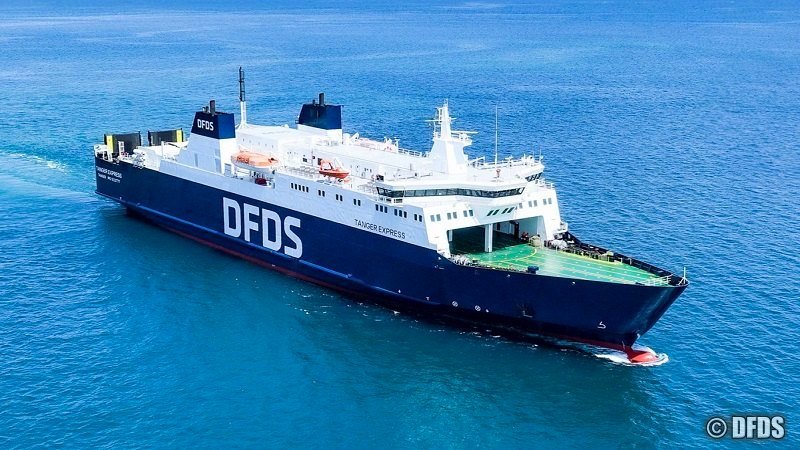
ALGECRIAS, SPAIN – August 25, 2025 – In a strategic move to consolidate and expand its footprint in one of Europe’s most vital maritime corridors, DFDS, the Danish shipping and logistics giant, has announced the acquisition of two ferries and associated assets from Naviera Armas, marking a significant development in the Strait of Gibraltar ferry market.
The deal, valued at DKK 240 million, includes the transfer of two vessels—the RoPax ferry Volcán de Tamasite and the high-speed catamaran Villa de Agaete—both of which are currently operating on overlapping routes to DFDS’ existing services. In addition, DFDS will assume permits for route operations and onboard approximately 200 employees from Naviera Armas, ensuring a seamless integration into ongoing operations.
“The growth of the Strait of Gibraltar ferry market has exceeded our expectations since we entered the market in 2024,” said Mathieu Girardin, Head of the Ferry Division at DFDS. “These vessels are already embedded in the route infrastructure, which positions us to deliver an immediate upgrade in service levels to both passengers and freight clients.”
Table of Contents
Strengthening Presence on Strategic Routes
The acquisition directly enhances DFDS’ services on its two active routes:
- Algeciras – Tanger Med
- Algeciras – Ceuta
With the additional tonnage and passenger capacity, DFDS is set to increase its scale and frequency, responding to surging demand for both freight and passenger transport across the Strait. These routes are not only commercially vital but geopolitically significant, connecting continental Europe with North Africa and serving as a crucial artery for international trade and tourism.
The expansion also boosts DFDS’ capacity share on the freight-focused RoRo vessel shared among existing operators on the Algeciras-Tanger Med route, further consolidating its position in the region.
Vessel Details: Proven Assets to Fuel Growth
The two vessels acquired are seasoned workhorses of the Mediterranean ferry sector:
- MV Volcán de Tamasite – A RoPax ferry built in 2004, designed to handle both rolling freight and passengers, offering reliable service across short sea routes.
- HSC Villa de Agaete – A high-speed catamaran built in 1999, renowned for swift passenger transfers across the busy Gibraltar Strait.
Both ships will continue operation during the transition, minimizing disruption and providing immediate capacity uplift.
Transaction Timing and Financial Outlook
The transaction is expected to close in Q1 2026, pending regulatory approvals, with no anticipated financial impact on DFDS’ 2025 earnings. However, the company projects that the deal will generate additional revenue of approximately DKK 500 million in 2026 and be earnings accretive from the outset.
This move further underscores DFDS’ aggressive growth strategy in southern Europe, following its 2024 entry into the Strait of Gibraltar, where market expansion has outpaced initial forecasts.
Industry Implications
The Strait of Gibraltar remains one of the busiest maritime crossings in Europe, with freight volumes steadily rising due to increasing trade between the EU and North Africa. By securing both assets and permits, DFDS is not only scaling its operations but also eliminating a competitor presence, as Naviera Armas exits the market.
This could signal further consolidation in the regional ferry industry, especially as operators seek economies of scale, digitalization, and improved energy efficiency to remain competitive in an evolving regulatory and operational landscape.
About DFDS
Founded in 1866 and headquartered in Copenhagen, DFDS is a leading European shipping and logistics company operating a comprehensive transport network across the continent. The company employs 16,500 full-time staff and reported DKK 30 billion in annual revenue. Its services span trailer transport via ferry, road, and rail, alongside logistics solutions and passenger ferry services on short-sea and overnight routes.
DFDS is publicly traded on the Copenhagen Stock Exchange and continues to be a bellwether for integrated maritime and logistics operations in Europe.
With the completion of this acquisition, DFDS is poised to further entrench its position as a dominant player in southern Europe’s maritime infrastructure. As market demand continues to rise and port capacity in the Strait is further optimized, DFDS’ expansion could set the tone for the next phase of competitive development in the region.
Source DFDS