
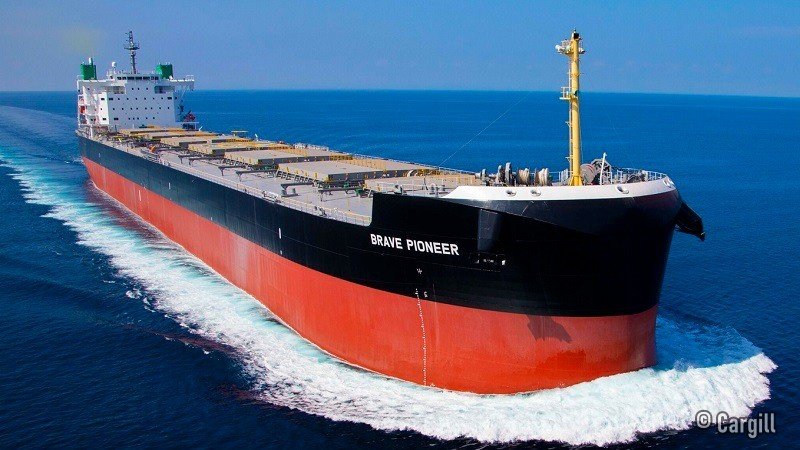
Geneva, Switzerland | January 15, 2026 – In a landmark move for the dry-bulk sector, Cargill has officially launched the maiden voyage of the Brave Pioneer, the first of five green methanol dual-fuel vessels slated to join the company’s chartered fleet. The deployment marks a critical phase in Cargill’s multi-solution strategy to decarbonize global ocean supply chains.
Built by Tsuneishi Shipbuilding and owned by Mitsui & Co. Ltd., the Brave Pioneer is engineered to operate on both conventional marine fuels and green methanol. When powered by green methanol, the vessel is estimated to achieve a CO2 reduction of up to 70% compared to traditional bunker fuels.
Table of Contents
Operational Trials and Global Transit
The vessel departed the Philippines today and is scheduled for a strategic bunker stop in Singapore to take on green methanol. From there, it will proceed to Western Australia before completing its transit to Europe.
During this maiden voyage, Cargill will utilize the Brave Pioneer as a live laboratory to:
- Evaluate Bunkering Readiness: Testing the infrastructure and safety protocols for green methanol handling.
- Refine Carbon Accounting: Verifying environmental attributes through advanced tracing and verification systems.
- Assess Market Demand: Measuring the appetite among global shippers for low-carbon freight services.
Leadership Through Uncertainty
Cargill, one of the world’s largest dry bulk charterers, is positioning itself as an “early mover” to resolve the maritime industry’s infrastructure deadlock.
Jan Dieleman, President of Cargill’s Ocean Transportation business, highlighted the necessity of proactive testing:
“Decarbonising global shipping requires a mix of technologies and the willingness to take bold steps before the entire ecosystem is ready. Technologies like green methanol or wind-assisted propulsion come with uncertainty. But as an industry leader, we have a responsibility to test these innovations on the water, share what we learn, and help shape the systems and standards that will enable wider adoption.”
Dieleman further noted that the new fleet is designed for “optionality and adaptability,” allowing Cargill to utilize conventional fuels where necessary while switching to greener alternatives as global availability improves.
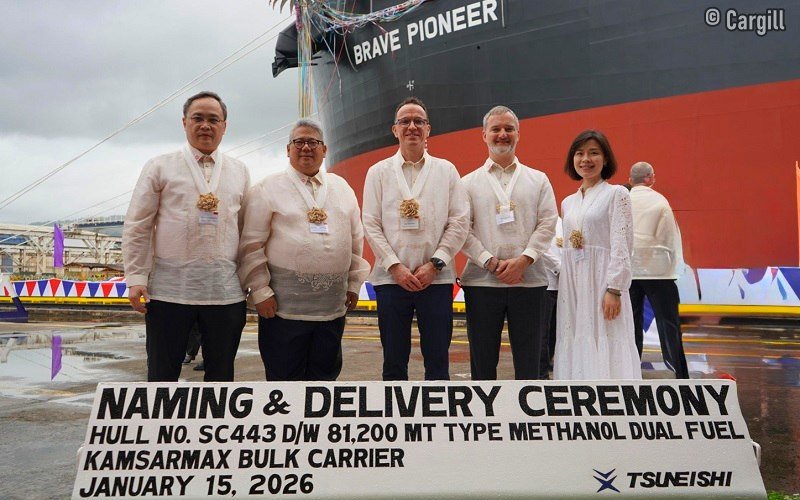
A Portfolio Approach to Shipping
The Brave Pioneer is the vanguard of a broader fleet expansion, with four more dual-fuel vessels expected in the coming years. This methanol initiative complements Cargill’s existing sustainability portfolio, which includes:
- Wind-Assisted Propulsion: Utilizing large-scale wing sails to reduce fuel consumption.
- Voyage Optimization: AI-driven routing to maximize fuel efficiency.
- Biofuel Exploration: Integrating drop-in renewable fuels across existing tonnage.
By commissioning these high-spec vessels, Cargill is sending a definitive demand signal to fuel producers and port authorities that green methanol is a viable pathway for the future of dry bulk shipping.
Why Methanol? The Shift in Maritime Energy
As the shipping industry moves toward the IMO’s 2030 and 2050 decarbonisation targets, green methanol has emerged as a frontrunner in the “alternative fuels” race. Unlike Liquefied Natural Gas (LNG), methanol is liquid at ambient temperatures and pressures, significantly reducing the complexity and cost of onboard storage and bunkering infrastructure.
The adoption of methanol offers three critical advantages for dry bulk operators:
- Ease of Handling: Existing bunkering infrastructure can be repurposed for methanol with relatively minor modifications compared to the cryogenic requirements of LNG or the toxicity management of ammonia.
- Immediate CO2 Impact: While “Grey” methanol (from natural gas) offers modest gains, Green Methanol (produced from biomass or captured CO2 and green hydrogen) can reduce lifecycle greenhouse gas emissions by 65% to 95%.
- Engine Maturity: Dual-fuel engine technology for methanol is already commercially proven and “future-ready,” allowing vessels like the Brave Pioneer to maintain operational flexibility by burning conventional fuels when green methanol supply is limited.
About Cargill
Cargill is committed to providing food, ingredients, agricultural solutions, and industrial products to nourish the world in a safe, responsible, and sustainable way. Sitting at the heart of the supply chain, the company partners with farmers and customers to source, make and deliver products that are vital for living. With 160 years of experience and over 155,000 employees, Cargill continues to innovate with purpose to ensure communities prosper and consumers live well for generations to come.
Source: Cargill