
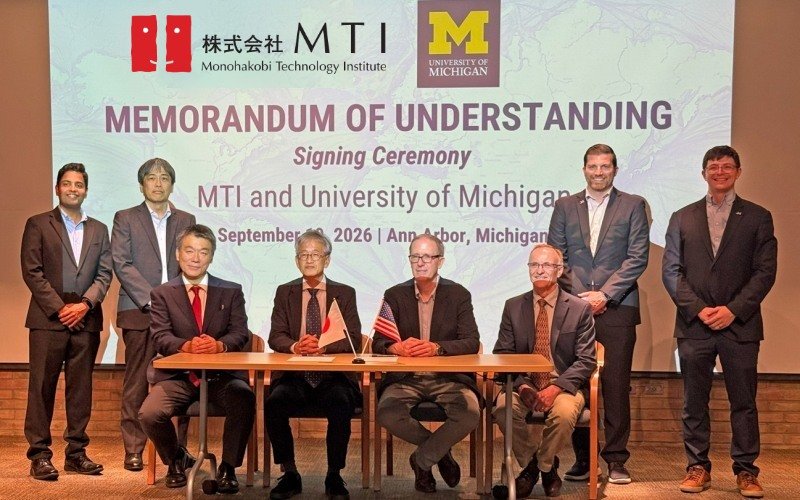
The Department of Naval Architecture and Marine Engineering at the University of Michigan and MTI Co., Ltd. (NYK Group) have signed a five-year Memorandum of Understanding during the Japan-U.S. Shipbuilding Summit. The agreement establishes a bilateral framework to expand joint research, promote researcher exchanges, and integrate robotics and AI into advanced shipbuilding. Together, both organizations will formulate a public joint technology strategy roadmap to guide future investments and support policy decision-making for the maritime industries of the United States and Japan.
Ann Arbor and Tokyo | September 16, 2026 – The Department of Naval Architecture and Marine Engineering at the University of Michigan and Monohakobi Technology Institute (MTI Co., Ltd.), the research and development arm of the NYK Group based in Tokyo, have signed a landmark Memorandum of Understanding (MOU) to establish a five-year framework for joint research, researcher exchanges, and bilateral maritime technology cooperation.
The agreement was officially concluded in conjunction with the Japan-U.S. Shipbuilding Summit “Deployment to Action,” held from September 9 to 10, 2026, across Newlab in Detroit and the University of Michigan. The summit gathered government officials, industry leaders, technology firms, and researchers to address the revitalization and global competitiveness of both nations’ maritime sectors, focusing heavily on robotics, artificial intelligence (AI), and advanced shipbuilding technologies.
A Joint Strategic Framework and Technology Roadmap
Under the new five-year cooperation framework, the University of Michigan and MTI will comprehensively map out challenges and opportunities across research, development, testing, and demonstration. Their shared objective is to formulate a Japan-U.S. joint strategic framework and technology roadmap that delivers mutual benefits to both countries.
This upcoming framework will be publicly released as a collaborative milestone, designed to guide and support decision-making for investments and R&D initiatives across the U.S. and Japanese maritime industries.
Key Attendees and Signing Representatives:
From the University of Michigan: College of Engineering Associate Dean for Research Todd Allen, Department Chair David Dowling, Associate Professor of Practice Thomas McKenney, and Assistant Professor Alan Papalia.
From MTI Inc.: President & CEO Hideki Suzuki, Managing Director Hideyuki Ando, Senior Researcher Sreenath Subramaniam, and Deputy Group Leader Yoshihiko Maeda.
Leadership Insights
Highlighting the synergistic benefits of the partnership, Dr. Alan Papalia of the University of Michigan noted “By combining the strengths of robotics and AI with researchers from the United States and Japan, it has been demonstrated that they can understand and analyze shipbuilding sites at a level that neither country alone can achieve. This MOU serves as a foundation to further develop these outcomes and elevate them into a common strategic framework that both governments can take concrete actions.”
Dr. David Singer of the University of Michigan added “The revival of shipbuilding in the U.S. and Japan cannot be achieved simply by imitating past successful models. It is necessary to take a comprehensive view of the entire system and make appropriate decisions based on a shared understanding. Through collaboration with MTI, we will build a shared vision together with one of Japan’s leading maritime technology organizations.”
Dr. Thomas McKenney of the University of Michigan emphasized the broader policy impact “The Japan-U.S. shipbuilding cooperation has already brought significant benefits to both sides. This MOU and the resulting strategic framework will provide policymakers across the Pacific with a clear, evidence-based roadmap showing where joint investment will have the greatest impact.”
MTI President and CEO Hideki Suzuki stated “MTI has always highly valued its partnership with the University of Michigan. This MOU demonstrates a shared commitment to the development of the maritime and shipbuilding industries of both countries. Going forward, we aim to further deepen collaboration and link our research results to concrete outcomes that can be utilized at shipbuilding sites in both the United States and Japan.”
MTI Managing Director Hideyuki Ando concluded “By bringing together the expertise of both Japan and the U.S. in robotics, automation, and AI in shipbuilding, we can identify the greatest impact of joint efforts. The strategic framework we develop will serve as a practical guideline for promoting ongoing innovation and technology transfer between the two countries.”
About University of Michigan (Dept. of Naval Architecture and Marine Engineering)
With a history spanning over 140 years, the University of Michigan‘s Department of Naval Architecture and Marine Engineering is one of the earliest established institutions in the United States for marine engineering and naval architecture, and remains one of the few specialized departments of its kind to this day. The origins of the department date back to an 1879 Act of the U.S. Congress, and even as other universities downsized or dissolved related programs, it has steadfastly maintained its tradition. Today, the department shapes maritime strategies for Michigan and the United States, operating as a global leader in education, talent development, and cutting-edge research in naval architecture and marine engineering.
About Monohakobi Technology Institute (MTI)
Monohakobi Technology Institute (MTI Co., Ltd.) is a research and development company within the NYK Group, headquartered in Tokyo. MTI drives the R&D of advanced technologies across digital transformation (DX), autonomous navigation, artificial intelligence (AI), robotics, and environmental and energy systems, contributing directly to the realization of safe, sustainable, and efficient global maritime transport.
Source: MTI Co.