
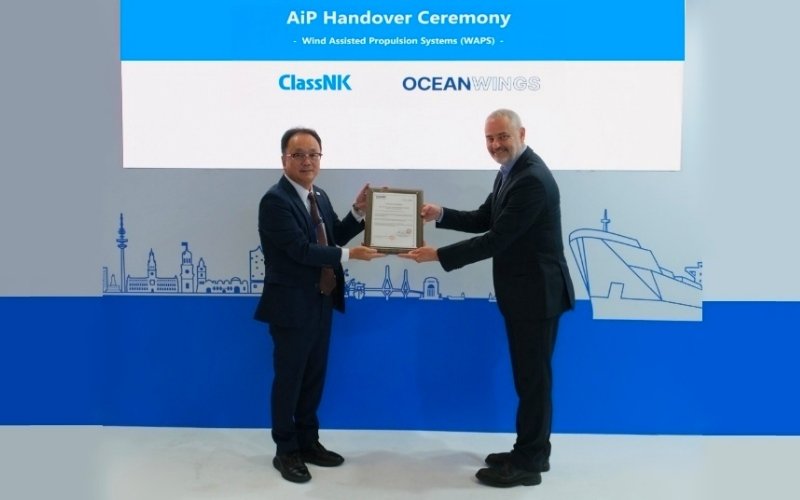
OceanWings has secured an expanded ClassNK Approval in Principle for its Rigid Fixed and Rigid Tiltable wingsail designs. The approval enables the technology to scale beyond the previously certified 363m² configuration to larger wingsails and vessel segments. The milestone supports wider adoption of wind-assisted propulsion across newbuild and retrofit projects globally.
Hamburg | September 3, 2026 – ClassNK has granted OceanWings an expanded Approval in Principle (AiP) covering its Rigid Fixed (RF) and Rigid Tiltable (RT) wingsail designs, confirming that the technology can be scaled across a wider range of vessel sizes and shipping segments.
The approval was formally presented during an official ceremony at SMM Hamburg on 2 September 2026.
Approval Builds on 2025 Certification
The latest AiP builds on ClassNK’s initial approval granted to OceanWings in 2025. That certification covered a 363-square-metre wingsail with a 38-metre span.
The expanded approval confirms that the core design principles behind both the RF and RT configurations can be applied to a broader range of wingsail sizes. OceanWings existing product portfolio includes wingsails of up to 407 square metres with a 42-metre span. The new approval also provides a basis for the technology to be developed toward even larger wingsails for bigger vessel segments and different operational profiles.
Flexible Sizing for Different Vessels
OceanWings CEO Emmanuel Schalit said the expanded AiP demonstrates the continued progress of the technology and its scalable design philosophy. “The design philosophy, control architecture and onboard integration principles remain the same across all wingsail sizes. In practice, the appropriate dimensions are determined by the technical and operational requirements of each vessel, rather than by a predefined size limitation.”
The company said this approach gives shipowners, shipyards and naval architects greater confidence when assessing the most suitable wingsail size and configuration for individual vessels. The expanded AiP is also expected to support the earlier integration of wind propulsion into both newbuild programmes and retrofit projects.
ClassNK Supports Wind-Assisted Propulsion
Hayato Suga, President & CEO of ClassNK, said the classification society was pleased to support OceanWings as adoption of wind-assisted propulsion continues to grow across the maritime sector. “As the adoption of wind-assisted propulsion technologies continues to grow across the maritime industry, we are pleased to grant this Approval in Principle for OceanWings’ RF and RT wingsail designs.”
Suga added that ClassNK would continue supporting the maritime industry’s transition toward more sustainable shipping through its certification services.
Part of OceanWings’ Industrialisation Roadmap
For OceanWings, the expanded AiP forms part of its ongoing qualification and industrialisation roadmap. The company said the milestone strengthens its ability to deploy wind-assisted propulsion systems globally and broadens the potential application of its technology across different vessel sizes and operating profiles.
By moving beyond the size limitations of the original 2025 approval, OceanWings can now pursue larger wingsail configurations while retaining the same underlying design philosophy, control architecture and onboard integration principles. The development marks another step in the commercialisation of wind-assisted propulsion, giving vessel owners and designers a broader certified framework for evaluating OceanWings’ RF and RT wingsail technology for future newbuild and retrofit projects.
About ClassNK
Established in 1899, ClassNK is a classification society dedicated to safety and environmental protection through third-party certification. ClassNK conducts diverse technical services, including surveys and classifications of ships and marine structures based on its own rules and international conventions on behalf of more than 100 flag states, as well as management system certifications in line with ISO and other industry standards. ClassNK is committed to providing the industry with full support to tackle digitalization and decarbonization challenges through expanding certification services and R&D with industry partners.
OceanWings in Brief
OceanWings is a French maritime technology pioneer specializing in automated, reefable, and retractable wingsails. While wind propulsion is an ancient concept, OceanWings has modernized it into a high-tech “propulsion-as-a-service” solution that treats wind as a predictable, high-performance fuel source.
Elite Heritage: From America’s Cup to Commercial Cargo
The technology behind OceanWings wasn’t born in a lab; it was born on the racetrack. The concept was developed by VPLP Design, the world-renowned naval architects responsible for the wingsail that propelled BMW Oracle Racing to victory in the 2010 America’s Cup.
Unlike “soft” sails, these are rigid, two-element foils, similar to an airplane wing, that generate significantly more lift and thrust. OceanWings successfully industrialised this high-speed racing tech into a robust, “marinized” version capable of surviving decades in the harsh conditions of the open ocean.
The “Smart” Sail: Automation & AI
For modern bunkering and shipping operations, “simplicity” is key. OceanWings are 100% automated, meaning they require no specialized crew.
- Adaptive Trimming: The system uses AI and machine learning to sense the wind and adjust the wings’ angle of attack and camber (curve) in real-time.
- Reefable and Retractable: In extreme weather or for port clearance (Air Draft), the wingsails can be lowered or folded, ensuring they never interfere with cargo operations or safety.
Source: OceanWings