
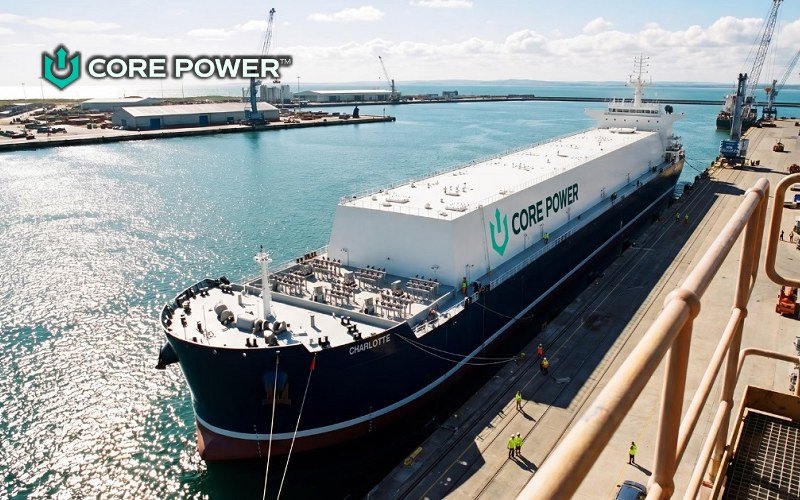
CORE POWER and the Port of Corpus Christi Authority have signed a Memorandum of Collaboration to conduct a landmark site-specific study on maritime nuclear readiness. The initiative will evaluate the feasibility of deploying floating nuclear power plants for regional baseload energy and establishing safe harbors for future nuclear-powered commercial vessels. Running alongside a parallel agreement with the U.S. Maritime Administration, this preliminary fact-finding effort aims to secure long-term industrial competitiveness and energy resilience for U.S. ports.
London, England | August 19, 2026 – In a landmark move bridging advanced marine energy and global trade infrastructure, CORE POWER and the Port of Corpus Christi Authority (PCCA) have formally signed a Memorandum of Collaboration. Announced on August 19, 2026, the agreement establishes a rigorous, comprehensive framework for a site-specific maritime nuclear readiness study at one of North America’s premier energy gateways.
As the maritime industry faces mounting pressure to decarbonize while securing reliable, high-capacity power, this initiative aims to evaluate how major U.S. ports can adapt to paradigm-shifting nuclear technologies.
Key Dual-Pathway Scope of the Study
The detailed feasibility and readiness study will investigate two distinct, forward-looking operational roles for the Port of Corpus Christi:
- Floating Nuclear Power Plants (FNPPs): Examining the deployment of offshore or shore-adjacent nuclear units (such as CORE POWER’s conceptual 300MWe FNPP design) to supply clean, firm, and reliable baseload power directly to port operations and broader regional grid demand.
- Nuclear-Powered Commercial Ships: Assessing the complex infrastructure, safety protocols, and operational frameworks required to serve as a safe harbor and logistics hub for future generations of civil nuclear-powered commercial vessels, including container ships and energy tankers.
Strategic Objectives for CORE POWER and PCCA
For the Port of Corpus Christi, the study serves as an empirical data-gathering exercise. Port leadership aims to build a practical evidence base to evaluate how next-generation maritime technologies can fortify regional energy resilience, attract forward-thinking industrial investments, and secure long-term economic competitiveness and high-value jobs.
For CORE POWER, the collaboration provides an invaluable sandbox within a live, high-volume industrial operating environment. Developing commercial maritime nuclear power requires aligning several complex vectors:
- For FNPPs: Identifying viable marine sites, establishing high-capacity grid interconnects, securing commercial off-takers, mapping regulatory and environmental compliance pathways, and engineering long-term operational and service support models.
- For Nuclear Ships: Designing predictable, secure protocols for vessel transit, navigation channels, safe berthing, and routine port servicing.
Federal Alignment and MARAD Collaboration
Demonstrating the broader national significance of the initiative, PCCA Commissioners have concurrently executed a separate Memorandum of Cooperation with the U.S. Department of Transportation’s Maritime Administration (MARAD).
This parallel federal agreement will examine the technical, regulatory, and operational criteria necessary for U.S. seaports nationwide to accommodate FNPP deployment and nuclear-vessel safe harbors. Together, these complementary agreements bridge local port strategy with federal maritime policy, positioning U.S. infrastructure at the forefront of the global energy transition.
Executive Perspectives
Jeff Pollack, Chief Strategy and Innovation Officer, Port of Corpus Christi Authority, said “Port Corpus Christi, as the preeminent energy gateway in North America, is committed to remaining a leader in the global energy marketplace, even as that marketplace expands and evolves. This collaboration will help us understand what would be required technically, environmentally, operationally and commercially for floating nuclear power plants and future calls by nuclear-powered commercial ships to be considered in the real-world context of the Port. It is about gathering evidence and keeping our region competitive for future investment, industry, and high-value jobs.”
Mikal Bøe, CEO, CORE POWER, said “Ports are where energy systems and global trade meet. For floating nuclear power plants, we need to understand sites, grids, customers, operating models and long-term service arrangements. For nuclear-powered commercial ships, we need safe and predictable pathways for transit, berthering and routine port operations. Port Corpus Christi gives us a real operating environment in which to assess both pathways separately, but as parts of the complete industrial and regulatory system needed to make maritime nuclear commercially deployable.”
Fact-Finding Scope and Limitations
Both organizations emphasize that the proposed initiative is strictly a preliminary, fact-finding exercise. At this stage, the agreement:
- Does not select a physical site, reactor technology, or vendor.
- Does not initiate formal licensing, regulatory permitting, or construction approval.
- Does not commit financial investment or authorize the physical deployment of an FNPP or commercial nuclear ship calls.
As the marine fuel and bunkering landscape evolves toward zero-carbon alternatives, this study marks a critical early step in determining whether advanced nuclear power can successfully transition from promising scientific concept to foundational maritime infrastructure.
About Port Corpus Christi
As a leading U.S. energy export gateway and a major economic engine for Texas and the nation, the Port of Corpus Christi is the third-largest port in the United States by total waterborne tonnage. Strategically located on the western Gulf Coast with access to 38 nautical miles of ship channels, including the La Quinta Ship Channel and the 54-foot (Mean Lower Low Water)-deep Corpus Christi Ship Channel, the Port is a premier hub for international and domestic maritime commerce. It features exceptional railroad and highway connectivity, backed by three North American Class-1 railroads and two major interstate highways. Guided by an outstanding staff overseen by its seven-member commission, the Port of Corpus Christi proudly stands as “Moving America’s Energy.”
About CORE POWER
CORE POWER is building the industrial platform to enable fleet-scale maritime nuclear infrastructure. As a maritime nuclear systems integrator, the company partners with selected reactor technology developers to transform advanced nuclear systems into deployable assets, including floating nuclear power plants and nuclear-powered commercial ships.
These products will be delivered using modern shipbuilding principles, commercial hull construction, specialist nuclear-licensed integration, and an end-to-end approach that aligns policy, regulation, insurance, operations, and lifecycle support. Headquartered in London with offices in Washington, D.C., and Tokyo, CORE POWER combines nuclear and marine engineering depth with extensive regulatory, policy, commercial, and industrial expertise.
Source: CORE Power