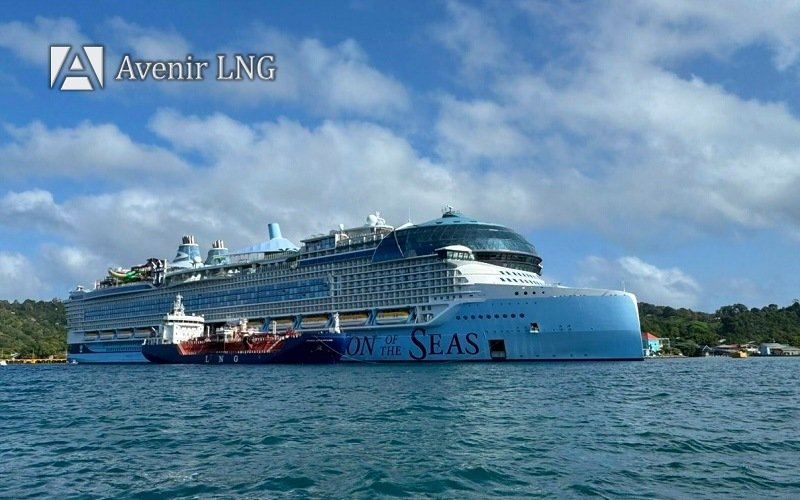
Avenir LNG’s bunkering vessel Avenir Advantage has completed its first ship-to-ship LNG bunkering operation for Royal Caribbean’s Icon of the Seas in Honduras. This milestone highlights the growing reach of flexible, small-scale LNG supply chains in supporting major cruise vessels outside traditional maritime hubs. By extending clean fuel logistics to regional Caribbean itineraries, the operation marks an essential step in bridging the gap between vessel deployment and alternative fuel availability.
Honduras | August 19, 2026 – Avenir LNG has marked a major operational milestone by completing its first liquefied natural gas (LNG) bunkering operation involving the bunker vessel Avenir Advantage and Royal Caribbean Group‘s flagship cruise liner, Icon of the Seas, in Honduras.
The milestone highlights the expanding reach of small-scale LNG supply chains and represents a vital new step for marine-fuel logistics in the Caribbean.
Expanding Beyond Traditional Hubs
Traditionally, LNG bunkering infrastructure has developed around major maritime energy centers where continuous demand justifies multi-million dollar investments in fixed storage and terminals. However, cruise shipping operates across a much broader, highly mobile geographical footprint, creating demand at regional destinations lacking deep local infrastructure.
The successful operation in Honduras, carried out with support from Axpo Group, port stakeholders, and local project teams, demonstrates how smaller, flexible LNG supply chains can bridge that gap. This development follows other recent regional strides, including Génesis Energías completing an LNG ship-to-ship transfer in Puerto Cortés in July, signaling a broader emergence of LNG activity extending from the power sector into marine fuel.
The Avenir Advantage and Flexible Small-Scale Logistics
Delivered in 2020, the 7,500-cubic-meter Avenir Advantage is one of five operational vessels in Avenir LNG’s bunker fleet. Designed for logistical agility, the fleet handles ship-to-ship, ship-to-truck, and ship-to-terminal transfers.
This model is exceptionally well-suited for cruise vessels like Icon of the Seas. Entering service in 2024, the ultra-large cruise ship runs Western Caribbean itineraries featuring recurring calls to Roatán, Honduras. Because fuel availability must follow ships rather than forcing vessels to alter routes, mobile bunker capacity provides a critical lifeline for maintaining operational schedules.
The Caribbean Opportunity
The Caribbean presents a unique proposition for marine LNG suppliers. As a premier global cruise market characterized by dense traffic between U.S. ports, Mexico, Central America, and island destinations, the region possesses a concentrated population of vessels with steady, distributed fuel requirements.
Flexible bunker solutions allow suppliers to position fuel closer to actual operating routes. Avenir LNG, which has executed more than 500 bunkering operations and delivered over 1.5 million cubic meters of LNG across seven regions and four continents, views this model as central to matching supply with dynamic customer demand.
Icon of the Seas puts the operation in context
Royal Caribbean Group’s Icon of the Seas is among the most prominent LNG-fuelled cruise ships in operation. The vessel entered service in 2024 and operates Western Caribbean itineraries that include Roatán, Honduras. Published schedules show the ship calling at Roatán on August 18, 2026, with further calls scheduled through the remainder of 2026 and into 2027.
The timing of the bunkering operation therefore fits directly into the vessel’s established Caribbean operating pattern. The operation also highlights one of the central challenges in scaling alternative marine fuels: fuel availability must follow ships, rather than ships being forced to follow fuel infrastructure.
For LNG-fuelled cruise ships, reliable bunkering across a network of destinations can be as important as the availability of LNG at the vessel’s homeport.
Navigating the Maritime Energy Transition
While LNG reduces sulfur oxides, particulate matter, and depending on engine design, nitrogen oxides and carbon dioxide, it remains a transitional fossil fuel. Strict methane management across the entire production, transportation, and bunkering lifecycle remains essential as the maritime sector eyes the International Maritime Organization’s long-term decarbonization goals.
For now, shipowners and suppliers see LNG serving as an immediately viable, lower-emission alternative while broader future fuel pathways like methanol and ammonia continue to mature.
The Path to Repeatability
The immediate success of the Avenir Advantage proves logistical capability, but long-term success hinges on repeatability. With Icon of the Seas scheduled for repeated returns to Roatán through late 2026 and 2027, a foundation for steady local demand is already in place.
Whether this initial operation blossoms into an integrated marine LNG supply corridor across the wider Caribbean will depend on sustained commercial scaling, predictable supply, and continuous multi-port collaboration. For now, the milestone underscores a definitive truth of maritime decarbonisation: vessel technology is only as powerful as the fuel supply chain that supports it.
About Avenir LNG
Avenir LNG, is a leading independent owner and operator of small-scale LNG carriers and LNG bunkering vessels. Founded in 2017, the company plays a key role in enabling the global energy transition by providing safe, reliable, and flexible LNG logistics solutions. Operating one of the world’s largest fleets of dedicated LNG bunker vessels, Avenir supports the marine fuel transition to LNG and Bio-LNG while servicing industrial off-grid energy users worldwide.
Source: Avenir LNG