London, UK | January 20, 2026 – Industry coalition SEA-LNG has published its annual View from the Bridge report, describing 2025 as a pivotal year in shipping’s methane decarbonisation journey, with LNG firmly established as a mainstream marine fuel and rapid progress underway in liquefied biomethane (LBM/bio-LNG) and e-methane.
The report, titled “The Journey”, marks a decade since SEA-LNG’s formation and highlights more than $150 billion of cumulative investment in LNG-fuelled vessels and associated infrastructure, positioning methane-based fuels as a practical and scalable pathway toward net-zero shipping.
LNG Strengthens Dominance Among Alternative Fuels
According to the report, LNG-powered vessels ordered in 2025 accounted for 79% of all alternative-fuelled tonnage, up from 67% in 2024, despite a broader slowdown in newbuild ordering caused by regulatory uncertainty and shipyard capacity constraints.
Including LNG carriers, the LNG-powered global fleet now represents around 10% of global deadweight tonnage, underlining LNG’s transition from a regional compliance solution in Northern Europe in 2016 to a globally adopted mainstream marine fuel.

SEA-LNG said LNG’s advantages over competing alternative fuels include:
- Higher energy density
- Global fuel availability
- Lower costs of regulatory compliance
- Greater commercial flexibility under regulatory uncertainty
Global LNG Bunkering Network Expands
The report shows continued expansion of LNG bunkering infrastructure worldwide:
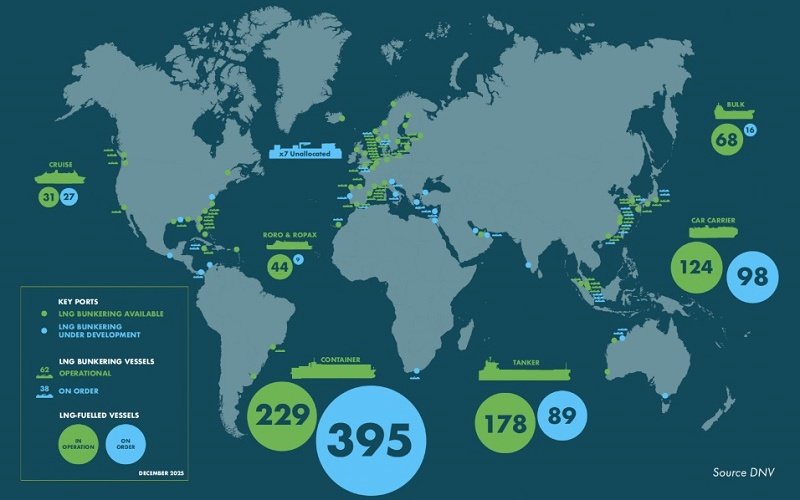
- 222 ports now offer LNG bunkering
- LNG bunker vessels have increased from one in 2016 to more than 62 in operation by 2025
- A further 38 LNG bunker vessels are on order
All LNG bunkering assets are described as future-proof, as LNG handling and bunkering processes are identical for fossil LNG, liquefied biomethane and liquefied e-methane, whether supplied physically or via mass balance mechanisms.
Biomethane Gains Momentum, E-Methane Emerges
SEA-LNG highlighted rapid growth in LBM bunkering during 2025, particularly in Europe, driven by tightening regional regulations and voluntary commitments from shipowners and cargo owners. Biomethane bunkering operations have already taken place across multiple European ports, involving a growing number of bunker suppliers.
At the same time, e-methane supply is beginning to emerge, with projects under development in Europe, North America, South America, Australia and Asia, supported by demand from both the maritime and energy sectors.
Call for Technology-Neutral Global Regulation
The View from the Bridge report calls for a single, global, technology-neutral decarbonisation framework that balances environmental ambition with commercial reality, protects first movers and incentivises fuels and solutions that are scalable and investable.
Commenting on the findings, Peter Keller, Chairman of SEA-LNG, said:
“After a year of regulatory drama exposing the complexity of the task faced by the IMO, the need for a single global decarbonisation framework is greater than ever. This framework must be goal-based and technology-neutral. It must allow flexibility so companies can plan fleet modernisation and invest with confidence.”
Ian Aitchison, SEA-LNG’s Communications Director, added:
“SEA-LNG’s messaging is built upon sound science and the professional expertise of our members. Despite environmental and regulatory tumult, our voice has remained consistent over the last decade. Being a credible and trusted advocate for a cleaner future is more important than ever.”
Methane Pathway Is Now a Clear Runway
Summing up the year, Steve Esau, COO of SEA-LNG, said 2025 marked a turning point:
“2025 is the year the methane decarbonisation pathway became a clear runway. Our advocacy for LNG as a transition fuel – from fossil LNG through liquefied biomethane to liquefied e-methane – took off, with record volumes of LBM already powering global shipping and growing strongly into the future.”
With fleet adoption accelerating, bunkering infrastructure in place and renewable methane supplies gaining momentum, SEA-LNG concluded that LNG now offers shipping one of the most practical and investable routes to decarbonisation available today.
Notable LNG bunkering milestones were recorded in 2025
Reflecting the continued geographic expansion of LNG as a marine fuel. Key first-of-their-kind operations during the year included:
- January: The Middle East’s first ship-to-ship LNG bunkering operation took place in Dubai, with Monjasa supplying LNG to the cruise vessel Costa Smeralda.
- February: Hong Kong recorded its inaugural ship-to-ship LNG bunkering of a containership, with Kunlun Energy, a subsidiary of PetroChina, supplying LNG to the Zim Aquamarine.
- March: Western North America’s first LNG bunkering of a pure car and truck carrier (PCTC) was completed in Vancouver’s English Bay, where Seaspan supplied LNG via ship-to-ship transfer to the MOL-operated Lake Herman.
- December: The Port of Trieste hosted Italy’s first ship-to-ship LNG bunkering involving a container vessel, with the operation carried out by Edison and CMA CGM.
SEA-LNG’s Leadership in LNG Adoption
Since its founding in 2016, SEA-LNG has been at the forefront of advocating for LNG as a key enabler of sustainability in shipping. The coalition includes a diverse membership comprising shipping companies, ports, LNG suppliers, bunkering companies and infrastructure providers, all working together to highlight LNG’s benefits across the entire maritime value chain.
Through independent research on emissions, investment, and infrastructure, SEA-LNG continues to play a pivotal role in promoting LNG adoption. As the global shipping industry strives to meet emission reduction targets, SEA-LNG’s efforts ensure that LNG remains a cornerstone of the sector’s shift towards greener, lower-emission fuels.
Source: SEA-LNG