
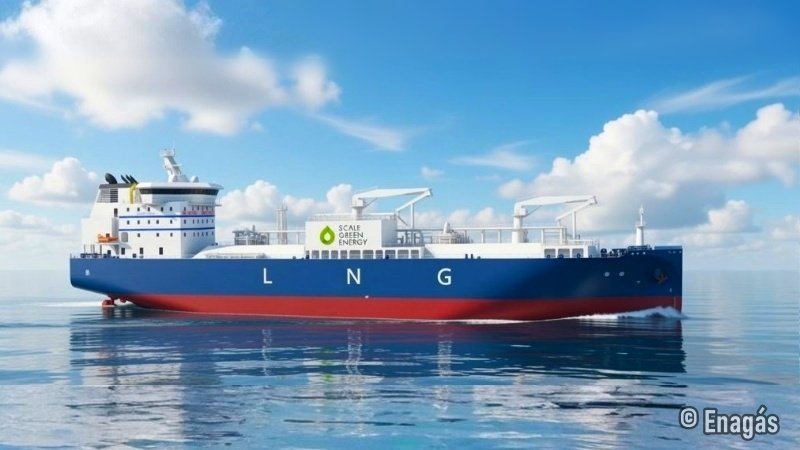
Madrid, Spain | January 15, 2026 – Energy majors Enagás and Naturgy have taken a decisive step toward the decarbonisation of maritime transport with an agreement to construct and charter a next-generation liquefied natural gas (LNG) bunkering vessel designed to become a European benchmark for sustainable shipping.
The vessel, to be named Mistral LNG, will have a cargo capacity of 18,900 cubic metres and will be capable of supplying both LNG and BioLNG to a wide range of vessel types. The project is being developed by Scale Green Energy, Enagás’ subsidiary dedicated to sustainable energy solutions, which will lead the construction and operate the vessel upon delivery.
Table of Contents
A flagship LNG bunkering vessel for Southern Europe
Construction of Mistral LNG is scheduled to begin in early 2026, with commercial operations expected to commence in 2028, when the vessel will be chartered by Naturgy under a long-term agreement.
The vessel is strategically positioned to reinforce the Iberian Peninsula’s role as a key LNG and BioLNG bunkering hub in southern Europe, supporting the region’s transition to low- and zero-emission marine fuels.
Primary operational areas will include:
- The Strait of Gibraltar, one of the world’s busiest maritime corridors
- The Canary Islands, supporting Atlantic and transoceanic trade routes
- Additional Atlantic and Mediterranean destinations as demand evolves
Mistral LNG will leverage Spain’s extensive LNG infrastructure, including its seven regasification plants, Facilities in Barcelona, Cartagena, Huelva, and Gijón are already operational for BioLNG supply services to vessels and tanker trucks, providing immediate scalability for renewable marine fuel distribution.
Technical Specifications and Environmental Performance
Designed with efficiency and emissions reduction at its core, Mistral LNG incorporates advanced maritime technologies to support the shipping industry’s energy transition.
Key specifications include:
- Length overall: 138.8 metres
- Cargo capacity: 18,900 m³ (the largest in the Scale Green Energy fleet)
- Propulsion: Dual-fuel engine
- Service speed: 13 knots
- Operational range: Over 4,500 nautical miles
Emissions profile:
- BioLNG: Net-zero CO₂ emissions
- LNG:
- 100% elimination of sulphur oxides (SOx)
- 80–90% reduction in nitrogen oxides (NOx)
- Approximately 25% reduction in CO₂ compared with conventional marine fuels
Industry data shows that orders for LNG- and BioLNG-powered vessels doubled in 2024 compared with 2023, reflecting accelerating demand driven by fuel economics and regulatory compliance. In Spain alone, LNG use in maritime transport could reduce CO₂ emissions by up to 2 million tonnes by 2030, equivalent to removing more than one million internal combustion vehicles from the road.
Strengthening LNG and BioLNG bunkering leadership
Through this initiative, Naturgy further consolidates its position as a strategic operator in the Iberian LNG and BioLNG bunker market, a segment expected to experience exponential growth in the coming decade. The company continues to advance its energy transition strategy by delivering competitive, lower-emission solutions backed by its extensive experience as Spain’s leading natural gas importer.
For Enagás, the project strengthens its role as a leading LNG bunkering shipowner in southern Europe. Via Scale Green Energy, Mistral LNG will join an existing fleet of specialised LNG bunkering vessels:
- Levante LNG
- Alisios LNG
- Haugesund Knutsen
With its larger capacity and next-generation design, Mistral LNG will become the fleet’s most advanced asset, specifically engineered to meet rising demand for both conventional LNG and renewable BioLNG. The vessel aligns closely with Europe’s broader strategy to reduce emissions from maritime transport, while also generating positive knock-on effects across Spain’s LNG value chain.
Rising Demand Driven by Regulation and Sustainability Goals
The Mistral LNG project aligns closely with tightening European maritime emissions regulations, which mandate progressive reductions in greenhouse gas emissions linked to marine fuels. LNG and BioLNG currently represent the most mature and immediately scalable alternative fuels, supported by growing vessel fleets and established infrastructure.
As regulatory pressure increases under EU climate frameworks, demand for LNG bunkering across the Iberian Peninsula is expected to rise steadily throughout the next decade, positioning Spain as a central node in Europe’s clean-shipping transition.
BioLNG: A Zero-Emissions Marine Fuel Pathway
BioLNG is produced from biomethane derived from organic household and industrial waste. Using Spain’s interconnected gas grid and regasification infrastructure, biomethane injected into the network is certified and recognised as BioLNG, enabling its use as a fully renewable marine fuel with no associated net emissions.
This closed-loop, circular-economy approach allows existing LNG infrastructure to be leveraged for renewable fuels, accelerating decarbonisation without the need for entirely new supply chains.
Setting a New Standard for Sustainable Maritime Operations
With Mistral LNG, Naturgy and Enagás are not only expanding Europe’s LNG bunkering capacity but also setting a new benchmark for sustainable maritime fuel logistics, reinforcing the Iberian Peninsula’s growing role in the global energy transition at sea.
About Naturgy
Naturgy is a multinational energy group with more than 180 years of history. A leader in the gas sector, the company is actively driving the energy transition through investments in renewable gases, circular economy solutions, and low- and zero-emission shipping, with the objective of achieving net-zero emissions by 2050.
About Scale Green Energy (Enagás Group)
Founded in 2017 as a spin-off from Enagás, Scale Green Energy specialises in integrated LNG and BioLNG downstream solutions. The company invests in, builds, and operates small-scale infrastructure, including bunkering vessels and road-fuelling stations, to supply sustainable gas to the global transport and maritime sectors.
About Enagás
Enagás is the Technical Manager of the Spanish Gas System and a certified European Transmission System Operator (TSO). Operating more than 11,000 km of pipelines and seven regasification plants, Enagás plays a central role in energy security while advancing Europe’s hydrogen backbone and carbon-neutral fuel infrastructure.
Source: Enagas