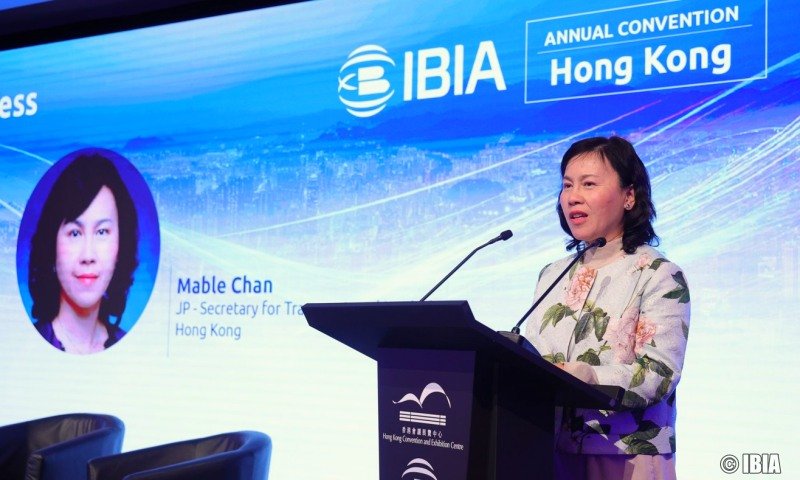
STL Mable Chan outlines Hong Kong’s roadmap for green maritime fuel bunkering, highlighting policy, collaboration, and global leadership at IBIA Convention 2025.
Hong Kong | 19 November 2025 – Hong Kong has declared itself “all in” on the global maritime energy transition. Secretary for Transport and Logistics (STL) Ms. Mable Chan delivered a landmark keynote address today at the International Bunker Industry Association (IBIA) Annual Convention 2025, charting a clear course for the city to become a premier green maritime fuel hub.
Table of Contents
About the Keynote Speaker: Ms. Mable Chan, JP
Appointed in December 2024 as Secretary for Transport and Logistics, Hong Kong, Ms. Chan brings over 30 years of distinguished public service to her role. Her career includes senior positions such as Commissioner for Transport, and Permanent Secretary for Transport and Logistics—the position she held immediately prior to her appointment as STL. Her experience also includes Deputy Secretary for Financial Services and the Treasury.
Her extensive experience in policy, regulation, and strategic planning provides a strong foundation for Hong Kong’s ambitious green maritime initiatives. At the IBIA Annual Convention 2025, Ms. Chan outlined the city’s vision for a sustainable, innovative, and globally connected maritime future, setting the tone for the event.
IBIA Annual Convention 2025 – Charting the Green Course
The event, attended by IBIA Chair Constantinos Capetanakis, Executive Director Alexander Prokopakis, and hundreds of international delegates, marked a pivotal moment for Hong Kong as it announced its ambition to become a leading global centre for green maritime fuel bunkering and trading.
A Milestone Moment for Hong Kong Maritime
Opening her address, Ms. Chan underscored the significance of hosting the IBIA’s flagship event during Hong Kong Maritime Week, a record‑breaking year drawing over 18,000 participants. Ms. Chan noted that Hong Kong and IBIA share a common philosophy: “Leadership grounded in action, not closed‑door discussions; solutions, not slogans; collaboration, not silos.”
Hong Kong’s longstanding reputation as a top-tier global maritime centre sets the foundation. The city ranks:
- 7th globally in bunkering activity
- 2nd in China
- 1st in the Greater Bay Area
Not only a cargo powerhouse, Hong Kong has been a key bunkering hub for ocean-going vessels for decades, strategically positioned at the junction of major international fairways.
Seizing the Decarbonisation Opportunity
As the global maritime community pivots toward decarbonisation, Ms. Chan framed this moment as Hong Kong’s opportunity, and responsibility, to lead.
Hong Kong’s response is anchored in the Action Plan on Green Maritime Fuel Bunkering, launched exactly one year ago to support the International Maritime Organization’s (IMO) 2050 net‑zero vision. Despite uncertainties over the IMO timetable, Hong Kong pressed forward.
The Action Plan sets out five strategic pillars:
- Green Fuel
- Green Port
- Green Incentives
- Green Collaboration
- Green Talents
Underpinned by 10 concrete measures, these strategies provide a clear roadmap to turn ambition into practical, scalable implementation.
A Multi-Fuel Future Backed by Real Policy and Real Action
A centrepiece of Hong Kong’s strategy is a multi‑fuel approach, preparing the port to handle LNG, biodiesel, methanol, ammonia, and hydrogen.
Ms. Chan detailed the rapid build‑out of the supporting ecosystem:
- Fuel sourcing collaboration with the Chinese Mainland, the world’s largest green fuel producer.
- Development of local storage, supply chains, and bunkering infrastructure.
- Passage of enabling legislation and publication of technical guidelines.
- Introduction of a duty exemption for methanol bunkering, with rigorous safeguards to prevent misuse.
This regulatory action is more than symbolic. “Hong Kong is not drafting, we are doing,” Ms. Chan emphasized.
And the numbers back that claim:
- Commercial LNG and biodiesel bunkering is already operational.
- Nearly 200,000 tonnes of green maritime fuels have been bunkered in the past year.
- The first methanol bunkering operation is imminent.
- Preparatory work for ammonia and hydrogen bunkering is underway.
Building Global Green Shipping Corridors
Recognizing the global nature of shipping, Ms. Chan highlighted Hong Kong’s commitment to international collaboration.
The city treats its shipping companies not as local operators, but as global industry players navigating geopolitical and regulatory complexities. Hong Kong’s role, she said, is to listen, facilitate, and act.
Key initiatives include:
- Actively identifying partner ports to form or join green shipping corridors—routes designed to achieve net‑zero emissions.
- Signing the first batch of partner port agreements, boosting Hong Kong’s international visibility.
- Preparing major infrastructure upgrades to support corridor participation.
Updates on Hong Kong’s green corridor initiatives are expected next year. But the strategic objective is clear: “To create truly net‑zero emission shipping lanes, setting a global benchmark for sustainable maritime routes.”
Strengthening Mainland–Hong Kong Collaboration
Another pillar of Hong Kong’s strategy is deepening ties with the Mainland’s fast‑developing green energy market.
In June, Hong Kong and the Ministry of Commerce co‑hosted the first Mainland–Hong Kong Green Energy Business Matchmaking Event, staged simultaneously in Hong Kong and Shenzhen.
At this groundbreaking dual‑city event:
- MOUs were signed with four green maritime fuel suppliers and bunker operators.
- Over 300 industry representatives participated.
- The platform showcased a shared commitment to building a robust, cross‑border ecosystem for green maritime fuel supply, trading, and commercialization.
To sustain this momentum, Hong Kong has created a communication platform connecting the entire maritime fuel bunkering supply chain. Companies registered in Hong Kong, and international firms setting up headquarters or branches here, are encouraged to join.
Hong Kong’s larger goal: “To become both the region’s premier green fuel bunkering hub and the trading gateway for Mainland-produced green maritime fuels.“
The Irreversible Path Forward
Closing her speech, Ms. Chan delivered a message that echoed across the convention hall: “The transition to green maritime fuels is not an option; it is an imperative. And Hong Kong is all in.”
Ms. Chan praised IBIA for bringing global leaders together and emphasized the crucial role of such forums in equipping the industry for the steps ahead. With shared passion, strategic clarity, and international partnerships, Ms. Chan noted, Hong Kong and the global maritime community have the chance to lead the next great transformation in shipping.
Hong Kong Sets the Course for Net-Zero Shipping
The IBIA Annual Convention 2025 in Hong Kong marked a decisive moment — one where policy met action, strategy met infrastructure, and ambition met measurable progress.
Hong Kong is no longer preparing for the green maritime future; “It is building it.” With its multi-fuel strategy, legislative readiness, Mainland partnerships, global corridor ambitions, and operational achievements, the city is positioning itself as a global leader in green maritime fuel bunkering and trading.
“The world’s shipping lanes may soon rely on Hong Kong not just for refueling, but for redefining the future of sustainable maritime energy.“
About IBIA
The International Bunker Industry Association (IBIA) is the unified voice of the global bunker sector, representing all stakeholders across the marine fuel value chain. Its diverse membership includes shipowners, operators, bunker suppliers, traders, brokers, storage providers, surveyors, port authorities, legal firms, P&I clubs, equipment manufacturers, shipping journalists, and consultants.
Founded in 1992, IBIA now counts members in more than 70 countries and continues to advocate for sustainable, safe, and transparent practices within the international bunker industry.
Source: IBIA | STL – Hong Kong