

Tsuneishi Shipbuilding has delivered the world’s first LNG dual-fuel Kamsarmax bulk carrier “Oceana Frontier”, featuring an in-house manufactured Type-C LNG fuel tank. The vessel achieves a 50% EEDI reduction, far exceeding IMO Phase 3 requirements. This milestone establishes Tsuneishi’s technical foundation for future alternative fuels, including ammonia, as the maritime industry transitions toward zero-emission goals.
Japan | March 31, 2026 – In a transformative moment for the dry bulk sector, Tsuneishi Shipbuilding Co., Ltd. officially delivered the world’s first LNG dual-fuelled Kamsarmax bulk carrier “Oceana Frontier” at its Tsuneishi Factory on March 31, 2026.
The delivery marks a dual triumph for the Japanese shipbuilder: the introduction of a more sustainable flagship vessel and the successful debut of its in-house LNG fuel tank manufacturing capabilities, a move designed to future-proof the yard for the next generation of alternative fuels.
Decarbonization Beyond Compliance
The new Kamsarmax is powered by a dual-fuel engine capable of using LNG as its primary energy source. This shift from conventional heavy fuel oil (HFO) drastically reduces the vessel’s environmental footprint, virtually eliminating sulfur oxides (SOx), significantly cutting nitrogen oxides (NOx), and lowering overall CO₂ emissions.
Beyond the fuel swap, the vessel’s technical specifications set a new industry benchmark:
- EEDI Phase 3 Mastery: Through optimized hull design and the integration of a shaft generator, the vessel achieves a 50% reduction in the Energy Efficiency Design Index (EEDI).
- Exceeding Standards: This performance substantially outperforms the IMO’s Phase 3 requirement of a 30% reduction (applicable from 2025), positioning the vessel as one of the most efficient bulkers on the water today.
The “In-House” Advantage: Type-C Tank Innovation
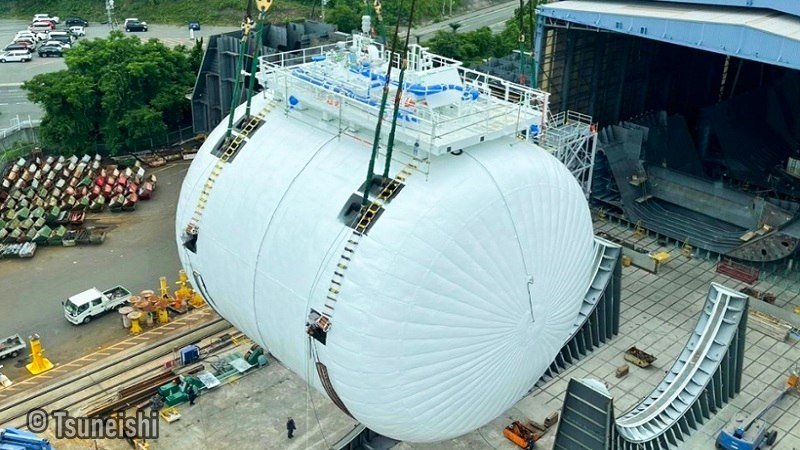
A standout feature of the vessel is the Type-C independent pressure tank installed on the aft deck. In a strategic shift, Tsuneishi manufactured this tank at its own facilities, overcoming the complex technical hurdles associated with cryogenic environments.
Manufacturing these tanks requires:
- Precision Fabrication: Working with specialized cryogenic materials.
- Advanced Welding: High-quality seams capable of withstanding extreme pressure and temperature cycles.
- Thermal Insulation: Sophisticated systems to maintain stable temperatures for liquid gas.
By leveraging expertise previously gained from producing LPG pressure tanks, the shipyard successfully navigated the challenges of forming “dished end plates” and managing the precision required for LNG storage.
A Foundation for Zero-Emissions
Mr. OKUMURA Sachio, President & CEO of Tsuneishi Shipbuilding, emphasized that this delivery is a stepping stone toward even greener technologies, such as ammonia.
“The pressure vessel manufacturing technologies and quality control expertise cultivated through the in-house production of LPG tanks have been successfully applied to the LNG fuel tank of this vessel,”
“We believe that continuously strengthening these low-temperature and pressure-handling technologies within the company will provide an essential foundation for responding to future fuels such as ammonia and ultimately contribute to the realisation of zero-emission vessels.” Okumura-san stated.
About Tsuneishi Shipbuilding Co., Ltd.
Founded in 1917, Tsuneishi Shipbuilding is the cornerstone of the Tsuneishi Group. With a global manufacturing footprint spanning Japan, the Philippines, and China, the company is a primary architect of the world’s bulk carrier fleet, as well as container carriers and tankers.
- Headquarters: Fukuyama, Hiroshima, Japan
- CEO: OKUMURA Sachio
- Employees: 847 (as of Jan 2026)
- Specialization: Pioneering ship designs that balance commercial deadweight capacity with aggressive environmental performance.
Source: Tsuneishi Shipbuilding Co., Ltd.