
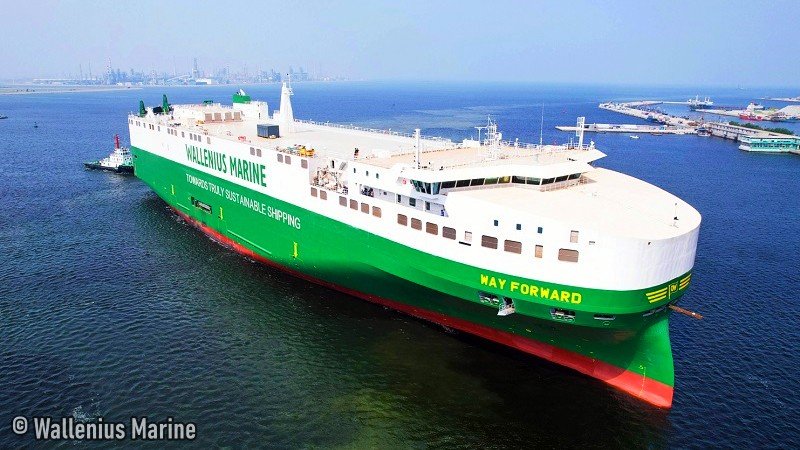
Stockholm | January 30, 2026 – After a year of rigorous real-world operations, Wallenius Marine has announced that the first two vessels in its groundbreaking Sleipner series, Way Forward and Future Way, have achieved the highest possible energy efficiency rating from the International Maritime Organization (IMO).
The vessels have secured an “A” rating under the IMO’s Carbon Intensity Indicator (CII) framework. This classification places them in the top 10% of Ro-Ro vehicle carriers globally, reflecting carbon emissions significantly lower than the industry average for comparable tonnage.
Table of Contents
Proving the Sleipner Concept
Launched as a collaboration between Wallenius Marine and naval architects KNUD E. HANSEN, the Sleipner concept was designed to redefine the efficiency of Pure Car and Truck Carriers (PCTCs).
The data collected over the past 14 months confirms that the vessels are not merely compliant with current regulations but are already meeting future, more stringent emission thresholds set for 2030.
“Seeing our first Sleipner vessels perform so well in real operations is highly gratifying,” says Johan Mattsson, CEO of Wallenius Marine. “It confirms that our vessel design, combined with efficient operations and a dedicated crew, together create measurable climate benefits.”
Technical Innovations Driving Performance
The “A” rating is the result of several “upstream” design choices that prioritize hydrodynamic efficiency and operational flexibility:
- Aerodynamic Superstructure: A streamlined, low profile with integrated ventilation reduces air resistance, a critical factor for high-sided car carriers.
- Reverse Bow Design: The hull features a hydrodynamically optimized shape and a specialized bow to minimize water resistance.
- Dual-Fuel Capabilities: The machinery is designed for multi-fuel use, capable of running on LNG/LBG (Liquefied Biogas) as well as diesel and synthetic biodiesels.
- Cargo & Ballast Optimization: A reconfigured cargo layout allows for faster loading and unloading while nearly eliminating the need for ballast water, reducing both weight and the risk of transferring invasive species.
The Road to 2030: Long-Term Viability
The CII measures a vessel’s carbon efficiency in grams of CO2 emitted per cargo-carrying capacity and nautical mile. Under the IMO’s “moving target” strategy, the thresholds for ratings A through E will become increasingly strict every year.
Because Way Forward and Future Way have entered the market with such a high efficiency margin, Wallenius Marine expects both vessels to retain their A-rating for several years, providing a competitive advantage in a market increasingly sensitive to carbon footprints and “green” chartering requirements.
Expanding the Horizon: Sleipner RoRo
Building on the success of these car carriers, Wallenius Marine and KNUD E. HANSEN have already begun adapting the Sleipner principles for the short-sea RoRo segment.
The next generation of this concept is designed to be “wind-ready,” with structural reinforcements to support wing-sail technology (such as the Oceanbird system). These future iterations will also feature:
- Azipod Propulsion: 360-degree steerable thrusters for superior maneuverability in tight ports.
- Hybrid Ready: Provisions for shore power, battery banks, and fuel cell integration.
Vessel Particulars: Way Forward & Future Way
- Capacity: 6,502 CEU (Car Equivalent Units)
- Length Overall: 199.95 m
- Gross Tonnage: 62,432
- Flag: Sweden
- Engine Type: Dual-fuel (capable of running on LNG/LBG, MGO, and Biodiesel)
About Wallenius Marine: Leading the Transition to Sustainable Shipping
Wallenius Marine is a global frontrunner in ship design, newbuilding, and ship management. Their core strategy is rooted in the “upstream” philosophy: solving environmental challenges at the design stage rather than relying solely on end-of-pipe solutions.
Strategic Mission
- Modal Shift: A primary goal is moving global freight from road to sea, which significantly lowers total atmospheric emissions.
- Wind Propulsion: Leading the “wind revolution” through the Oceanbird concept, a joint venture with Alfa Laval, aiming for vessels that reduce emissions by up to 90%.
- Data-Driven Excellence: Utilizing big data and digital twins to manage fleets with maximum fuel efficiency.
- Continuous Innovation: Operational feedback from the current fleet (like the Sleipner series) is directly integrated into the design of the next generation of vessels.
Wallenius Marine at a Glance
- Global Presence: Approximately 800 employees across strategic hubs in Sweden, Singapore, Philippines, and Myanmar.
- Operational Hubs: Two primary ship management offices located in Stockholm and Singapore.
- Proven Track Record: Since the mid-1990s, the company has designed and supervised the construction of more than 70 sustainable vessels.
- Industry Standards: Fully certified under ISO 9001:2015 (Quality Management) and ISO 14001:2015 (Environmental Management).
- Heritage: A family-owned enterprise and a core pillar of the Soya Group, which has been a pioneering force in the maritime sector since 1934.
Source: Wallenius Marine