

Summary: This technical deep-dive reveals how the “Speed Gap” the discrepancy between commanded and actual RPM—wastes up to 10% of fuel and damages turbochargers during rough seas. By aligning engine commands with the Maximum Attainable Main Engine Speed (MAMES), operators can save over $71,000 annually and reduce emissions through simple operational optimization.
February 16, 2026 – The maritime industry is navigating a pivotal transition toward net-zero GHG emissions, as mandated by the International Maritime Organization (IMO) for 2050. While alternative, carbon-neutral fuels are under development, operational efficiency is no longer optional, it is a commercial necessity.
With future fuels forecasted to cost significantly more than current Very Low Sulphur Fuel Oil (VLSFO), optimizing engine performance and ship operations remains a high-impact, low-cost strategy that produces immediate economic returns, independent of fuel type.
Understanding the physical relationship between engine power and ship behavior in rough seas is now essential for profitability, mechanical integrity, and regulatory compliance.
Table of Contents
The Hidden Efficiency Leak: The Main Engine Speed Gap
A recent study published in Technical Journal No. 11 (2025) by ClassNK revealed that improper main engine operation in heavy weather is not merely a performance inefficiency, it represents a measurable economic loss and mechanical liability.
The Physics Behind the Speed Gap
In calm seas, a main engine easily reaches its commanded RPM. When the vessel encounters wave and wind resistance, significantly more torque is required to maintain speed.
Every engine is protected by a physical ceiling: the Fuel Rack Limiter, which restricts the maximum fuel injected per cycle to prevent overloading.
The point where propeller resistance intersects this limiter defines the Maximum Attainable Main Engine Speed (MAMES). In rough seas, MAMES shifts downward, creating a speed gap when commanded RPM exceeds what the engine can physically achieve.
Maximum Attainable Main Engine Speed (MAMES)
The Core Problem
If a navigator commands 85 RPM, but MAMES under the prevailing sea conditions is 82 RPM, a 3 RPM speed gap emerges.
The governor interprets the engine as “slow” and pushes the fuel rack toward the maximum. Since torque is already at its limit, fuel is wasted without increasing propulsion.
Key Considerations
- Fuel Rack Limiter: Caps the fuel per cycle; beyond this, the engine cannot accelerate.
- Aging Factor: Hull and propeller fouling increase resistance, lowering MAMES over time.
- Bollard Pull: Maximum theoretical resistance when stationary, imposing the strictest torque ceiling (15–20% above light running conditions).
MAMES is dynamic, affected by both environmental conditions and mechanical aging.
Propulsion Dynamics in Variable Sea States
Increased wave resistance demands more engine torque to maintain a given speed. This relationship is nonlinear, causing a dynamic shift in the engine power-to-speed ratio compared to calm-water operation.
The Speed-Power Operating Point Shift
Severe sea conditions fundamentally alter propulsion physics. The engine must deliver higher torque, but the relationship between power and speed is nonlinear, shifting the engine power-to-speed ratio compared to calm water.
Speed-Power Operating Point Shift (Panamax Example):
- Calm conditions: Operates on “light” propeller curves.
- Heavy seas: Moves to “heavy” curves, requiring more torque.
Empirical Data: Engine speeds cluster along discrete settings in calm conditions. Under rough seas, normalized data relative to NMCR (Maximum Continuous Rating) deviates downward, indicating the engine has reached its torque limit.
This defines the onset of the Main Engine Speed Gap.
Quantifying the Speed Gap and Fuel Waste
When commanded RPM exceeds MAMES, the governor attempts to close the gap by injecting more fuel:
- Excess fuel consumption
- No increase in propulsion
- Wasted energy and higher emissions
Real-World Impact: Panamax Bulk Carrier Example
| MAMES Ratio (N/NMCR) | Speed Gap: 1 RPM | Speed Gap: 2 RPM | Speed Gap: 3 RPM |
|---|---|---|---|
| 0.75 | 3.3% (607 kg/day) | 6.7% (1,213 kg/day) | 10.0% (1,820 kg/day) |
| 0.79 (Panamax) | 3.3% (648 kg/day) | 6.5% (1,295 kg/day) | 9.8% (1,943 kg/day) |
| 0.85 (Panamax) | 3.0% (753 kg/day) | 6.0% (1,507 kg/day) | 9.0% (2,260 kg/day) |
| 0.90 | 2.8% (851 kg/day) | 5.6% (1,702 kg/day) | 8.3% (2,553 kg/day) |
Observed case: 3 RPM speed gap → 2,286 kg/day fuel loss (12.2%), USD 71,000 annually (US East Coast–Europe).
With high-cost carbon-neutral fuels, these losses could triple, making speed gap mitigation critical.
Additional Impacts
- Daily Fuel Waste: ~2,260 kg/day for a typical 10,000 kW engine
- Aging Factor: Fouling lowers MAMES, increasing both frequency and severity of gaps
- Global Route Impact: On rough routes, a single vessel may waste 114 metric tons/year, heavily affecting fleet economics
For bunker planning and voyage estimation, even a 3 RPM misalignment can invalidate consumption forecasts under heavy weather conditions.
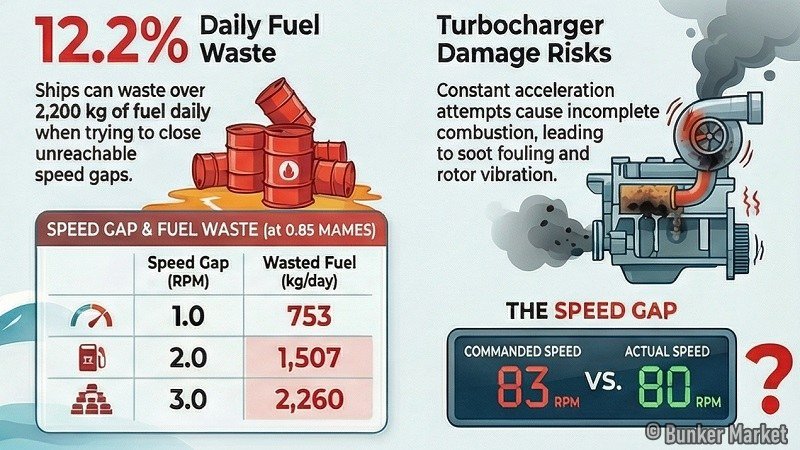
Technical Risks: Incomplete Combustion and Turbocharger Failure
The speed gap also threatens engine integrity:
Turbocharger Rotor Inertia and Soot Formation:
- Low air-fuel ratio during forced acceleration
- Incomplete combustion → dense soot
- Rotor imbalance → vibration and accelerated bearing wear
- Potential catastrophic turbocharger failure
Operational adjustment remains the only immediate and cost-free preventive measure.
Standard Operating Procedure (SOP) for Heavy Weather
Operators can eliminate the speed gap without hardware investment:
Heavy Weather SOP Steps
- Monitor the Speed Gap: Compare commanded vs. actual RPM.
- Iterative Adjustment: Gradually reduce commanded RPM until it aligns with MAMES.
- Achieve Equilibrium: Engine operates efficiently, fuel injection optimized, turbocharger stress minimized.
- Proactive Data Review: Analyze past voyages to identify routes prone to recurring speed gaps.
Benefits:
- Immediate fuel savings
- Reduced turbocharger wear
- Improved operational reliability
- Lower GHG emissions
Data-Driven Navigation in Rough Seas
Respecting MAMES constraints and eliminating the main engine speed gap is operationally and financially critical.
Consequences of neglect include:
- Up to 12.2% fuel waste
- Soot-induced turbocharger degradation
- Increased maintenance and downtime costs
By adopting a simple SOP to align commanded speed with attainable RPM, operators achieve:
- Immediate economic savings
- Enhanced fleet reliability
- Reduced GHG emissions
- Compliance with emerging decarbonization mandates
In the era of high-cost carbon-neutral fuels, data-driven, intelligent engine management is no longer optional, it is a fleet survival strategy.

Operational Discipline: Engine Speed Gap Control
Understanding and managing MAMES is critical for both deck and engine departments. In heavy weather conditions:
- Continuously compare commanded RPM vs. actual RPM
- A persistent 1–3 RPM gap indicates measurable fuel waste
- Reduce commanded RPM gradually until it aligns with attainable speed (MAMES)
- Prevent the governor from holding the fuel rack at maximum index
- Eliminate unnecessary fuel over-injection
- Restore optimal air–fuel ratio and combustion efficiency
- Minimize soot formation and turbocharger fouling
- Reduce vibration risk and bearing wear
- Lower daily fuel consumption immediately
- Cut CO₂ emissions and carbon intensity without capital investment
- Achieve fuel savings and mechanical protection through operational adjustment alone
The Bottom Line for Shipowners
ClassNK encourages shipping companies to:
- Review historical voyage data
- Identify persistent speed gaps
- Train crews in MAMES management
Reducing commanded speed by a few RPM in heavy weather is not just a safety measure, it is one of the most effective fuel-saving and decarbonization strategies available today. In the era of high-cost carbon-neutral fuels, data-driven engine management is a fleet survival strategy.
About ClassNK
ClassNK is one of the world’s leading classification Society, providing ship classification, statutory certification, and technical services to the global maritime industry. Through its Technical Journals and research initiatives, ClassNK contributes to improving safety, environmental performance, and operational efficiency across international shipping.
Source: ClassNK Study