
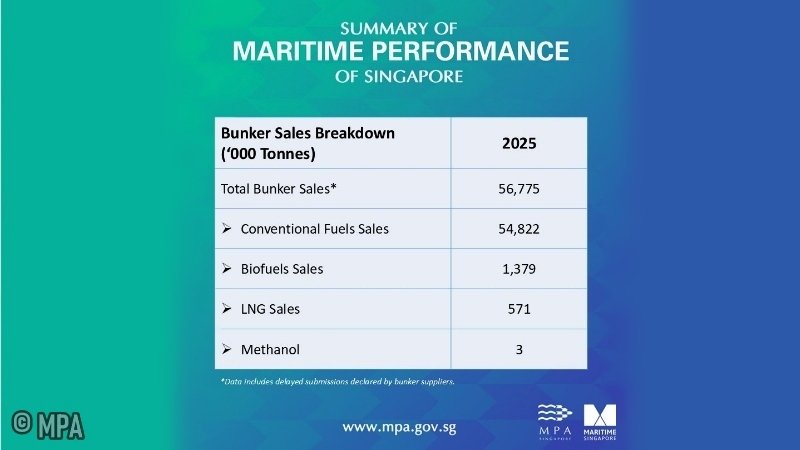
January 15, 2026 | Singapore, the world’s premier bunkering hub, has smashed its own records once again. In 2025, the Port of Singapore reached a historic milestone, with total bunker sales hitting 56.77 million tonnes, a 3.4% increase over the previous record of 54.92 million tonnes set in 2024.
This performance reinforces Singapore’s dominance in the global maritime sector, driven not just by volume, but by a rapid acceleration in the adoption of sustainable, alternative fuels.
Table of Contents
Bunker Sales Snapshot: Year-on-Year Performance
While conventional fuels still form the backbone of the industry, the market is shifting. 2025 saw a notable divergence in fuel preferences, specifically a rise in High Sulphur Fuel Oil (HSFO) and a slight dip in Very Low Sulphur Fuel Oil (VLSFO).
| Fuel Category | 2024 (Million Tonnes) | 2025 (Million Tonnes) | Growth (%) |
| Total Bunker Sales | 54.92 | 56.77 | +3.4% |
| Conventional Fuels | 53.57 | 54.82 | +2.3% |
| Alternative Fuels | 1.35 | 1.95 | +44.4% |
The 2025 performance was defined by a distinct “tale of two halves,” illustrating how monthly volatility reflects broader maritime logistics trends and the necessity of identifying seasonal demand peaks. For the strategist, these fluctuations are not random but correspond to the re-calibration of fleet schedules and seasonal trade lane adjustments that dictate global bunkering demand.
Comparative Monthly Volume Analysis (2024 vs. 2025)
| Month | 2024 Total (M Tonnes) | 2025 Total (M Tonnes) | YoY Change | YoY % |
|---|---|---|---|---|
| January | 4,906.1 | 4,487.9 | -418.2 | -8.5% |
| February | 4,509.3 | 4,145.1 | -364.2 | -8.1% |
| March | 4,445.1 | 4,469.2 | +24.1 | +0.5% |
| April | 4,232.2 | 4,404.4 | +172.2 | +4.1% |
| May | 4,826.8 | 4,878.1 | +51.3 | +1.1% |
| June | 4,274.9 | 4,594.7 | +319.8 | +7.5% |
| July | 4,653.8 | 4,918.0 | +264.2 | +5.7% |
| August | 4,559.5 | 4,965.3 | +405.8 | +8.9% |
| September | 4,383.1 | 4,765.1 | +382.0 | +8.7% |
| October | 4,877.7 | 4,817.7 | -60.0 | -1.2% |
| November | 4,462.2 | 4,820.7 | +358.5 | +8.0% |
| December | 4,790.0 | 5,508.6 | +718.6 | +15.0% |
Analysis of this data reveals an “early-year softness” where January and February volumes contracted by 8.5% and 8.1% respectively, a correction following the exceptionally high baseline set during the initial Red Sea diversions in early 2024. However, a powerful H2 rebound secured the record, with 2025 consistently overtaking 2024 from April onward.
This trend culminated in a staggering 15.0% surge in December, driven by a year-end peak in vessel calls that solidified the annual total. These volume fluctuations were inextricably linked to the evolving marine energy mix and the diverging demand between conventional and alternative fuels.
The Alternative Fuel Revolution
The standout story of 2025 is the 44% surge in alternative fuel offtake. As shipowners align with the IMO’s decarbonization targets and new regulations like FuelEU Maritime take effect, Singapore has successfully scaled its green fuel infrastructure.
- Biofuels: Remaining the top choice for immediate decarbonization, bio-blended bunker sales reached 1.38 million tonnes in 2025 the port also saw the debut of B100 (100% biofuel) sales, totaling approximately 26,000 tonnes.
- LNG (Liquefied Natural Gas): LNG continued its steady climb as a transitional fuel, reaching 571,400 tonnes.
- Methanol: While still in its early stages, methanol sales nearly doubled to 3,013 tonnes in 2025. With three new methanol bunkering licenses issued in late 2025, this segment is expected to explode in 2026.
Digital Bunkering Becomes the New Standard
Beyond fuel volumes, 2025 was a landmark year for operational efficiency.
- 100% Digital Bunkering: As of August 2025, all bunker suppliers in Singapore have fully adopted digital bunkering, saving an estimated 40,000 man-days annually in administrative work.
- Green Shipping Corridors: Singapore expanded its network to nine corridors, adding new partnerships with India and the Republic of Korea to trial zero-emission routes.
Alternative Fuels: Breaking the 1.9 Million Tonne Barrier
For the second consecutive year, Singapore has seen its alternative fuel sales surge, surpassing 1.95 million tonnes in 2025, a 44.4% increase over 2024. This growth reflects the industry’s shift from small-scale trials to commercial-scale adoption as global shipping decarbonization gains momentum.
Bio-Blends Become Mainstream in 2025
Bio-blended fuels continue to be the primary choice for immediate emission reductions.
- 2023: 524,000 tonnes
- 2024: 883,000 tonnes (+68.5%)
- 2025: 1.38 million tonnes (+56.3%)
New in 2025: For the first time, Singapore recorded sales of B100 (100% biofuel), totaling approximately 25,500 tonnes, signaling a move toward higher-concentration blends.
LNG Bunkering Volumes Continue Upward Trajectory
LNG has solidified its role as a key transitional fuel, supported by new LNG bunker vessels and competitive pricing.
- 2023: 111,000 tonnes
- 2024: 464,000 tonnes (+318.9%)
- 2025: 571,400 tonnes (+23.1%)
Methanol Volumes Rise as Market Prepares for Scale
While still a niche segment, methanol bunkering sales nearly doubled in 2025 as more dual-fuel vessels entered service.
- 2023: (Debut Year)
- 2024: 1,626 tonnes
- 2025: 3,013 tonnes (+85.3%)
“In November 2025, the MPA issued three new methanol bunkering licenses to prepare for an expected volume spike in 2026.”
Ammonia Moves from Trial Phase to Standardization
Following the world’s first ammonia bunkering trial in 2024 (9.74 tonnes), 2025 was a year of regulatory preparation. While no commercial sales were recorded in 2025, the MPA completed several feasibility studies and is set to launch the first technical standards for ammonia bunkering in early 2026.
Quick Comparison: Alternative Fuel Sales (Tonnes)
| Fuel Type | 2023 | 2024 | 2025 |
| Biofuels | 524,000 | 883,000 | 1,380,000 |
| LNG | 111,000 | 464,000 | 571,400 |
| Methanol | Trial | 1,626 | 3,013 |
| Ammonia | 0 | 9.74 (Trial) | Standards Phase |
Operational Drivers and Digital Transformation
For a global hub, operational transparency and vessel call efficiency serve as force multipliers for bunkering volumes. Singapore’s ability to process more vessels with greater precision has directly enabled the 2025 volume records, transforming the bunkering process from a manual, paper-intensive exercise into a data-driven competitive advantage.
A watershed moment occurred in August 2025, with the 100% mandatory adoption of digital bunkering for all suppliers. This transition eliminated administrative bottlenecks and optimized bunkering anchorage utilization, directly increasing berth throughput.
The operational impact is quantifiable: 42,603 vessels called specifically for bunkering in 2025, a 2.6% increase over the previous year. By reducing turnaround times through digital documentation, the port essentially expanded its capacity without the need for physical berth expansion. These operational gains, however, must be viewed through the lens of the “geopolitical tremors” that have redefined global shipping routes.
The following table contextualizes the primary indicators of Singapore’s maritime throughput for the 2025 calendar year.
Key Port Indicators (2025)
| Key Port Indicator | 2025 Performance | Y-o-Y Growth (%) |
|---|---|---|
| Vessel Arrivals (M GT) | 3,220.32 | +3.5% |
| Vessel Arrivals (Number) | 131,821 | +4.7% |
| Container Throughput (M TEUs) | 44.66 | +8.6% |
| Cargo Throughput (M Tonnes) | 614.34 | -1.4% |
| Total Bunker Sales (M Tonnes) | 56.77 | +3.4% |
Beyond Volume: Singapore’s Shift to an Energy Hub
“These figures underscore the Republic’s enduring role as a choice port of call and its position as a global maritime and trade hub.” – Senior Minister of State for Law and Transport.
Singapore’s 2025 performance proves it is no longer just a “refueling station” but a sophisticated “energy hub.” By balancing the sustained demand for traditional fuels with a massive leap in bio-blends and LNG, the port has solidified its status as a leader in the global energy transition.
Source: MPA Singapore