
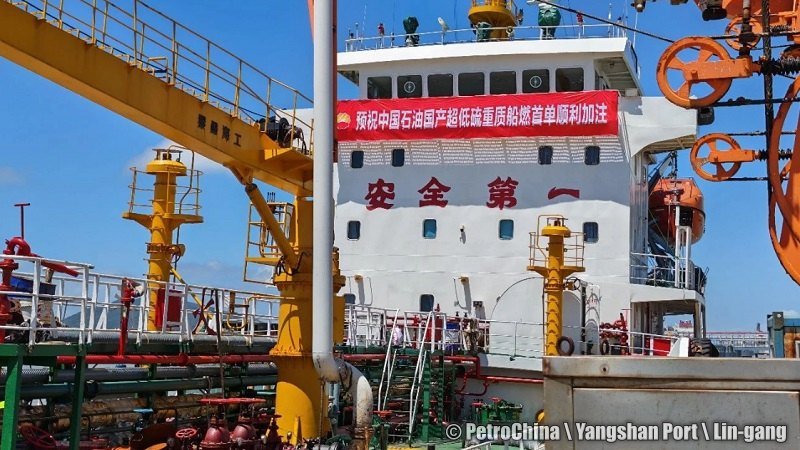
Yangshan Port’s historic ULSFO bunkering highlights China’s move to a comprehensive green marine fuel supply, including LNG, methanol, and biofuels.
Shanghai, China – August 1, 2025 – A pivotal shift in global maritime energy sourcing is unfolding in Asia, with Shanghai’s Yangshan Port emerging as a trailblazer. This leading logistics hub has become the first port in China to establish a comprehensive suite of advanced marine fuels, encompassing liquefied natural gas (LNG), green methanol, cutting-edge biofuels, and ultra-low sulfur fuel oil (ULSFO). This monumental achievement positions Shanghai not merely as a national benchmark for eco-friendly bunkering, but as a burgeoning international nexus for sustainable shipping solutions.
Table of Contents
ULSFO Bunkering Operation
The operational milestone was solidified on July 24, 2025, when the dedicated bunkering vessel, Qi Hong 9, successfully executed a ship-to-ship transfer of 875 metric tons of domestically produced ULSFO to COSCO Shipping Lines’ container ship, COSCO PRIDE. This historic event marks the inaugural instance of Chinese-manufactured ULSFO being supplied via ship-to-ship bunkering to an internationally navigating vessel within China’s waters. Consequently, Yangshan Port is now fully equipped to cater to the diverse fuel needs of ships operating within or transiting through stringent Emission Control Areas (ECAs) worldwide.
Innovating to Meet Evolving Global Standards
This strategic advancement is exceptionally timely. The International Maritime Organization (IMO) has recently implemented stricter environmental mandates, notably reducing the sulfur content cap for marine fuels in designated ECAs, such as the Mediterranean Sea, to a mere 0.1% (effective May 1, 2025). This regulatory tightening is precipitating a sharp escalation in global demand for ULSFO and other compliant fuels.
Illustrating this surging market trend, Rotterdam, a significant European bunkering hub, recorded ULSFO and bio-blended ULSFO sales reaching an impressive 250,000+ metric tons in the second quarter of 2025, Projections indicate that the Mediterranean ECA alone could stimulate an annual demand for approximately three to four million tons of marine light diesel and ULSFO. Recognizing these profound shifts, China has proactively aligned itself to be a key supplier of compliant fuels and a leader in sustainable maritime innovation.
The ULSFO deployed in Shanghai’s groundbreaking operation was meticulously developed by PetroChina Huabei Petrochemical Company, an integral part of China National Petroleum Corporation (CNPC). This advanced-grade fuel boasts a sulfur content nearly 80% lower than comparable ULSFO products currently available, ensuring compliance even within the most stringent global emission zones. Beyond its environmental credentials, the fuel is engineered for optimal engine compatibility, mitigating performance and maintenance risks for vessel operators transitioning to low-sulfur blends.
Operational Advantages and Environmental Stewardship
For shipowners, the benefits extend beyond mere regulatory adherence. Shanghai’s capability to offer multiple fuel types from a single port streamlines logistical planning and simplifies the complex process of fuel switching, particularly for vessels navigating between high- and low-sulfur zones. This operational flexibility translates into enhanced vessel uptime, reduced transit risks, and robust support for shipping companies’ broader Environmental, Social, and Governance (ESG) objectives.
A CNPC representative commented that the successful ULSFO operation “underscores Shanghai’s evolution into a comprehensive bunkering nexus. It now offers a fully integrated supply chain encompassing traditional marine fuels, LNG, biofuels, green methanol, and notably, domestically engineered ULSFO.”
This initiative also highlights China’s increasing self-sufficiency in energy production and its expanding footprint in high-value downstream bunkering services. The ULSFO supplied was entirely refined, stored, and delivered through China’s own infrastructure, reinforcing the nation’s capacity to serve both its domestic fleet and a growing international clientele under ever-tightening global regulations.
Navigating a Competitive Global Arena
While Shanghai’s advancements are undeniably significant, industry analysts recognize that global bunkering competitiveness transcends mere technical readiness. Factors such as geopolitical location, proximity to major trade routes, and cost-efficiency profoundly influence demand patterns. Established hubs like Rotterdam, which serves as Europe’s largest bunkering port and a vital artery for Northern European maritime traffic, retain inherent strategic advantages for high-volume ULSFO operations.
Nevertheless, PetroChina Fuel Oil, the CNPC sales unit spearheading this expansion, is vigorously enhancing Shanghai’s bunkering capabilities. Its subsidiary, Shanghai Fuyuan Fuel Oil Co. Ltd., established in 2022 within the Yangshan Free Trade Zone, has been instrumental in this growth. By June 2025, the company had already supplied 2.50 million metric tons of bonded oil to international vessels – a volume projected to increase substantially with the broader integration of ULSFO and other green fuels.
This strategic scaling-up is a testament to both ambitious foresight and robust infrastructure development. Yangshan now operates as a sophisticated multi-fuel hub, featuring integrated storage facilities, efficient supply mechanisms, and rigorous regulatory oversight. This positions it as a holistic solution for shipowners prioritizing fuel flexibility, operational continuity, and unwavering emissions compliance.
Shanghai Charting a Course for a Greener Maritime Future
Shanghai’s pioneering leap into diversified and compliant marine fuel supply signals more than just local progress; it offers a compelling regional blueprint. As global regulatory pressures intensify and shipowners recalibrate their fleet strategies for decarbonization, ports capable of providing comprehensive “fuel optionality” – be it LNG, methanol, ULSFO, or emerging alternatives – are poised to increasingly capture global maritime traffic.
By spearheading the domestic supply of ULSFO for international operations, China is meticulously carving out a critical and influential role in this pivotal energy transition. Shanghai’s Yangshan Port is no longer just a port of call; it stands as a strategic enabler of cleaner, more compliant, and ultimately more sustainable global shipping. In a world inexorably moving towards carbon neutrality, Shanghai is not merely keeping pace – it is demonstrably setting the course.
About Yangshan Port
Yangshan Port, a crucial deep-water component of Shanghai Port, continues to demonstrate its leadership in global maritime trade and automation. In the first half of 2025, the port handled over 14.02 million TEUs, marking a 7.3% year-on-year increase. This robust performance contributes to Shanghai Port’s sustained position as the world’s busiest container port, having surpassed 50 million TEUs in 2024. Yangshan’s Phase IV automated terminal, powered by Chinese-made technology, exemplifies advanced efficiency, leveraging remote-controlled cranes and AGVs to achieve a 213% increase in productivity compared to traditional terminals. The port’s ongoing expansion, including a new LNG berth, reinforces its strategic importance in global supply chains and the Belt and Road Initiative.
Source Petrochina | Xinhua Agency