
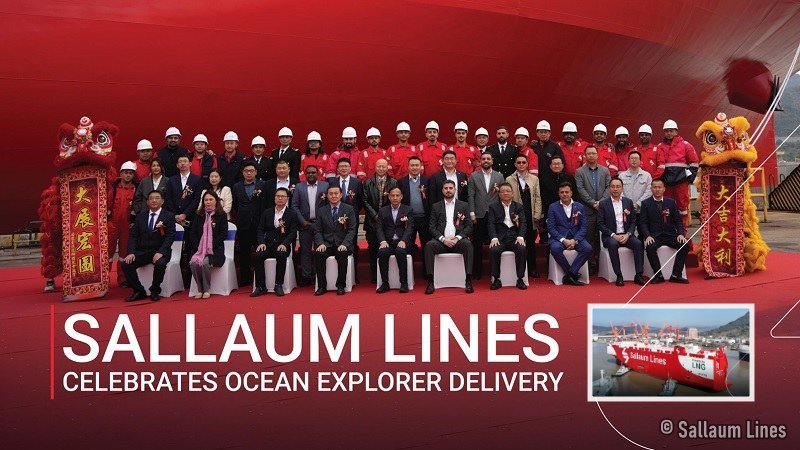
Fuzhou, China | January 07, 2026 – In a major stride toward its 2050 net-zero emissions goal, Sallaum Lines has taken delivery of the MV Ocean Explorer, its newest 7,500 CEU (Car Equivalent Unit) Pure Car and Truck Carrier (PCTC). The delivery, finalized on January 6, 2026, at the Fujian Mawei Shipbuilding facility, marks the arrival of the second vessel in a series of six next-generation, LNG-powered dual-fuel carriers.
The Ocean Explorer joins its sister ship, Ocean Breeze (delivered in mid-2025), as a cornerstone of Sallaum Lines’ “Ocean Class” fleet. This expansion significantly increases the company’s capacity to serve global automotive trade corridors, specifically targeting the growing vehicle flow between Asia, Europe, and North America.
Table of Contents
MV Ocean Explorer Technical Specifications & Design
The Ocean Explorer is engineered for high-volume efficiency and environmental compliance. Its design features 13 vehicle decks capable of transporting a diverse mix of cargo, from passenger electric vehicles (EVs) to heavy trucks and rolling projects.
| Feature | Specification |
| Length Overall | 199.90 meters |
| Breadth (Beam) | 38.00 meters |
| Capacity | 7,500 CEU |
| Decks | 13 (including liftable decks for heavy cargo) |
| Propulsion | LNG Dual-Fuel System |
| LNG Tank Capacity | 3,536.21 cubic meters |
| Shipyard | Fujian Mawei Shipbuilding Ltd., China |
Bunkering & Environmental Impact
A critical milestone for the vessel occurred on December 17, 2025, when the Ocean Explorer successfully completed its first LNG bunkering operation at Mawei Shipyard. By utilizing Liquefied Natural Gas, the vessel achieves:
- Sulphur Oxides (SOx): Near 100% reduction.
- Nitrogen Oxides (NOx): Up to 96% reduction (Tier III compliant).
- Particulate Matter: Over 95% reduction.
- CO2 Emissions: Significant decrease compared to traditional Heavy Fuel Oil (HFO).
The Role of LNG as a Marine Fuel
LNG is the leading choice for new PCTCs, providing a scalable pathway toward Bio-LNG and Synthetic LNG. The successful bunkering of the Ocean Explorer at Mawei Shipyard demonstrates the reliability of the global LNG supply chain, ensuring high-efficiency operations across international routes.
“The delivery of MV Ocean Explorer is another bold step toward a more sustainable future for maritime transport. This vessel reflects our dedication to providing reliable, efficient, and environmentally responsible shipping solutions,” stated Sallaum Lines.
Strategic Growth: From Keel Laying to Operation
The journey of the Ocean Explorer has been a showcase of rapid shipbuilding execution. Following its keel laying as the second in the series, the vessel was launched in October 2025, signaling the completion of its primary hull structure. The transition from launch to delivery in just a few months, and reportedly ahead of the original contract schedule, underscores the strong partnership between Sallaum Lines and Fujian Mawei Shipbuilding.
Towards Net-Zero 2050
Sallaum Lines remains committed to its visionary mission of reaching zero emissions by 2050. With the Ocean Explorer now active, the company is on track to have its entire “Ocean Class” series operational by 2027, adding a total of 45,000 CEU of “green” capacity to the global maritime market. In the past year, the company has achieved several additional strategic goals:
- Biofuels Transition: Initiation of biofuel trials for its existing fleet to bridge the gap toward total decarbonization.
- Digitalization: Upgrading satellite communication services with NexusWave (partnered with Inmarsat) to enhance fleet-wide connectivity.
About Sallaum Lines
Established in 2010, Sallaum Lines ranks among the top 10 vehicle carriers globally, specializing in RoRo cargo transportation. The company’s modern fleet and customer-centric approach underscore its vision for a sustainable and prosperous future in the maritime industry. Prioritizing innovation and environmental stewardship, Sallaum Lines is committed to achieving zero emissions by 2050.
Source: Sallaum Lines