
Barcelona, Spain | January 27, 2026 – In the global maritime energy transition, headline growth figures often attract attention. But leadership is more accurately measured by consistency, operational maturity, and readiness for scale. In this regard, the Port of Barcelona’s LNG bunkering performance in 2025 stands out as one of the most instructive case studies in Europe.
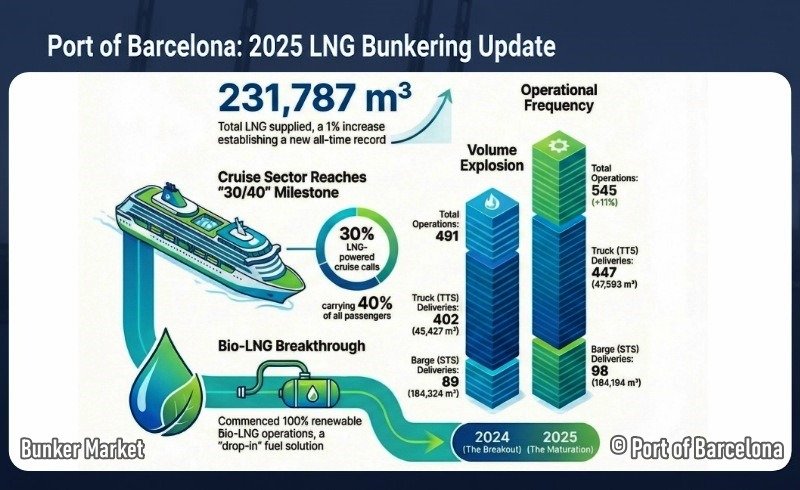
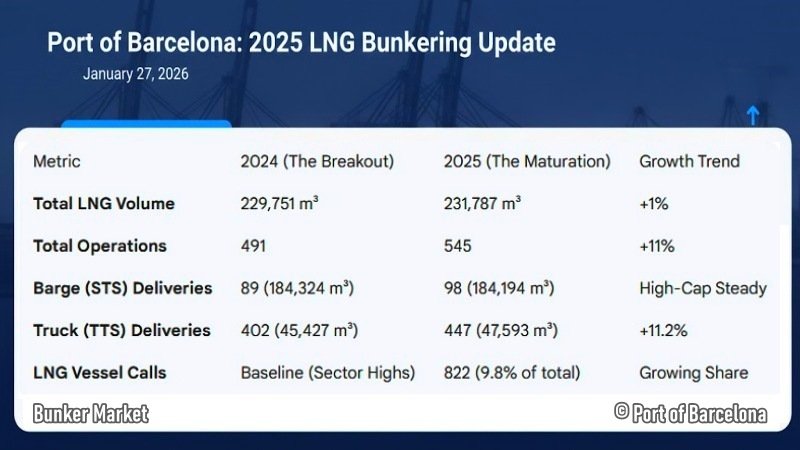
During 2025, the Port of Barcelona supplied 231,787 m³ of LNG, representing an increase of close to 1% compared to its all-time record in 2024. While this year-on-year growth appears modest at first glance, it reflects a port operating at the upper limits of its current infrastructure, while maintaining its position as Spain’s leading LNG bunkering port and one of the foremost LNG hubs in Europe.
Table of Contents
Operational Intensity at Infrastructure Limits
The most telling indicator of 2025 was not volume alone, but operational intensity. According to the port, a total of 545 LNG supply operations were carried out during the year. Of these, 98 ship-to-ship (STS) operations were conducted via LNG bunker barge, supplying 184,194 m³, while the remaining operations were carried out by tanker trucks.
Despite relatively stable volumes, the number of STS operations increased at a double-digit rate compared to the previous year, underscoring the port’s ability to optimize scheduling and logistics within fixed physical constraints.
Central to this performance was the Haugesund Knutsen LNG bunker barge, owned by Knutsen-Scale Gasi, which has been operating from a permanent base in Barcelona since early 2023. As confirmed by the Port Authority, the barge operated at maximum operational capacity for several months in 2025, particularly during peak cruise activity.
This sustained utilization highlights both the reliability of existing assets and the growing demand pressure on the port’s LNG bunkering system.
Strategic Contribution from Baleària and Market Stability
The Port of Barcelona has also emphasized the role of Baleària, whose continued commitment to LNG propulsion, and the slight increase in its ship-to-ship LNG supply operations during 2025, contributed to maintaining overall growth despite infrastructure saturation.
This steady demand provided important operational continuity during periods of peak utilization and reflects the value of long-term partnerships between ports and shipping companies in supporting the energy transition.
Cruise Shipping Confirms LNG’s Role as a Transition Fuel
One of the most decisive signals from 2025 came from the cruise sector. Approximately 30% of all cruise calls at the Port of Barcelona were made by LNG-powered vessels, accounting for more than 40% of total cruise passengers. This concentration of modern, lower-emission tonnage reinforces Barcelona’s role as a preferred Mediterranean hub for next-generation cruise shipping.
Beyond cruise vessels, the port continues to see LNG adoption expand to new ship types, including car carriers (PCTCs), further diversifying the LNG bunkering customer base and strengthening the port’s commercial resilience.
Bio-LNG Enters Operations
In parallel with conventional LNG, bunkering operations for Bio-LNG (liquefied biomethane) commenced at the Port of Barcelona during 2025. The introduction of this renewable fuel represents an important step in supporting compliance with FuelEU Maritime, the European Green Deal, and the Fit for 55 framework.
As LNG is used as a transition fuel, it delivers immediate local and global environmental benefits:
- 100% reduction in sulphur oxides (SOx) and particulate matter
- Up to 70% reduction in nitrogen oxides (NOx)
- Around 20% reduction in CO₂ emissions
The start of Bio-LNG operations positions the port to progressively expand renewable fuel availability as supply and demand mature in the coming years.
Seven Years of LNG Growth Built on Structural Strength
Over the past seven years, LNG bunkering at the Port of Barcelona has experienced sustained and significant growth. This has been supported by several structural factors repeatedly highlighted by the port:
- The presence of major LNG infrastructure within the port
- The entry into operation of the Haugesund Knutsen bunker barge
- The long-term commitment of Baleària to LNG
- The consolidation of LNG within the cruise industry
- The arrival of new LNG-fuelled vessel segments, including car carriers
Together, these elements have transformed LNG from an alternative fuel into an integrated component of the port’s energy ecosystem.
Preparing the Next Phase: 2026 and Beyond
Looking ahead, the Port of Barcelona is actively preparing the next stage of LNG and alternative fuel development. Commercial specifications for LNG bunkering services are currently being drafted, with a simplified authorisation framework by vessel type, including cruise ships, container ships, RoRo and RoPax vessels. The port has also confirmed plans to conduct its first LNG bunker supplies to container ships and anchored vessels in 2026, expanding the scope of operations.
To support future volume growth, the port has identified the need to increase the number of authorized fuel and barge suppliers. Several companies have already expressed interest in positioning LNG barges in Barcelona or elsewhere in the Western Mediterranean, which would relieve current capacity constraints.
At the same time, the port is drafting commercial service specifications for methanol bunkering, with the first pilot methanol bunkering test scheduled to be carried out this year, marking a further step toward zero-emission fuels.
A Year That Defined Maturity
In an industry often focused on rapid expansion, 2025 demonstrated the Port of Barcelona’s operational maturity. Maintaining growth while operating at maximum capacity is a signal not of stagnation, but of demand readiness, and of a system prepared for scale.
By consolidating LNG operations, initiating Bio-LNG supply, and laying the regulatory and technical groundwork for additional operators, container ships, and methanol, the Port of Barcelona has positioned itself not only as a leading LNG hub, but as a reference point for the next phase of maritime energy transition in the Mediterranean.
Source: Port of Barcelona