
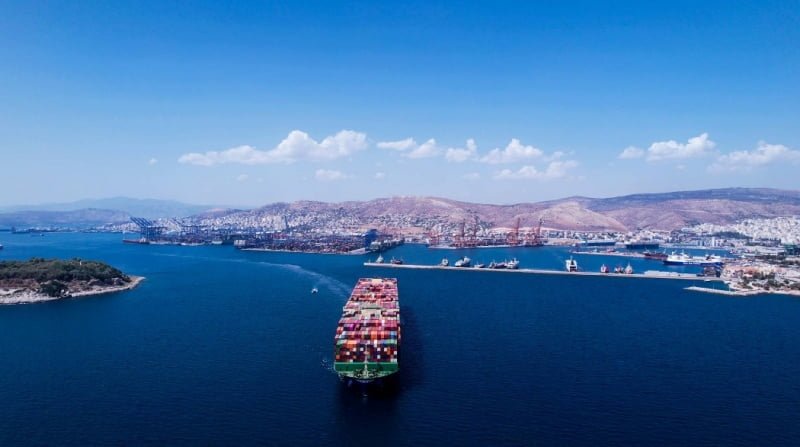
Busan, South Korea | July 23, 2025 – A Joint Development Project (JDP) between flagship carrier HMM and the Korean Register (KR) has completed an exhaustive risk analysis on the use of 100% biofuel (B100) across a fleet of 24,000 TEU-class behemoths, the largest container ships currently afloat. a landmark engineering trial in South Korea has provided the most detailed blueprint yet for the industry’s next major fuel transition.
The findings, centered on 12 “mega-boxships” supplied by energy major GS Caltex, signal that while “drop-in” biofuels offer a rapid escape from carbon taxes, the operational price of 100% adoption involves a shift from mechanical to chemical fuel management.
Table of Contents
The 2026 Regulatory Convergence
The shipping industry is currently caught in a pincer movement between two major EU mandates:
- EU ETS (Emissions Trading System): Starting January 2026, 100% of reported emissions must be converted into allowances (EUAs).
- FuelEU Maritime: This regulation, which entered force in 2025, sets strict limits on the Well-to-Wake (WtW) greenhouse gas intensity of energy used on board.
For HMM, transitioning from B30 (30% blend) to B100 isn’t just an environmental choice; it’s a financial shield. B100 can reduce a vessel’s carbon factor to near-zero in the eyes of the ETS, potentially saving €1.5 million+ per vessel annually in carbon penalties.
The Engineering Reality: Five Critical Nodes of Risk
The KR HAZID (Hazard Identification) team—including experts from HD KSOE, Everllence (MAN), and GS Caltex—identified five functional “nodes” where B100 introduces volatilities that conventional VLSFO does not.
- Oxidation & Polymerization: Unlike fossil fuels, B100 is prone to oxidation. During long-haul transits, the fuel can “thicken” into a sludge, leading to filter clogging and fuel-line seizure.
- The Cold-Flow Crisis: B100 has a higher “cloud point.” In cold-water routes, wax formation can occur rapidly. The study recommends maintaining fuel temperatures at least 10°C higher than the pour point, but cautions against exceeding 40°C above it to prevent gelling.
- Hygroscopy (Moisture Attraction): B100 is “hydrophilic,” actively absorbing water from the atmosphere. This moisture acts as a catalyst for microbial colonies that cause tank corrosion and fuel segregation.
- Combustion Deposits (Coking): While B100 offers superior lubricity, it carries a higher risk of carbon “coking” in the combustion chamber during high-temperature operations, requiring real-time cylinder monitoring.
- Corrosion of Seals & Gaskets: B100 acts as a solvent. The study warns that rubber sealings, gaskets, and metallic components containing copper or brass may degrade, requiring a fleet-wide audit of fuel system materials.
Mechanical Verdict: Not a “Plug-and-Play” Solution
A critical takeaway for bunkering managers is that major engine manufacturers like MAN Energy Solutions and Wärtsilä only grant conditional approval for B100. Compatibility depends on:
- Active Moisture Management: Implementing nitrogen blanketing or continuous dewatering.
- Thermal Control: Retrofitting advanced trace-heating for fuel lines.
- Fuel Age: B100 must be treated as “perishable goods,” with the study recommending use within a short window to prevent chemical degradation.
The B100 Management Blueprint
| Hazard Node | Key Risk | Operational Requirement |
| B.F.O Transfer | Pump Cavitation | Keep viscosity stable via heat exchangers |
| Fuel Purification | Filter Clogging | Use 10-micron auto-backflushing filters |
| Equipment Ops | Carbon Deposits | Monitor cylinder pressure in real-time |
| Sludge & Bilge | Emulsification | Use bio-compatible Oily Water Separators |
| Tank Storage | Microbial Growth | Periodic biocide treatment & moisture sounding |
Conclusion: The “Laboratory” Engine Room
The HMM/KR study concludes that B100 is a viable weapon for the 2030 GHG reduction targets (aiming for 36-47% reduction). However, it transforms the engine room from a purely mechanical space into a chemical laboratory.
For the modern shipowner, the “HMM Model” proves that B100 can save millions in EU ETS costs, but only if the crew is trained to manage the fuel’s biological lifecycle. The era of “passive” bunkering is over; the era of active chemical management has begun.
Partner Contributions
| Partner | Sector | Key Project Contribution |
| HMM | Shipping | Provided the 24k TEU fleet and operational data. |
| KR | Class | Led risk assessment (HAZID) and safety certification. |
| GS Caltex | Energy | Supplied B100 and managed fuel chemical analysis. |
| HD KSOE / HHI | Shipbuilding | Analyzed vessel structural and transfer system integrity. |
| Everllence (MAN) | Engineering | Set technical engine parameters for B100 combustion. |
| SAMGONG | Equipment | Developed filtration and sludge management solutions. |
About HMM
HMM is a globally recognized leader in integrated logistics and shipping services, offering a wide range of customized solutions for various cargo types, including container, bulk, and special cargo. The company operates a fleet of over 100 vessels, ensuring seamless and reliable shipping services across the globe. HMM’s commitment to sustainability, innovation, and customer-focused service positions it as a vital player in the future of the maritime industry.
About Korean Register (KR)
Founded in 1960, the Korean Register (KR) is a leading classification society renowned for its technical service excellence. KR offers a wide range of services for ships and marine structures, including technical support, compliance verification, and R&D services. The organization is committed to enhancing the safety of life and property at sea while promoting environmental protection.
KR’s team of highly skilled professionals leverages their extensive experience in shipbuilding, shipping, and engineering to stay at the forefront of industry developments, continuously improving safety and compliance standards across the maritime sector.
Source Korean Register