
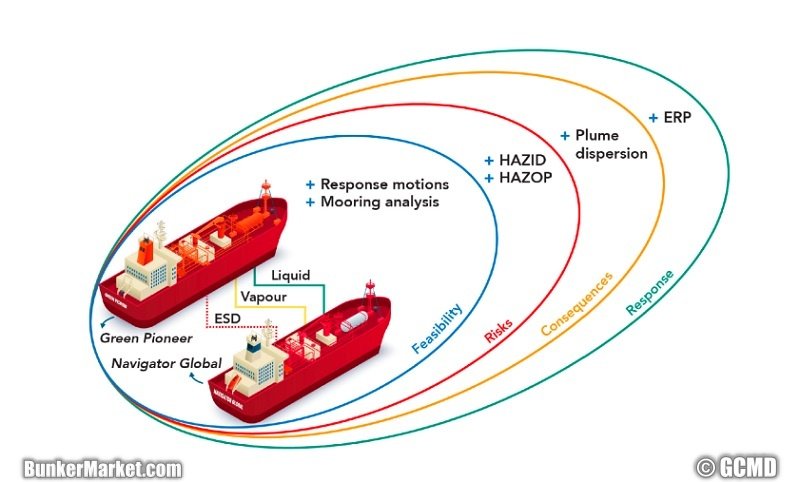
Singapore — June 13, 2025 — In a landmark step toward the decarbonisation of the maritime sector, the Global Centre for Maritime Decarbonisation (GCMD) has released the findings of a pioneering pilot trial that successfully demonstrated the ship-to-ship transfer of liquid ammonia in open waters near Port Dampier, Western Australia. The trial, conducted on 14 September 2024, is being hailed as a key milestone in the pathway to scalable and safe ammonia bunkering operations.
The operation involved two gas carriers — the Green Pioneer and the Navigator Global — conducting a liquid ammonia transfer of 2,700 metric tonnes (MT) at a rate of 700–800 m³/hour at Western Anchorage WA19, located 20 nautical miles off the Pilbara coast. This site was strategically selected for its mature infrastructure, including an existing ammonia terminal, established handling expertise, and a large, dedicated anchorage zone isolated from populated coastal areas.
Table of Contents
Insights from a Landmark Ammonia Transfer Trial
GCMD’s report, titled “Path to zero-carbon shipping: insights from ammonia transfer trial in the Pilbara,” provides a detailed evaluation of the technical, operational, regulatory, and safety-related aspects of the transfer operation.
The pilot simulated both lightering and future bunkering scenarios, and confirmed that — with appropriate safeguards — ship-to-ship ammonia transfer at anchorage is both safe and operationally viable.
The comprehensive safety studies within the report focused on four critical dimensions: feasibility, risks, consequences, and emergency response. Key findings include:
- A mooring analysis evaluating 36 sea states determined that ammonia transfers can be safely executed in conditions up to 20 knots wind speed and 0.3m swell height — parameters well within the thresholds to avoid vessel contact during operations.
- Computational Fluid Dynamics (CFD) modelling of ammonia plume dispersion simulated a conservative 33 m³ deck release (4x the likely worst-case). The model predicted a maximum plume height of 40 metres, width of 60 metres, and length of 750 metres — well contained within the 1 NM anchorage safety buffer, with no significant impact on nearby vessels.
- Risk assessments including HAZID and HAZOP identified 23 medium-level risks, all of which were mitigated using controls such as Emergency Release Couplings (ERC), avoiding Simultaneous Operations (SIMOPS), and deploying a standby incident response vessel.
Emergency Preparedness & Operational Learnings
The report outlines a robust set of emergency response protocols implemented during the trial. These included:
- Deployment of a firefighting tugboat
- A clearly defined communications plan
- Ammonia-specific PPE matrices
- Verification of spill response equipment onboard
- Appointment of a dedicated incident handler
- Execution of emergency drills by the vessel crew
Operational elements such as transfer systems, shutdown procedures, and a chronological sequence of key events are also documented in the report, offering a replicable model for future trials and early commercial use.
Paving the Way for Commercial Ammonia Bunkering
This trial comes at a pivotal time for the maritime industry. The first two-stroke dual-fuel ammonia engine is set to enter service in early 2026, and the IMO’s recent approval (April 2025) of a global emissions pricing framework — based on fuel greenhouse gas (GHG) intensity — is expected to further accelerate the adoption of low- and zero-carbon fuels like ammonia.
According to Professor Lynn Loo, CEO of GCMD, the significance of the trial goes beyond the successful transfer itself:
“In the past, bunkering guidelines took years to develop and were typically derived from experience with actual operations. In this case, guideline development is preceding commercial-scale implementation, which makes it essential that these pilot studies are rich in detail and utility. The insights gathered here will help shape safer operational procedures, response plans, and international guidelines for ammonia handling.”
GCMD continues to collaborate with global stakeholders to address remaining safety, technical, and infrastructure challenges associated with ammonia as a marine fuel, with further pilots planned across major bunkering hubs.
A Step Toward Zero-Carbon Shipping
As global shipping intensifies efforts to decarbonise, ammonia is increasingly viewed as a leading candidate for future marine fuel. However, its highly toxic and corrosive nature presents unique handling challenges. This GCMD-led trial provides proof-of-concept that — with meticulous planning and robust protocols — ammonia can be transferred safely at sea.
The Pilbara ammonia transfer trial now stands as a benchmark for regulators, port authorities, classification societies, and ship operators seeking practical, science-based frameworks for future ammonia bunkering operations.
About the Global Centre for Maritime Decarbonisation (GCMD)
Founded in August 2021 and headquartered in Singapore, GCMD was established with an initial endowment of S$120 million from the Maritime and Port Authority of Singapore (MPA) and six founding partners: BW Group, BHP, Eastern Pacific Shipping, Ocean Network Express, Sembcorp Marine (now part of Seatrium), and Shell.
GCMD’s mission is to help the maritime industry eliminate greenhouse gas emissions by:
- Conducting feasibility studies and real-world pilot projects.
- Shaping future fuel supply chains.
- Developing technical and regulatory standards in collaboration with regulators and industry.
GCMD is currently spearheading projects involving ammonia bunkering trials, carbon capture onboard vessels, and establishing drop-in fuel verification frameworks, among others.
Source GCMG