
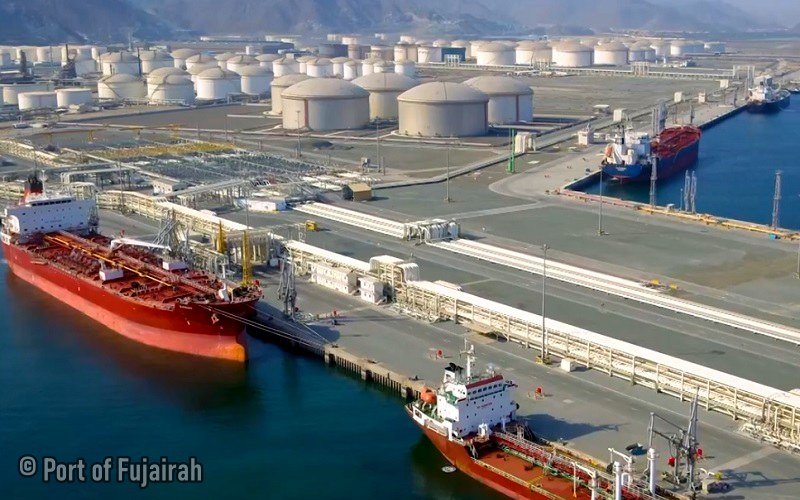
Fujairah Bunker Sales Report 2025, Fujairah remains a critical strategic node in the global maritime corridor, though 2025 marked a transition toward “softer volumes” with total bunker sales reaching 7.40 million cubic meters.
Fujairah | January 19, 2026 – Fujairah continues to occupy a critical position within the Middle East’s maritime corridor, functioning as a key barometer for global ton-mile demand and overall shipping health. However, the 2024-2025 period marked a transition from post-disruption recovery to a phase of cautious consolidation, where bunker fuel sales in 2025 reach to 7.40 million cubic meters.
While 2024 delivered strong volume growth and a temporary recovery of global market ranking, 2025 saw bunker fuel demand soften as evolving trade patterns, intensified regional competition, and heightened safety considerations reshaped vessel routing decisions. The result was a modest contraction in volumes and a recalibration of Fujairah’s competitive standing.
Table of Contents
Year-on-Year Performance Overview
| Metric | 2024 | 2025 |
|---|---|---|
| Total Sales Volume | 7.61 million m³ | 7.40 million m³ |
| YoY Change | +1.9% (vs. 2023) | −2.8% (vs. 2024) |
| Global Ranking | 3rd | 4th |
The loss of third place in the global bunkering rankings in 2025 represents a meaningful strategic inflection point. In 2024, Fujairah’s throughput of 7.61 million m³ comfortably surpassed Zhoushan, China, which recorded 7.26 million metric tons (approximately 7.33 million m³).
By 2025, that lead had eroded. Zhoushan’s rapid infrastructure expansion, coupled with increasingly competitive pricing, enabled it to capture a larger share of East Asian vessel deviation flows. Together with Singapore’s record-breaking performance, this shift underscores an eastward realignment in the global bunkering center of gravity, intensifying competitive pressure on Fujairah and exposing it to greater regional volatility.
Product Mix Evolution: HSFO Emerges as the Growth Anchor
Beyond headline volumes, the most consequential development during the period was a structural reshaping of Fujairah’s fuel grade demand.
As shipowners seek cost-efficient pathways to environmental compliance, Fujairah has experienced a decisive shift away from low-sulphur fuels toward high-sulphur alternatives, particularly for scrubber-equipped vessels.
High-Sulphur Fuel Oil (HSFO)
HSFO has emerged as Fujairah’s most resilient and strategically important product:
- 2024: HSFO sales surged 17%, exceeding 2.1 million m³
- 2025: Volumes rose a further 4% to 2.22 million m³
Strategic Implication: HSFO’s growth signals a durable transformation in the port’s demand profile. Market share expanded from 20% in 2022 to 28% in 2024, before reaching a record monthly peak of 35.9% in September 2025. This expansion has been driven primarily by an influx of scrubber-fitted bulkers and tankers seeking to capitalize on the widening price differential between HSFO and VLSFO.
For port operators and suppliers, this trend necessitates a reallocation of tankage and logistical capacity to support higher HSFO throughput.
Low-Sulphur Fuels: A Gradual Retreat
In contrast, low-sulphur grades have entered a sustained downtrend:
- 2024: Combined VLSFO and MGO sales declined 3% to approximately 5.55 million m³
- 2025: VLSFO (380 CST) volumes fell a sharper 7.3% to 4.72 million m³
This divergence highlights Fujairah’s increasing specialization as a hub for scrubber-heavy trade routes, a dynamic also reflected in heightened monthly volume volatility.
Monthly Performance and Volatility Drivers
Monthly bunker sales during 2024–2025 exhibited pronounced variance, illustrating Fujairah’s sensitivity to both cyclical recovery effects and external geopolitical pressures.
Monthly Bunker Sales Comparison
| Month | 2024 (m³) | 2025 (m³) | Key Driver |
|---|---|---|---|
| January | 674,632 | 655,000 | Strong start; HSFO at 29% share |
| February | 633,436 | 554,117 | 2025 low |
| March | 700,918 | 639,811 | 2024 peak; 2025 rebound |
| April | 638,960 | 669,378 | 2025 peak |
| May | 615,462 | 614,296 | Regional tensions |
| June | 610,765 | 563,000 | Safety-driven vessel avoidance |
| July | 621,679 | 650,000 | Seasonal Q3 recovery |
| August | 656,034 | 650,714 | Stable daily demand |
| September | 614,929 | 639,001 | HSFO share peaks at 35.9% |
| October | 635,471 | 623,694 | Softer VLSFO pricing |
| November | 606,042 | 569,000 | Sharp YoY contraction |
| December | 606,427 | 572,000 | Soft year-end close |
Interpreting the Extremes
- March 2024 marked the period’s strongest performance, with volumes up 25.2% year-on-year as post-disruption demand normalized.
- April 2025, the highest month of that year, was driven almost entirely by HSFO demand rather than broad-based recovery.
- February 2025 recorded the lowest monthly volume since formal reporting began in 2021, reflecting acute market caution.
- June 2025 underscored the impact of geopolitical risk, as vessel operators actively minimized regional exposure.
Despite this volatility, March 2025 demonstrated Fujairah’s ability to rebound swiftly, posting a 15.5% month-on-month recovery when conditions aligned.
Competitive Pressures and Strategic Risks
Fujairah’s performance in 2025 was shaped as much by competitive dynamics as by absolute demand.
Key Threat Vectors
- Intra-regional pricing pressure: Competing ports such as Khor Fakkan and Jebel Ali frequently undercut Fujairah on fuel pricing, diverting regional demand.
- Asian hub expansion: Singapore’s scale and Zhoushan’s rapid ascent have reshaped global bunkering hierarchies.
Geopolitical Risk Premiums
The critical takeaway from Fujairah’s 2.8% volume decline in 2025 is the reintroduction of meaningful “risk premiums” into voyage planning. Unlike 2024, when disruptions redirected traffic toward established hubs, the 2025 environment encouraged avoidance rather than consolidation. This shift disproportionately impacted volumes during high-risk months such as June and November.
Fujairah Remains an Indispensable Node
Despite a modest annual contraction and a slip to fourth place globally, Fujairah’s 2024–2025 performance underscores its structural resilience. The port has successfully adapted to evolving fleet economics by capturing a growing share of HSFO demand, while continuing to deliver operational reliability amid regional uncertainty.
As global bunkering patterns evolve, Fujairah remains an indispensable node, one that is recalibrating rather than retreating, positioned to retain its strategic relevance in an increasingly competitive and risk-sensitive maritime landscape.
Source: Fujairah Oil Industry Zone