

Bunker One has successfully executed Latin America’s first bioethanol bunkering of a deep-sea vessel, delivering 500,000 liters of anhydrous ethanol to a tri-fuel CMA CGM container ship at the Port of Santos. Powered by Copersucar’s mature supply chain and Bunker One’s specialized low-flashpoint safety protocols, the landmark operation proves that bioethanol is no longer just a concept, but a safe, commercially viable marine fuel ready for global shipping.
Santos, Brazil | July 14, 2026 – As the global maritime industry navigates the complexities of the energy transition, the conversation has rapidly shifted from theoretical fuel viability to the cold realities of port-side execution. While laboratory-tested alternative fuels offer promising decarbonization pathways on paper, the maritime sector’s ultimate decarbonization relies on a singular, critical capability: safe, commercial-scale physical delivery at the point of demand.
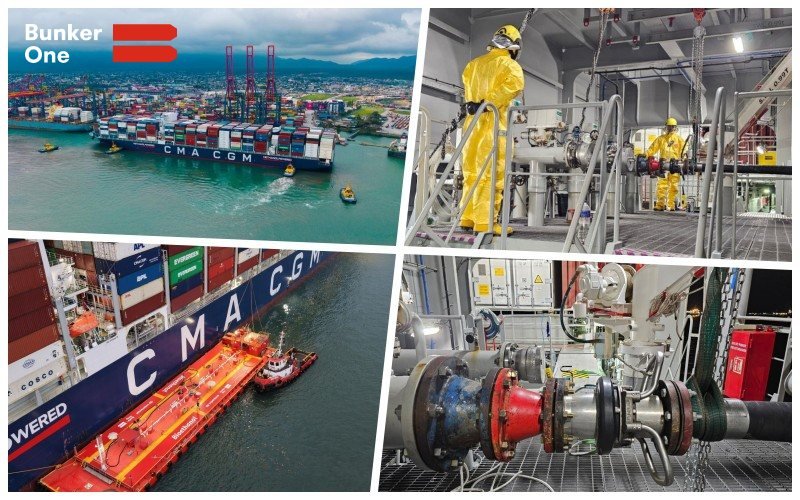
In a landmark development for regional and global bunkering, Bunker One has bridged this gap in Latin America. The physical supplier successfully executed the region’s first-ever bioethanol bunkering operation for an ocean-going vessel, delivering 500,000 liters (approximately 400 metric tons) of anhydrous ethanol to the CMA CGM IRON at the Port of Santos, Brazil.
This historic operation, carried out via Bunker One’s bunker barge DONA ISA, marks a pivotal transition for bioethanol, elevating it from a niche conceptual fuel to a commercially viable, physically delivered reality for deep-sea container shipping.
The Strategic Partnership: Connecting Supply to Demand
The scale of the operation required a seamless integration of world-class agricultural supply chains and highly specialized marine logistics.
- The Fuel Provider: The anhydrous ethanol was supplied by Copersucar, one of the world’s largest sugar and bioethanol cooperatives.
- The Vessel: The recipient was the CMA CGM IRON, CMA CGM’s state-of-the-art 13,000 TEU container vessel. The vessel is equipped with a certified tri-fuel engine designed to run on conventional fuels, liquefied natural gas (LNG), and low-flashpoint bioethanol.
- The Bunker Operator: Bunker One LatAm managed the entire last-mile delivery, utilizing its bunker barge DONA ISA to safely transfer the liquid cargo.
Peter Zachariassen, CEO of Bunker One, said “The question is no longer whether bioethanol can be used as a marine fuel. It is whether it can be supplied safely and reliably at the point of demand. This operation demonstrates Bunker One’s ability to bring together the expertise, infrastructure, and execution required to make that happen.”
Overcoming the Low-Flashpoint Hurdle
While bioethanol represents a highly effective pathway to lower greenhouse gas (GHG) emissions, it introduces significant technical hurdles at the manifold. As a low-flashpoint liquid (with a flashpoint of approximately 13C / 55F, ethanol is highly volatile compared to conventional marine fuels like Very Low Sulfur Fuel Oil (VLSFO), which require a minimum flashpoint of 60C under SOLAS regulations.
Handling low-flashpoint fuels requires entirely different operational protocols, specialized equipment, and intensive risk mitigation. To transform the barge DONA ISA into an eligible supply asset, Bunker One underwent rigorous technical preparation:
Technical & Safety Protocols Implemented
- Cargo Tank Conditioning: The barge’s cargo tanks underwent meticulous preparation and inerting to safely accommodate the chemical and physical properties of anhydrous ethanol.
- Specialized Transfer Procedures: Custom closed-loop transfer protocols were engineered to prevent vapor escape during the bunkering process.
- Regulatory Alignment: Bunker One incorporated the International Association of Ports and Harbors (IAPH) checklist for low-flashpoint fuel operations, establishing a new operational benchmark for the region.
- Human Element & Training: Before a single liter of fuel was transferred, crew members, operational personnel, and Health, Safety, and Environment (HSE) teams underwent comprehensive theoretical and physical dry-run training programs.
Brazil’s Scaling Advantage in the Marine Fuel Mix
For international shipping lines plotting their multi-fuel strategies, fuel availability and scalability are paramount. This is where the Santos operation carries global significance. Unlike synthetic e-fuels or green ammonia, which face severe global supply deficits and infrastructure bottlenecks, bioethanol boasts an incredibly mature, pre-existing supply chain, most notably in Brazil.
Why the Brazilian Bioethanol Supply Chain Matters
| Feature | Bioethanol (Brazil) | E-Methanol / Ammonia |
| Supply Chain Maturity | Decades of large-scale commercial production and pipeline infrastructure. | Highly nascent; green production facilities still under planning/construction. |
| Infrastructure | Well-established transport networks, storage terminals, and domestic distribution. | Requires dedicated, high-capital import/export terminal development. |
| Scalability | Immediately available at commercial volumes for maritime off-take. | Highly constrained; limited by global renewable electricity capacity. |
By linking Copersucar’s massive agricultural supply chain with Bunker One’s physical bunkering network, the operation demonstrates how Brazil’s domestic biofuel strength can be leveraged directly into the international maritime fuel matrix.
Tomás Manzano, President of Copersucar, said “More than a pioneering bunkering operation, we are building the conditions for ethanol to become part of the navigation energy matrix in a competitive way, expanding Brazil’s leading role in the transition to a low-carbon economy.”
Operationalizing the Energy Transition
As the International Maritime Organization (IMO) tightens its greenhouse gas emission targets toward net-zero by or around 2050, the pressure on physical bunker suppliers to deliver alternative fuels has intensified. The Santos bunkering operation proves that the bottleneck is no longer fuel chemistry, but operational readiness.
By successfully managing the safety, regulatory, and physical challenges of a 500,000-liter low-flashpoint bunkering operation, Bunker One has set a new precedent for Latin America.
Flavio Ribeiro, Managing Director of Bunker One LatAm, said “Brazil already possesses one of the world’s most mature and scalable bioethanol supply chains. This operation demonstrates how that capability can be connected to international shipping through safe and reliable bunkering infrastructure.”
For shipowners investing in multi-fuel and tri-fuel tonnage, the message from the Port of Santos is clear: the infrastructure, the safety protocols, and the physical bunker supply capabilities required to run deep-sea vessels on bioethanol are no longer a future ambition. They are online, operational, and ready to scale.
CMA CGM Reaffirms Multi-Fuel Decarbonization Strategy
For container shipping giant CMA CGM, the operation at the Port of Santos represents a major operational milestone in its diversified approach to fleet decarbonization. The CMA CGM IRON, a 13,000 TEU vessel delivered in 2025, is the first in a series of twelve sister ships equipped with a certified tri-fuel engine designed to run on bioethanol, LNG, and conventional fuels.
The success of the Santos operation highlights CMA CGM’s broader strategic objective to actively test, validate, and scale multiple alternative fuel pathways to achieve Net Zero Carbon by 2050.
Commenting on the landmark bunkering operation, Christine Cabau Woehrel, Executive Vice President of Assets and Operations at CMA CGM Group, emphasized that real-world testing is vital to the industry’s energy transition “Together with our partners, we have shown that innovation can move from the laboratory to real maritime operations. The certification of our first tri-fuel vessel is a major technological milestone for CMA CGM. It opens the way for the broader use of lower-carbon fuels and gives us new options to accelerate the decarbonization of our shipping activities.”
Woehrel extended congratulations to the joint coalition that facilitated the complex logistics, including Bunker One, Copersucar, Ageo Terminais, Santos Brasil and Everllence, noting that the operation was executed to the highest international safety standards despite the handling complexities of low-flashpoint bioethanol.
By combining technological innovation with strong ecosystem partnerships, the carrier aims to accelerate its energy transition while maintaining resilient, competitive global supply chains.
About Bunker One
Bunker One is a leading independent global marine fuel supplier, delivering reliable energy solutions to shipping companies worldwide. Backed by the heritage and financial strength of Bunker Holding and the USTC Group, the company combines global scale with localized physical execution. Operating and controlling assets across more than 20 key physical locations, Bunker One ensures supply security and operational certainty, whether offshore, at anchor, or in port.
From upstream storage positions to last-mile delivery via tanker, barge, truck, or pipeline, the company provides consistent, high-quality execution backed by global standards and local expertise. Beyond conventional marine fuels, Bunker One is actively driving the maritime energy transition. Its evolving portfolio includes biofuels, LNG, methanol, and other alternative fuels, supported by dedicated decarbonization advisory services and hands-on operational experience.
Through its integrated digital platform, AtoZ, the supplier brings transparency and efficiency to fuel procurement, covering pricing, planning, execution, and real-time delivery updates. With physical delivery at the core of its business, Bunker One partners with shipowners, operators, and energy companies to deliver safe, reliable, and future-ready fuel solutions globally.
Source: Bunker One | CMA CGM