
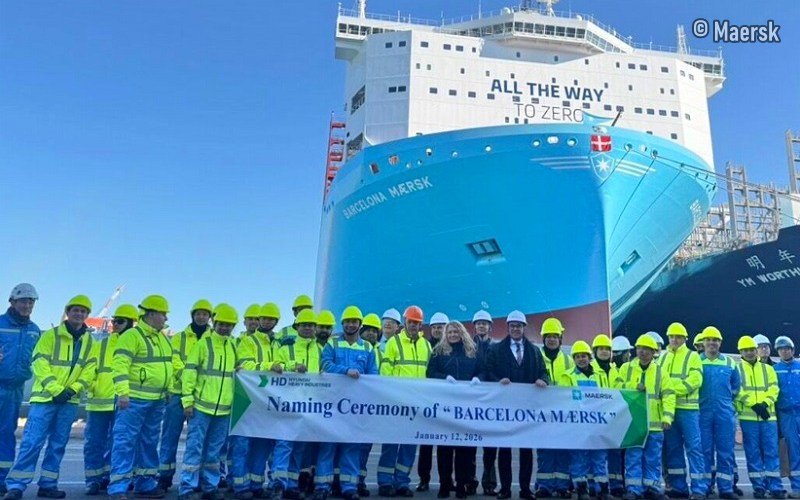
Ulsan, South Korea | January 12, 2026 – A.P. Moller – Maersk has officially taken delivery of the Barcelona Mærsk, marking a major milestone in the carrier’s decarbonization journey. The vessel is the sixth and final ship in a groundbreaking series of 17,480 TEU dual-fuel methanol container vessels built by HD Hyundai Heavy Industries (HHI).
The delivery, celebrated today at the HHI shipyard in Ulsan, South Korea, signifies the completion of the “Equinox Mk-II” class of vessels. These ships represent the next generation of Maersk’s “ocean toolkit,” following the earlier Ane Mærsk class (16,592 TEU). With a wider beam and optimized design, the Barcelona Mærsk and its sister ships are currently the largest methanol-powered vessels in the Danish giant’s fleet.
Table of Contents
Vessel Naming and Ceremony
The vessel was officially named by its godmother, Berit Vincentz Andersen, Senior Communications Advisor for Maersk’s Fleet Management & Technology team. The ceremony was attended by the vessel’s crew, Maersk’s local site team, and representatives from HHI and Everllence.

Technical Specifications & Bunkering Capabilities
Designed to run on green methanol, the Barcelona Mærsk is equipped with a high-efficiency dual-fuel propulsion system.
- Engine: Powered by an 8-cylinder MAN B&W G95ME-C10.5-LGIM dual-fuel engine (built by Hyundai-MAN), capable of operating on both methanol and conventional low-sulfur fuels.
- Fuel Capacity: The vessel features two massive methanol fuel tanks located forward of the engine room with a combined capacity of approximately 16,000 m³.
- Operational Range: When fully bunkered with methanol, the vessel can sail up to 23,000 nautical miles (approx. 41,400 km), allowing for full round-trips on major trade lanes like the AE3 route between Asia and Europe using alternative fuel.
- Environmental Impact: Utilizing green methanol can reduce greenhouse gas (GHG) emissions by up to 90% compared to traditional fossil fuels. On a daily basis, these vessels can save approximately 280 tonnes of CO2.
The Path to Net Zero 2040
The delivery of the Barcelona Mærsk brings Maersk’s total methanol-capable fleet to approximately 19 vessels. This is a critical component of the company’s strategy to reach net-zero GHG emissions by 2040.
Maersk defines “reduced GHG emissions fuels” as those achieving at least 65% lifecycle reductions compared to standard fossil fuels 94g CO2e/MJ. While the company was a first-mover in methanol, it has recently expanded its “multi-fuel” approach to include LNG-fuelled newbuilds to ensure flexibility as the global bunker market for green fuels matures.
| Vessel Feature | Specification |
| Class | Equinox Mk-II |
| Capacity | 17,480 TEU |
| Length / Beam | 350m / 56.4m |
| Propulsion | Dual-fuel Methanol/MGO |
| Builder | HD Hyundai Heavy Industries |
About A.P. Moller – Maersk
A.P. Moller – Maersk is a global leader in integrated logistics, dedicated to connecting and simplifying supply chains for customers worldwide. Operating in more than 130 countries with a workforce of approximately 100,000 employees, the company is leveraging its massive scale to spearhead the maritime industry’s energy transition.
The 2040 Net Zero Mandate
Maersk has set one of the most ambitious climate targets in the shipping sector: achieving net-zero greenhouse gas (GHG) emissions across its entire business by 2040. This target, validated by the Science Based Targets initiative (SBTi), covers all Scope 1, 2, and 3 emissions. To reach this goal, the company is following a multi-pronged roadmap:
- Fleet Renewal: Investing in a new generation of dual-fuel vessels capable of operating on green methanol and other low-emission alternatives.
- Technological Innovation: Implementing AI-driven routing, hull retrofitting (such as the 200-vessel efficiency program), and engine optimizations to reduce fuel consumption.
- Green Logistics: Expanding low-carbon landside transportation, warehousing, and terminal operations to provide end-to-end “green” supply chain solutions.
Defining “Reduced GHG Emissions Fuels”
In the bunkering and marine fuel sector, Maersk adheres to a strict lifecycle (Well-to-Wake) assessment for its fuel sourcing. The company defines “reduced GHG emissions fuels” as those that meet the following criteria:
- Reduction Threshold: At least 65% reduction in GHG emissions on a lifecycle basis.
- Reference Baseline: Compared against a standard fossil fuel baseline of 94g CO_2e/MJ (aligned with the RED II methodology).
By prioritizing fuels that significantly outperform conventional VLSFO and MGO, Maersk aims to move beyond incremental gains and achieve the deep decarbonization required to meet the 1.5°C pathway.
Source: A.P. Moller – Maersk