
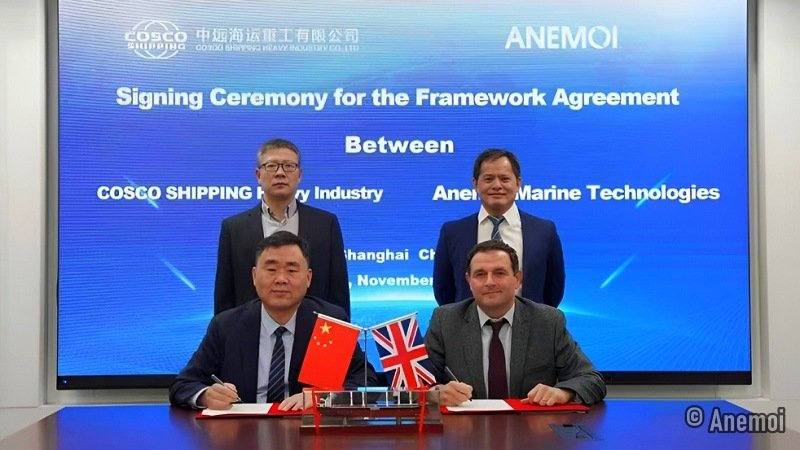
Anemoi Marine Technologies and COSCO SHIPPING Heavy Industry have renewed their landmark agreement to provide turnkey Rotor Sail installations across nine Chinese shipyards.
London | February 10, 2026 – In a significant move for the maritime decarbonization sector, UK-based Anemoi Marine Technologies and COSCO SHIPPING Heavy Industry Ltd (CHI) have officially renewed and expanded their framework agreement. The deal cements a long-term partnership aimed at streamlining the installation of Rotor Sail technology across CHI’s extensive network of Chinese shipyards.
The announcement comes as the shipping industry faces mounting pressure from CII (Carbon Intensity Indicator) ratings and the EU Emissions Trading System (EU ETS), driving a surge in demand for proven wind-assisted propulsion systems (WAPS).
Table of Contents
A Proven Track Record: From Concept to VLOC Scale
Since their initial cooperation agreement in 2022, the duo has moved beyond pilot projects to large-scale commercial deployments. To date, the partnership has successfully completed the installation of nine Rotor Sails at CHI subsidiary shipyards.
Key milestones include:
- Vale & U-Ming VLOCs: High-profile installations on Very Large Ore Carriers (VLOCs) at CHI Zhoushan, including the Grand Pioneer.
- Rapid Integration: Recent projects have demonstrated a “plug-and-play” capability, with sails being lifted and secured in as little as 1.5 days, significantly reducing off-hire time for owners.
- Tonnage Milestone: Anemoi recently surpassed 1.6 million DWT of vessel tonnage equipped with its technology, much of it facilitated through CHI’s technical infrastructure.
Turnkey Solutions for the Global Fleet
The renewed agreement shifts the collaboration into a higher gear. Under the updated terms, CHI provides full-spectrum technical installation services, ranging from initial integration design to final onboard commissioning.
For shipowners, this “one-stop-shop” approach at any of CHI’s nine large-scale shipyards offers:
- Flexibility: Customers can choose from a variety of service levels and locations across the CHI network in China.
- Cost Clarity: Shared data from previous projects allows for more accurate forecasting of installation costs and timelines.
- Retrofit & Newbuild Support: The framework covers both the retrofitting of the existing fleet and the integration of wind propulsion into newbuild designs.
“Renewing our framework agreement with CHI marks a major benefit for our customers. By combining CHI’s installation expertise with our proven Rotor Sail technology, we can deliver even more value, clarity, and confidence to owners.” said Nick Contopoulos, CCO of Anemoi Marine Technologies.
The Technology: Harnessing the Magnus Effect
Anemoi’s Rotor Sails (also known as Flettner Rotors) are tall, spinning cylinders that use the Magnus effect to generate forward thrust. When wind hits the spinning rotor, it creates a pressure differential that pulls the ship forward, allowing the main engine to be throttled back.
| Feature | Specification / Benefit |
| Fuel Savings | Typically 5–30% depending on route and vessel type. |
| Design Options | Fixed, Rail-mounted (movable), or Folding (to clear air draft). |
| Environmental Impact | Direct reduction in CO2, SOx, and NOx emissions |
| Regulatory Boost | Significantly improves EEDI, EEXI, and CII scores. |
Jony Guo, Director, Repair & Conversion, Commercial Headquarters of CHI, commented: “We are delighted to renew and expand our partnership with Anemoi. Our combined experience position us strongly to support the growing adoption of wind-assisted propulsion. This agreement reflects our ongoing commitment to enabling greener maritime operations.“
Wind’s Second Wind
The timing of this renewal is strategic. With bunker prices remaining volatile and new 2026 environmental benchmarks approaching, the market for wind-assisted propulsion is projected to grow at a CAGR of over 7% through 2032. By aligning with a shipbuilding giant like COSCO, Anemoi ensures its technology is backed by the industrial muscle required for global fleet-wide adoption.
The Anemoi Marine Technologies: Reclaiming the Wind for the 21st Century
While the shipping industry spent the last century tethered to the fluctuations of the oil market, a London-based team of innovators was looking up. Anemoi Marine Technologies, Wind propulsion technology expert, has taken a 100-year-old concept, the Flettner Rotor, and weaponized it with modern materials science and AI-driven automation.
Rotor Sails the Science: The Magnus Effect
Anemoi’s Rotor Sails are not traditional “sails” in the sense of canvas and rigging. They are massive, spinning composite cylinders. When wind hits the spinning surface, it creates a pressure differential, low pressure in front, high pressure behind, known as the Magnus Effect. This generates a powerful forward thrust that pulls the ship through the water, allowing the main engines to throttle back.
Key Performance Metric: Anemoi’s technology can reduce fuel consumption and carbon emissions by 5% to 30%, depending on the vessel type and route.
Three Pillars of Innovation
What sets Anemoi apart in a crowded “Green Tech” market is their focus on operational reality. They recognize that a 35-meter tower is a liability in a busy port unless it can adapt. They offer three distinct deployment systems:
- Fixed: Vertical towers for vessels with no height or cargo-access restrictions.
- Rail-Mounted: The rotors can slide along the deck to clear the way for massive port cranes.
- Folding: The towers “tuck away” to clear low bridges or air-draught restricted waterways.
A Decade of Momentum
- 2015: Anemoi is incorporated, fueled by a mission to solve the shipping emission crisis.
- 2018: Successful pilot on the m/v Afros, the first-ever installation on a dry bulk carrier, which swept international industry awards.
- 2024: The “Gigantism” era begins. Installation of five Rotor Sails on the Sohar Max, a 400,000 DWT Valemax, the largest wind-propelled vessel in history.
- 2025/2026: Global scaling. The opening of a state-of-the-art production facility in Jiangsu, China, capable of producing 250 rotors per year to meet surging demand
Source: Anemoi Marine Technologies