
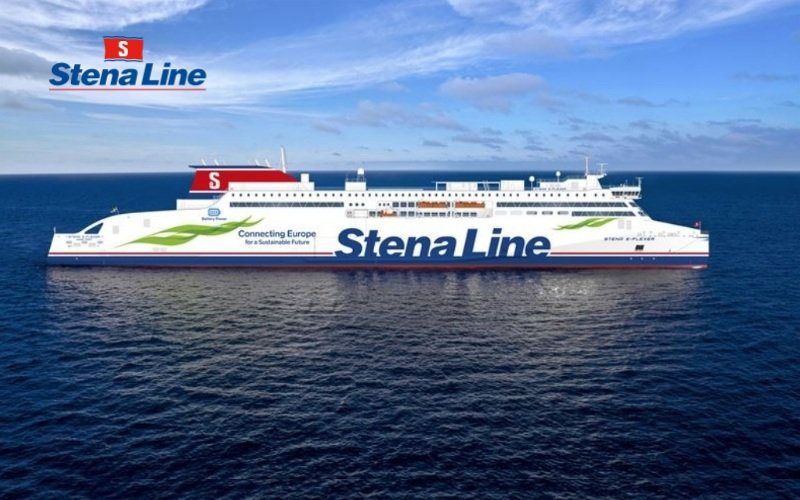
Stena Line has placed an order for two advanced hybrid E-Flexer RoPax ferries, scheduled to enter service on the Gothenburg–Frederikshavn route by 2030. The new day ferries will feature hybrid propulsion capable of running on conventional fuel or electricity, with full future-proofing for 100% electric operation as shoreside infrastructure develops. Built by China Merchants Industry Weihai Shipyard, the vessels will accommodate 1,500 passengers and 2,750 lane metres of freight, driving Stena Line’s sustainable fleet modernization and CO₂ reduction targets.
Gothenburg | September 23, 2026 – Stena Line has announced a major investment in its fleet, placing an order for two advanced hybrid E-Flexer ferries slated to enter service in 2030. Designed specifically as high-capacity day ferries, the new vessels will primarily serve the vital Gothenburg–Frederikshavn route, replacing long-serving workhorses while significantly advancing the company’s decarbonization roadmap.
The newly commissioned RoPax ferries represent a major milestone for the marine fuel and maritime sectors, blending high-volume logistics with cutting-edge green propulsion technology.
E-Flexer 2.0: Technical Specifications at a Glance
The new ships will represent the sixth and seventh E-Flexer vessels in Stena Line’s expanding network, following successful deployments on the Irish Sea and between Sweden and Poland. They will be constructed by the China Merchants Industry Weihai Shipyard, which has delivered 15 E-Flexer class ships to date.
- Length: 214.5 metres
- Width: 27.8 metres
- Vehicle Capacity: Three vehicle decks (one for passenger vehicles, two for freight)
- Freight Lane Metres: 2,750 lane metres
- Passenger Capacity: 1,500 passengers
- Accommodation: 132 cabins designed for crew and passengers
- Builder: China Merchants Industry Weihai Shipyard, China
- Scheduled Delivery: 2030
Pioneering Hybrid Propulsion and Future-Proofing
The vessels will feature state-of-the-art hybrid propulsion technology, providing the flexibility to operate on conventional marine fuels or electricity. Crucially, the design is fully future-proofed for a transition to 100% electric operation once regional shoreside charging infrastructure matures.
“This is a historic investment for Stena Line, giving us the opportunity to take further steps towards the sustainable modernisation of our fleet, At the same time, we are future-proofing our own CO₂ reduction targets while preparing for the stricter environmental requirements ahead,” said Niclas Mårtensson, CEO of Stena Line.
Retiring a Generation, Boosting Freight Logistics
The incoming E-Flexers will supersede iconic legacy vessels on the Denmark corridor: the Stena Danica (in service since 1984) and the Stena Jutlandica (in service since 1996).
According to Christina Bromander, Trade Director for Stena Line’s Denmark routes, the capacity boost is strategically timed “With the new vessels, we are increasing our freight capacity, which we believe will be particularly valuable in connection with our upcoming move to a new port location in Arendal. The conditions there are excellent for developing our freight business, with opportunities for increased intermodality thanks to the rail connection.”
While custom-built for the Gothenburg–Frederikshavn corridor, the ships are engineered with operational flexibility in mind, capable of deployment across other daytime routes within Stena Line’s network to ensure high redundancy.
- Expanded Capacity: The 2,750 lane metres will heavily boost regional freight throughput.
- Strategic Port Relocation: The added capacity aligns directly with Stena Line’s upcoming move to a new port location in Arendal, which features superior rail connections for enhanced intermodal transport logistics.
Expanding the E-Flexer Legacy
With this latest order, the total number of E-Flexer vessels in Stena Line’s network will rise to seven. The series has proven to be a cornerstone of the company’s fleet strategy since the first unit debuted in 2019. Currently, three E-Flexers operate on the Irish Sea, while two connect Sweden and Poland.
Construction will take place at the China Merchants Industry Weihai Shipyard, a facility with extensive experience having already delivered 15 E-Flexer-class vessels globally.
Mårtensson concluded: “This major investment demonstrates Stena Line’s long-term commitment, our determination to prioritise the sustainable transition and our confidence in the continued strong development of the Gothenburg–Frederikshavn route.”
As regulatory pressures mount across the maritime sector, Stena Line’s latest commitment highlights how major ferry operators are successfully bridging commercial growth with long-term, zero-emission ambitions.
About Stena Line
Stena Line is one of Europe’s leading ferry companies, operating approximately 40 vessels across 19 routes in Northern Europe and the Mediterranean Sea with 35,000 sailings each year. As a vital component of the European logistics network, the company develops innovative intermodal freight solutions combining rail, road, and sea transport, while also driving European tourism through its extensive passenger operations. Founded in 1962 and headquartered in Gothenburg, the family-owned enterprise employs 8,750 people and generates an annual turnover of 20.2 billion SEK.
Source: Stena Line