
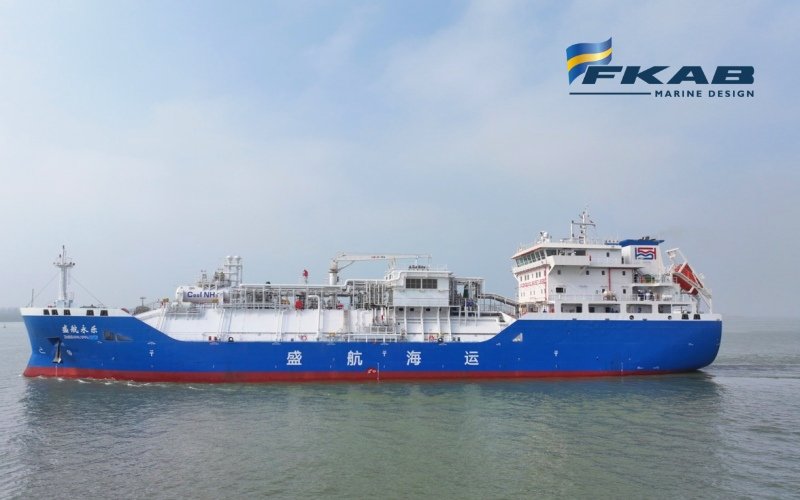
The Shenghang Yongle has officially entered service as the world’s first operational ammonia bunker vessel, securing the industry’s maiden ammonia bunkering class certificate. Converted from a 5,500 m3 liquefied gas carrier under the leadership of Jiangsu Andefu Energy Development and FKAB, the dual-purpose vessel features advanced ship-to-ship transfer systems and strict safety protocols. This milestone successfully closes a critical infrastructure gap in the global marine fuel supply chain, turning zero-carbon ammonia shipping from a concept into operational reality.
Uddevalla, Sweden | September 10, 2026 – The global maritime energy transition has reached a major operational milestone with the debut of the Shenghang Yongle, officially recognized as the world’s first operational ammonia bunker vessel. The milestone vessel has successfully completed its conversion for ship-to-ship liquid ammonia fuel bunkering and secured the industry’s very first ammonia bunkering class certificate.
Led by Jiangsu Andefu Energy Development in close cooperation with the China Classification Society (CCS), the project transitions ammonia from a theoretical future fuel into a tangible bunkering reality, closing a critical infrastructure gap in the zero-carbon shipping supply chain.
Project Blueprint & Key Stakeholders
The success of the Shenghang Yongle relies on a collaborative framework of leading marine engineering and shipping entities:
- Vessel Design & Conversion Documentation: FKAB Marine Design (provider of the original L21 design and conversion documentation) alongside cargo handling supplier Gloryholder.
- Conversion Leadership: Jiangsu Andefu Energy Development.
- Shipyard & Construction: China Merchants Shipbuilding Industry Dingheng Shipyard.
- Vessel Management: Shenghang Shipping Co., Ltd.
- Classification: China Classification Society (CCS).
From Liquefied Gas Carrier to Bunkering Asset
Originally built as a flexible, 5,500 m3 semi-refrigerated and semi-pressurised liquefied gas carrier, the Shenghang Yongle was engineered for unrestricted navigation. It is capable of carrying diverse liquefied gas cargoes including ammonia, LPG, and vinyl chloride monomer.
Key technical specifications of the base platform include:
- Cargo Capacity: 5,500 m3 containment system.
- Minimum Design Temperature: -48 C.
- Reliquefication Systems: Equipped with dual low-temperature reliquefication systems to ensure safe cargo management.
Engineering the Conversion
Adapting a conventional gas carrier into a dedicated bunkering vessel required rigorous engineering modifications. FKAB and Gloryholder developed comprehensive technical drawing documentation covering:
- Bunkering system modifications tailored for ship-to-ship transfer.
- Robust safety, leak-detection, and emergency-response frameworks.
- Detailed risk assessments addressing ammonia’s specific properties, most notably its high toxicity, material compatibility constraints, and strict low-temperature containment requirements.
Overcoming the Maritime Infrastructure Gap
While major shipping lines increasingly order dual-fuel ammonia tonnage, the widespread adoption of green ammonia has historically stalled over the “chicken-and-egg” dilemma of supply chain infrastructure: the lack of physical assets to safely deliver the fuel at sea.
By converting an existing, adaptable gas carrier design into an active bunkering asset, the Shenghang Yongle demonstrates a commercially viable blueprint for scaling up green fuel delivery networks. Because ammonia can be produced using renewable energy to achieve net-zero carbon footprints, reliable ship-to-ship bunkering is a vital prerequisite for deep-sea decarbonization.
A Milestone for Future-Proof Naval Architecture
The successful commissioning of the Shenghang Yongle highlights the long-term value of forward-thinking naval architecture. By designing vessels with inherent operational flexibility from day one, maritime stakeholders can pivot existing fleets to meet future environmental regulations without starting from scratch.
This monumental step forward proves that with robust engineering, meticulous safety protocols, and cross-industry collaboration, the maritime energy transition is shifting decisively from blueprint to active service.
Industry Spotlight: We congratulate Jiangsu Andefu Energy Development, Shenghang Shipping, China Classification Society, FKAB, Gloryholder, and all project partners on achieving this historic industry milestone.
About FKAB Marine Design
With over 60 years of industry experience, FKAB Marine Design is a premier international naval architecture and marine consultancy firm with operational hubs in Sweden and China. As part of the Swedish Mattsson Group, the company delivers comprehensive, future-ready engineering solutions spanning the entire vessel lifecycle, from initial concept sketches and feasibility studies to complete production drawings, alternative fuel conversions, and project management.
Specializing in diverse asset classes ranging from tankers and gas carriers to specialized ferries and dredging vessels, FKAB combines robust technological expertise with a forward-looking focus on energy efficiency, positioning itself as a trusted partner in driving sustainable maritime innovation and decarbonization.
Source: FKAB