
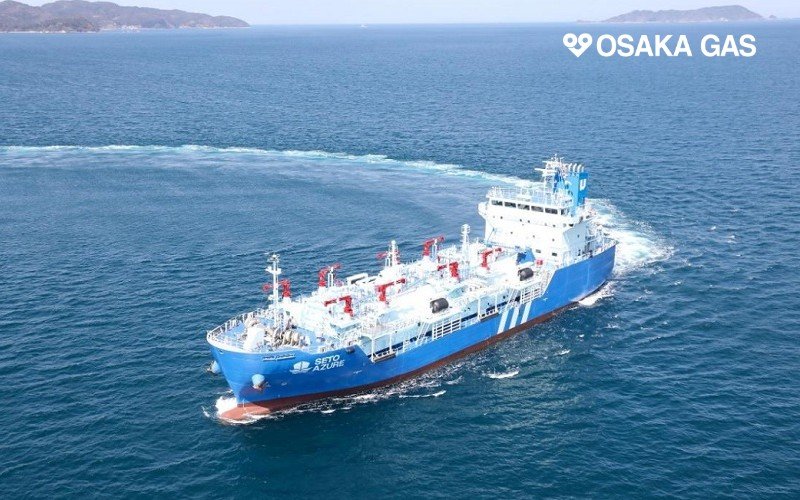
Osaka Gas has successfully executed the first-ever ship-to-ship LNG bunkering operation in Osaka Bay, supplying fuel to an LNG-fueled pure car and truck carrier at the Port of Kobe using the bunker vessel SETO AZURE. Coordinated via Integr8 Fuels, the landmark milestone strengthens regional infrastructure and supports the Port of Kobe’s transition into a Carbon Neutral Port. This capability expands Osaka Gas’s comprehensive supply network, which includes truck-to-ship and port-to-ship methods, providing crucial support for shipowners navigating IMO decarbonization targets.
Osaka, Japan | September 4, 2026 – Osaka Gas Co., Ltd. has announced a major milestone for Japanese maritime logistics, successfully executing the first-ever ship-to-ship (STS) liquefied natural gas (LNG) bunkering operation within Osaka Bay.
The landmark operation involved supplying marine LNG fuel to an LNG-fueled pure car and truck carrier (PCTC) operated by an overseas shipping company calling at the Port of Kobe. The bunkering procedure was performed using the SETO AZURE, an advanced LNG bunkering vessel owned by Osaka Bay LNG Shipping Co., Ltd., an affiliate of Osaka Gas. Commercial coordination for the fuel delivery was managed through Singapore-based marine fuel trading firm Integr8 Fuels Pte. Ltd.
Expanding Regional Infrastructure and Supporting Carbon Neutral Ports
The historic operation marks a critical step forward in establishing a robust, stable supply network for marine gas in the Kansai region. As international shipping works to comply with stricter environmental mandates, expanding STS capabilities directly supports the Port of Kobe’s strategic ambition to develop into a certified Carbon Neutral Port.
While Japan’s broader LNG bunkering infrastructure has historically faced limitations relative to surging demand, Osaka Gas maintains a comprehensive service framework. In addition to newly established ship-to-ship capabilities, the company delivers LNG fuel via truck-to-ship and port-to-ship methods, giving shipowners a flexible triad of supply options across Japanese waters.
Meeting IMO Targets and Future Green Fuels
The acceleration of LNG-fueled vessel adoption is heavily driven by the global push toward maritime decarbonization and the International Maritime Organization’s (IMO) stringent greenhouse gas reduction targets. Compared to conventional heavy fuel oil (HFO) or marine gas oil (MGO), LNG drastically cuts carbon dioxide emissions and virtually eliminates sulfur oxides.
Looking ahead, Osaka Gas positions LNG infrastructure as a vital bridge technology capable of accommodating future drop-in green alternatives. The integration of e-methane and bio-LNG into existing supply chains will enable even deeper lifecycle emissions reductions over the long term, cementing Osaka Bay’s role in the global energy transition.
LNG Bunkering Vessel SETO AZURE
- Total length: 86.29 m
- Breadth: 17.60 m
- Gross tonnage: Approx. 4,350 t
- LNG tank system: IMO Type C independent tank
- LNG tank capacity: Approx. 3,610 m3
- Propulsion system: Electric propulsion (LNG/fuel oil dual-fuel engine)
- Ship owner: Osaka Bay LNG Shipping Co., Ltd.
- Builder: Shitanoe Shipbuilding Co., Ltd.
About Osaka Gas
Osaka Gas is a leading Japanese energy company engaged in the supply of gas and electricity, as well as the development of energy-related businesses. Under the Daigas Group Energy Transition 2050 plan, the company is advancing initiatives such as the expansion of LNG bunkering services and the promotion of e-methane, with the aim of supporting decarbonization across society, including the maritime sector.
Source: Osaka Gas