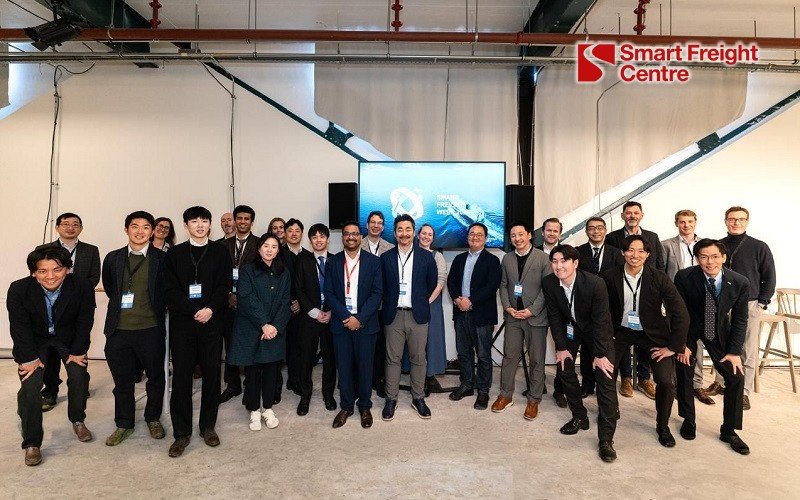
An initiative of the Smart Freight Centre (SFC), The Global Ro-Ro Community (GRC), representing roughly 80% of the world’s car carrier fleet, has established the GRC Council (GRCC) to oversee greenhouse gas emissions data and methodology. Major classification society ClassNK helped build the new governance framework, This initiative aims to provide reliable, independently verified primary data to help Ro-Ro carriers, cargo owners, and vehicle manufacturers streamline compliance and advance supply chain decarbonization.
Amsterdam, The Netherlands | August 19, 2026 – The Global Ro-Ro Community (GRC), an influential coalition representing roughly 80% of the world’s car carrier fleet capacity by Car Equivalent Units (CEU), has established the GRC Council (GRCC). The newly formed governing body aims to oversee GHG emissions accounting, data handling rules, and operational transparency across the roll-on/roll-off shipping sector.
An initiative of the Smart Freight Centre (SFC), the GRC brings together deep-sea and short-sea carriers, independent verifiers, cargo owners, and other stakeholders, giving it the scale necessary to establish robust industry benchmarks and reliable primary data foundations and to enhance the accuracy, transparency, and comparability of emissions reporting across the sector,
Major classification society ClassNK played a foundational role in shaping the initiative, having helped formulate the new Governance Framework and data handling guidelines. Furthermore, Hiroshi Ochi, General Manager of ClassNK’s Green Certification Department, has been elected Vice-Chair of the GRCC, cementing the society’s active leadership in independent verification and maritime decarbonization.
- Fleet Representation: The GRC coalition covers approximately 80% of global car carrier transport capacity, driving cross-industry alignment between operators, cargo owners, and manufacturers.
- New Governance Body: The GRCC will manage the continuous review, improvement, and enforcement of the GRC Methodology and data protocols.
- Regulatory Alignment: Designed to meet rising compliance demands, including FuelEU Maritime, updated IMO greenhouse gas reduction rules, and corporate Scope 3 emissions reporting.
Key Leadership Appointments
To steer its next phase of growth, the newly formed Council has elected key industry figures to lead its administrative and technical committees:
- Chair of the GRC Council: Mr. Yasuyuki Sakurai, Wallenius Wilhelmsen
- Vice-Chair of the GRC Council: Mr. Hiroshi Ochi, ClassNK – ClassNK serves as an independent verifier.
- Chair of the Methods Committee: Mr. Joonyohan Lee, Hyundai Glovis
Powering Scope 3 Accounting and Supply Chain Transparency
With international regulatory pressure mounting through regional mandates like FuelEU Maritime alongside the IMO’s evolving frameworks, the demand for precise primary emissions data has surged. Cargo owners and automotive manufacturers face strict corporate Scope 3 disclosure requirements, making accurate, independently verified data a commercial necessity.
Established originally in 2024 under the auspices of the Smart Freight Centre (SFC), the GRC brings together carriers, cargo owners, and verifiers to standardize emissions calculations. The newly minted GRCC will take charge of managing the GRC Methodology, a specialized framework published in 2025 that aligns with ISO 14083 and the GLEC Framework to calculate vessel-level GHG emission intensity factors.
By establishing rigorous oversight and standardized data handling, the GRCC provides a trusted foundation that empowers Ro-Ro carriers to transparently communicate their environmental performance while giving vehicle manufacturers and cargo owners the precise metrics needed to accelerate supply chain decarbonization.
Evolving Standards
Published originally in 2025, the GRC methodology aligns fully with ISO 14083 and the GLEC Framework, enabling the calculation of ship-specific and tradelane-level GHG emission intensities using verified primary data.
The establishment of the Council hands participating carriers and verifiers direct responsibility for the methodology’s ongoing evolution, data governance, and industry benchmarking. This structure is critical as maritime stakeholders navigate an increasingly complex regulatory landscape, including:
- FuelEU Maritime and the IMO Net-Zero Framework
- SBTi’s Corporate Net-Zero Standard Version 2.0
- Heightened corporate sustainability and Scope 3 emissions reporting requirements
“The new GRC Council adopted its Governance Framework focusing on fair governance, decision-making processes, and competition compliance,” said Yasuyuki Sakurai, Chair of the GRC Council (Wallenius Wilhelmsen). “We will continue with our founding philosophy of fairness and openness, working together with Smart Freight Centre, OEMs, and cargo owners to develop the GRC program further.”
Independent Verification
Over the past six months, a specialized working group comprising ClassNK, NYK, SFC, and Wallenius Wilhelmsen engineered the framework’s legal architecture, terms and conditions for data reporting, and handling rules.
Hiroshi Ochi, Vice-Chair of the GRCC and General Manager of ClassNK’s Green Certification Department, highlighted the rigorous legal alignment “ClassNK’s legal professionals specialized in the maritime sector led this initiative and finalized the legal documents through a series of discussions with lawyers of the member carriers and SFC. ClassNK, together with other classification societies, will continue to support GRC’s decarbonization efforts as specialist and third-party verifiers.”
While the Council takes charge of member-led governance, Smart Freight Centre (SFC) will continue its role as Secretariat, providing technical leadership, independent stewardship, data management, and neutral stakeholder convening.
Capt. Prashant Widge, Maritime Director at Smart Freight Centre, added “By placing governance in the hands of participating members while maintaining SFC’s independent technical stewardship, the GRC is creating a robust foundation for trusted emissions data and informed decarbonisation decisions across the Ro-Ro sector.”
With broader carrier participation aimed at improving data quality and market-wide benchmarking, the GRC invites additional deep-sea and short-sea Ro-Ro operators to join the initiative, contribute verified operational data, and shape the future of transparent maritime logistics.
About Smart Freight Centre
Smart Freight Centre (SFC) is a globally active non-profit organization for climate action in the freight sector. Our goal is to mobilize the global logistics ecosystem, in particular our members and partners, in tracking and reducing its greenhouse gas emissions. We accelerate the reduction of logistics emissions to achieve a zero-emission global logistics sector by 2050 or earlier, consistent with 1.5° pathways.
About ClassNK
Established in 1899, ClassNK is a classification society dedicated to safety and environmental protection through third-party certification. ClassNK conducts diverse technical services, including surveys and classifications of ships and marine structures based on its own rules and international conventions on behalf of more than 100 flag states, as well as management system certifications in line with ISO and other industry standards. ClassNK is committed to providing the industry with full support to tackle digitalization and decarbonization challenges through expanding certification services and R&D with industry partners.
About the Global Ro-Ro Community
The Global Ro-Ro Community is an Smart Freight Centre (SFC)-led collaborative program bringing together deep-sea Ro-Ro carriers, independent verifiers, cargo owners, and other stakeholders. It develops harmonised methods, verified primary data, and representative emission-intensity factors to support transparent and consistent greenhouse gas accounting across the Ro-Ro transport sector.
Source: ClassNK | Smart Freight Centre