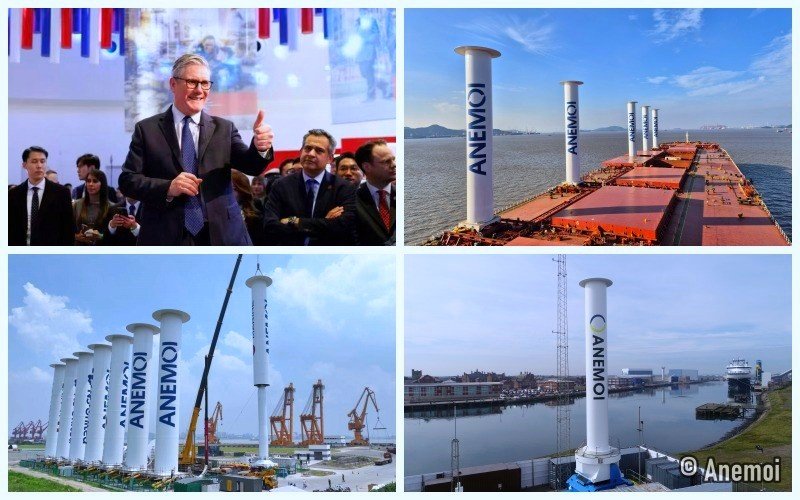
London | February 3, 2026 – In a high-profile validation of British maritime engineering, Anemoi Marine Technologies has been featured as a cornerstone of UK-China commercial relations during Prime Minister Keir Starmer’s official visit to China this week.
As the maritime industry grapples with the escalating costs of traditional and alternative fuels, Anemoi’s “free fuel” solution, Rotor Sails, is being held up by the UK government as a prime example of how clean-tech innovation can drive both environmental compliance and massive export growth.
The Power of Wind: £28 Million in Proven Exports
Anemoi’s success is not theoretical; it is operational. Since June 2023, the company has secured £28 million in export deals, involving the installation of 29 Rotor Sails across seven vessels. Notably, this includes four of the world’s largest ore carriers (VLOCs) currently operating the critical iron ore trade route between Brazil and China.
These installations serve as a “live laboratory” for the industry, proving that wind-assisted propulsion (WASP) can survive and thrive on the most demanding long-haul routes.
A Strategic UK-China Hybrid Model
Anemoi’s business model represents a sophisticated bridge between the two maritime giants:
- UK-Led Innovation: All R&D and engineering are conducted in the UK, supported by the Clean Maritime Demonstration Competition and test facilities in Northern England.
- China-Led Scale: Production operations are based in China, allowing the company to scale manufacturing and integrate technology into the global newbuild and retrofit pipeline at pace.
This “Best of Both Worlds” approach was highlighted during the ‘House of UK Reception’ and the UK-China Business Forum, attended by Anemoi’s newly appointed Programme Director, Andrew Starforth.
Decarbonization by the Numbers
For bunker managers and fleet operators, the fuel savings are the primary metric of success. Anemoi’s Rotor Sails, which utilize the Magnus Effect to generate forward thrust, deliver:
- CO2 Reduction: Over 91,000 tonnes of CO2 saved to date across their global fleet.
- Fuel Efficiency: Each Rotor Sail typically saves one tonne of fuel per day.
- Global Impact: Installations on Newcastlemax and VLOC vessels are helping owners navigate the tightening “green corridor” regulations between South America and Asia.
Clare Urmston, CEO of Anemoi, commented:
“Our model of UK-led innovation combined with China’s maritime manufacturing expertise allows us to scale reliably and support shipowners globally. This recognition by the Prime Minister highlights the increasing relevance of clean maritime technology in the global market.”
Why This Matters
As the industry faces the EU ETS and the CII (Carbon Intensity Indicator), wind-assisted propulsion is no longer a “niche” experiment. It is a “fuel-agnostic” hedge. Whether a vessel burns VLSFO, LNG, or green ammonia, reducing the total energy demand via wind power directly improves the vessel’s commercial viability and regulatory grading.
The Prime Minister’s spotlight on Anemoi signals that the UK government views maritime decarbonization not just as a climate obligation, but as a major economic engine for the next decade.
The Anemoi Marine Technologies: Reclaiming the Wind for the 21st Century
While the shipping industry spent the last century tethered to the fluctuations of the oil market, a London-based team of innovators was looking up. Anemoi Marine Technologies, Wind propulsion technology expert, has taken a 100-year-old concept, the Flettner Rotor, and weaponized it with modern materials science and AI-driven automation.
Rotor Sails the Science: The Magnus Effect
Anemoi’s Rotor Sails are not traditional “sails” in the sense of canvas and rigging. They are massive, spinning composite cylinders. When wind hits the spinning surface, it creates a pressure differential, low pressure in front, high pressure behind, known as the Magnus Effect. This generates a powerful forward thrust that pulls the ship through the water, allowing the main engines to throttle back.
Key Performance Metric: Anemoi’s technology can reduce fuel consumption and carbon emissions by 5% to 30%, depending on the vessel type and route.
Three Pillars of Innovation
What sets Anemoi apart in a crowded “Green Tech” market is their focus on operational reality. They recognize that a 35-meter tower is a liability in a busy port unless it can adapt. They offer three distinct deployment systems:
- Fixed: Vertical towers for vessels with no height or cargo-access restrictions.
- Rail-Mounted: The rotors can slide along the deck to clear the way for massive port cranes.
- Folding: The towers “tuck away” to clear low bridges or air-draught restricted waterways.
A Decade of Momentum
- 2015: Anemoi is incorporated, fueled by a mission to solve the shipping emission crisis.
- 2018: Successful pilot on the m/v Afros, the first-ever installation on a dry bulk carrier, which swept international industry awards.
- 2024: The “Gigantism” era begins. Installation of five Rotor Sails on the Sohar Max, a 400,000 DWT Valemax, the largest wind-propelled vessel in history.
- 2025/2026: Global scaling. The opening of a state-of-the-art production facility in Jiangsu, China, capable of producing 250 rotors per year to meet surging demand
Source: Anemoi Marine Technologies