
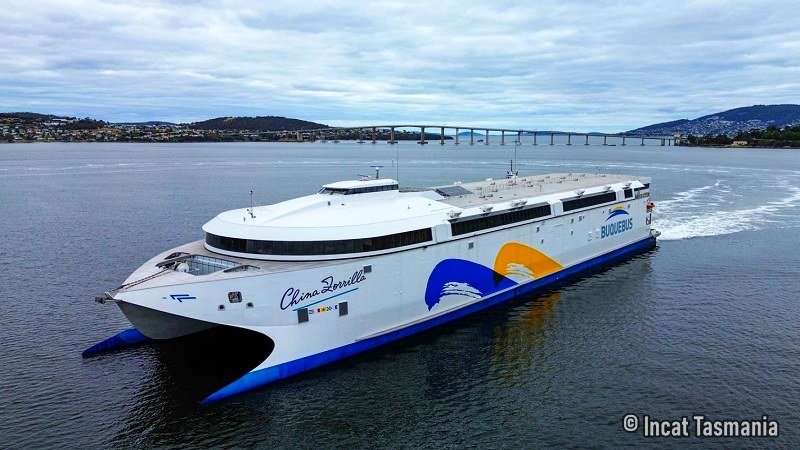
Hobart, Tasmania | January 16, 2026 – In a milestone that signals a seismic shift in the maritime landscape of the future, Incat Tasmania has officially commenced harbour trials for the China Zorrilla (Hull 096), the world’s largest battery-electric vessel. The 130-metre Ro-Pax ferry moved under its own battery-electric propulsion for the first time on the River Derwent this week, marking the transition from dry-dock construction to real-world operational testing.
For a maritime industry grappling with decarbonization and the transition away from traditional VLSFO and MGO, the China Zorrilla represents a radical departure. Originally envisioned as an LNG-dual fuel vessel, the project was pivoted mid-construction to a 100% electric design, a move that underscores the growing viability of large-scale electrification for short-sea shipping and high-frequency ferry routes.
Table of Contents
The “New Bunkering”: 40 MWh of Energy Storage
The technical scale of the China Zorrilla is unprecedented. At the heart of the vessel lies an Energy Storage System (ESS) supplied by Corvus Energy and integrated by Wärtsilä.
- Total Battery Capacity: Over 40 MWh (megawatt-hours), roughly four times larger than any existing maritime battery installation.
- Battery Weight: Exceeding 250 tonnes of lithium-ion modules.
- Propulsion: Eight electric motors driving eight Wärtsilä axial flow waterjets, designed for a shallow draft of just 2.5 metres.
- Capacity: 2,100 passengers and 225 vehicles.
From a bunkering perspective, the “fueling” of this vessel replaces traditional bunker barges with high-capacity shore charging infrastructure. In its eventual home port on the River Plate between Argentina and Uruguay, the vessel will utilize 16 MW charging systems, capable of recharging the batteries from 20% to 80% in approximately 45 to 60 minutes.
Testing and Sea Trials
Incat Chairman Robert Clifford described the harbour trials as a “watershed moment” for global shipbuilding.
“Moving Hull 096 under its own battery-electric power confirms that electric propulsion is no longer just for small harbour craft; it is viable for large-scale commercial vessels,” said Clifford.
The current trials in Hobart are focusing on:
- Manoeuvrability: Testing the responsiveness of the eight-waterjet configuration.
- System Integration: Ensuring the Energy Management System (EMS) balances the massive load across four separate battery rooms.
- Speed Performance: The vessel is expected to maintain service speeds of approximately 25 knots.
Strategic Shift for Incat
The delivery of the China Zorrilla to South American operator Buquebus (scheduled for later in 2026) marks Incat’s strategic pivot toward zero-emission aluminium vessels. The shipbuilder argues that the lightweight nature of aluminium is the key “enabler” for electric shipping, as it reduces the power required for propulsion compared to traditional steel hulls.
As the maritime sector faces tightening EEXI and CII regulations, the success of the China Zorrilla’s trials provides a blueprint for how high-density battery technology can replace traditional bunkering on fixed routes.
About Incat Tasmania
For over four decades, Incat Tasmania has been at the forefront of the maritime industry, specialising in the design and construction of lightweight aluminium passenger and vehicle ferries. With nearly 100 vessels in operation worldwide, Incat continues to lead the way in innovative shipbuilding.
Based in Hobart, Tasmania, Incat is Australia’s largest commercial shipyard and one of the few globally capable of producing large aluminium vessels for the international market. In recent years, Incat has made a strategic shift from building diesel-powered ships to environmentally friendly vessels, including the world’s largest electric ferry currently under construction.
Source: Incat Tasmania