
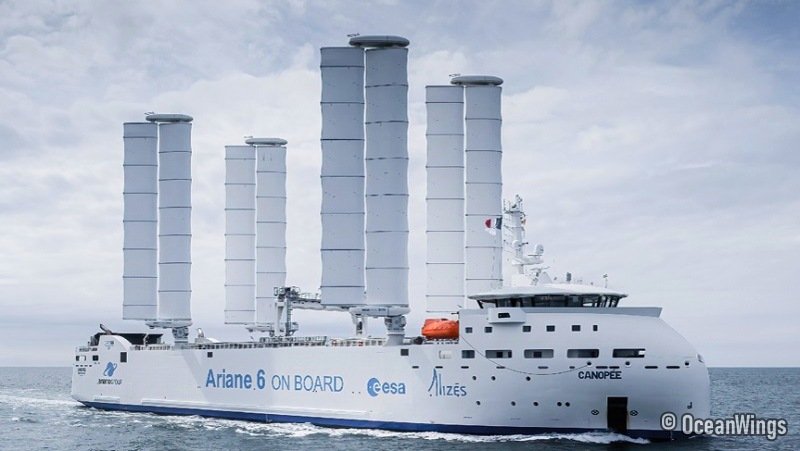
Saint-Nazaire, France | June 20, 2025 – Two years after the historic launch of the Canopée, the world’s first industrial cargo vessel equipped with four automated OceanWings®, the data is in: wind-assisted propulsion is no longer just a “concept”, it is a high-performance reality for the merchant fleet.
Operating on a demanding transatlantic schedule to transport Ariane 6 rocket components, the Canopée has provided a robust “return on experience” that validates wind as a primary lever for maritime decarbonization.
The Data: Real-World Bunker Savings
The operational results, shared during the presentation of the Henri Kummerman Prize by the French Académie de Marine, showcase a significant reduction in fuel dependency.
- Average Daily Savings: Each wingsail saves an average of 1.3 tonnes of fuel per day.
- Total Vessel Impact: With four wingsails, the Canopée cuts its daily consumption by 5.2 tonnes of fuel, preventing 20.8 tonnes of CO2 emissions every 24 hours.
- Power Equivalent: This translates to roughly 1,200 kW of engine power provided entirely by the wind.
Peak Performance: Transatlantic Success
While the averages are impressive, recent data shows the system’s potential is even higher as the OceanWings AI platform continues to learn and optimize.
- Best-in-Class Voyage: On recent transatlantic crossings, savings reached 2.2 tonnes per day per wingsail (Totaling 2 MW of equivalent engine power).
- Pure Sail Power: The Canopée was recently clocked at 13.7 knots using sail power alone, demonstrating that wind can effectively move large-scale commercial tonnage.
Reliability and Ease of Use
For shipowners, “availability” is as important as “efficiency.” Over the two-year period, the OceanWings system demonstrated a remarkable 99.6% operational availability.
Alizés, the joint venture (Jifmar and Zéphyr & Borée) operating the vessel, highlighted two key takeaways for the industry:
- Seamless Integration: The automated wingsails integrate into daily bridge operations without requiring additional crew or specialized sailing skills.
- Seaworthiness: The system has proven its durability in the harsh, variable conditions of the North Atlantic.
“The performance and sea worthiness of the OceanWings have exceeded expectations,” noted the team at Alizés. “Canopée is a pioneering success that paves the way for broader adoption of wind-assisted technologies across the global fleet.”
| Metric | Average Performance | Peak Transatlantic Performance |
| Fuel Saved (Per Sail/Day) | 1.3 Tonnes | 2.2 Tonnes |
| CO2 Reduced (Total/Day) | 20.8 Tonnes | 35 Tonnes |
| Engine Power Equivalent | 1,200 kW | 2,000 kW (2 MW) |
| Max Speed (Sail Only) | N/A | 13.7 Knots |
A Proven Lever for Decarbonization
The success of Canopée serves as a “lighthouse project” for the industry. Beyond the immediate fuel savings, the vessel’s performance validates the seaworthiness and aerodynamic versatility of the OceanWings technology in the harsh North Atlantic environment.
With double-digit savings now a proven metric rather than a projection, the partners are confident that this project paves the way for the broader adoption of wind-assisted technologies across the global merchant fleet.
About OceanWings
OceanWings is a pioneering French maritime technology company specializing in Wind Assisted Propulsion Systems (WAPS). Originally developed from the high-performance world of elite yacht racing (specifically the 2010 America’s Cup), the company has successfully industrialised rigid wingsail technology for the global merchant fleet.
The Technology: “Smart” Rigid Wingsails
Unlike traditional soft sails, OceanWings are automated, reefable, and rotatable vertical wingsails. They function more like an airplane wing than a canvas sail, using a two-element profile (a main mast and a flap) to create aerodynamic lift that translates into forward thrust.
Product Lineup
OceanWings offers four primary configurations to fit different vessel types (Bulk Carriers, Tankers, Ro-Ros, and Gas Carriers):
| Model | Type | Best For |
| OW RF | Rigid Fixed | Tankers and Gas Carriers with no air draft (height) limits. |
| OW RT | Rigid Tiltable | Bulk carriers requiring clearance for port cranes or bridges. |
| OW RE | Rigid Elevator | Vessels requiring vertical height adjustment for port operations. |
| OW LF | Lowerable Fixed | Modular, lightweight solution for Ro-Ro and Passenger ships. |
Source: OceanWings